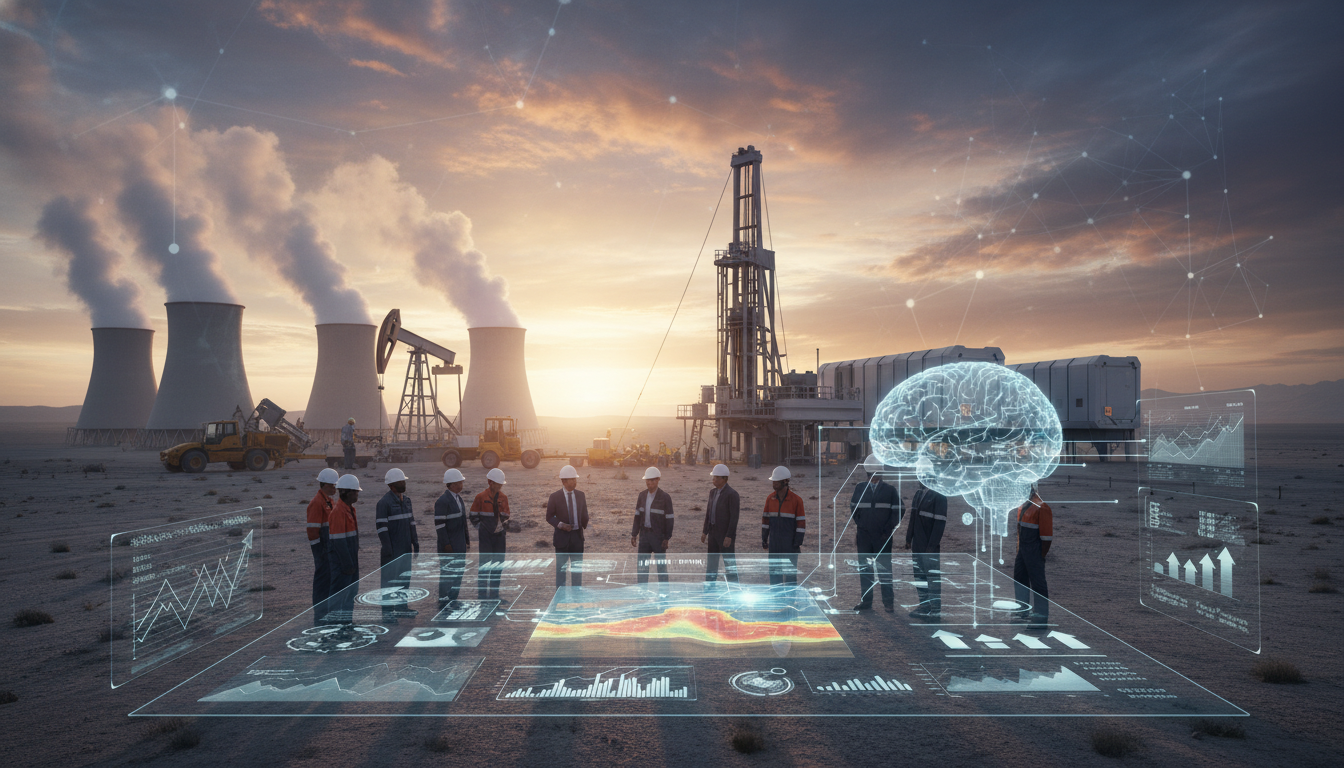
Geothermal Ascends: Powering the AI Boom and Securing Grid Futures
The investment landscape for energy is witnessing a profound shift, with geothermal power rapidly moving from the periphery to a central role. This resurgence is not merely a consequence of environmental policies or ambitious climate targets; rather, it is a direct response to a fundamental and urgent market demand: the imperative for reliable, always-on baseload electricity. Savvy investors and energy operators are now recalibrating their portfolios and strategies to seize this burgeoning opportunity within the U.S. energy matrix.
Institutional Capital Mobilizes for Geothermal Development
Significant institutional capital is now channeling into the geothermal sector, signaling a pivotal moment for scalable deployment. A case in point is EIG’s recent launch of a dedicated investment fund specifically targeting geothermal projects. This move underscores a crucial evolution: investors are increasingly confident in geothermal’s capacity to deliver robust, continuous power solutions that can effectively compete in an electricity grid marked by growing volatility and unprecedented demand surges. This institutional commitment validates geothermal’s potential to move beyond early-stage ventures and into widespread commercial application, offering compelling returns for those positioned to capitalize.
AI’s Insatiable Appetite Fuels Demand for Reliable Power
The primary driver behind this escalating power demand is unequivocally the Artificial Intelligence (AI) revolution. The exponential buildout of data centers, essential infrastructure for AI processing, is dramatically altering electricity consumption patterns. These facilities require not just substantial, but constant and high-density power. Crucially, this demand is emerging in regions where existing grid capacity often faces severe strain. While solar and wind power remain vital components of the renewable energy transition, their inherent intermittency presents operational hurdles for data center operators who require absolute uptime guarantees. This creates a critical vacuum that firm, dispatchable power sources are uniquely positioned to fill.
Here, geothermal energy re-enters the conversation with a distinct advantage. Unlike many other renewable sources, geothermal delivers firm, dispatchable electricity. It operates akin to conventional baseload generators, such as natural gas or nuclear plants, but with a significantly cleaner emissions profile. This unique combination of reliability and environmental stewardship makes geothermal an increasingly attractive proposition for both hyperscale technology companies and traditional utilities facing immense pressure to secure stable, sustainable power supplies for the digital economy.
Technological Advances Drive Industrial Scale Deployment
The sector’s rapid scaling is further evidenced by strategic moves from key players. Fervo Energy’s initiative to secure a staggering 1.7 gigawatts of turbine supply highlights an unequivocal confidence in a substantial pipeline of projects poised for execution. Such a large-scale equipment procurement is far from speculative; it signifies a concrete shift toward industrialization and repeatability in geothermal project development, moving beyond mere resource availability to efficient, predictable deployment.
This acceleration is largely underpinned by transformative technological advancements, many of which are directly adapted from the oil and gas industry. Innovations in advanced drilling techniques, including precision horizontal wells, and sophisticated subsurface modeling have unlocked geothermal resources previously deemed uneconomic. Furthermore, the development of Enhanced Geothermal Systems (EGS) is expanding the viable development map, enabling projects in regions historically lacking conventional, high-quality heat reservoirs. These technological leaps are fundamentally reshaping geothermal’s profile, transforming it into a legitimate and high-growth platform for energy investment.
Geothermal’s Unique Policy Position and Investor Security
In a dynamic energy policy environment, geothermal enjoys a relatively insulated position. While other segments of the renewable sector have occasionally become politically polarized, geothermal has largely avoided similar scrutiny. Its characteristics—domestic resource, inherent reliability, and significant infrastructure development—align seamlessly with broader national energy security narratives. For investors, this translates into a crucial advantage. In an era where regulatory uncertainty can significantly impede project timelines and financial viability, geothermal offers a degree of stability. It strategically intersects energy independence, grid robustness, and emissions reduction goals, all while remaining less exposed to volatile political shifts.
Navigating Challenges and Charting the Path Forward
Despite its compelling advantages, the geothermal sector still confronts inherent challenges. Development projects typically entail high upfront capital expenditures and extended timelines. Furthermore, subsurface risk, while mitigating with advanced geological techniques, remains a factor. To support the necessary large-scale deployment, financing structures must continue to evolve, and the nascent supply chains, though improving, require further maturation and scale-up. Addressing these hurdles will be critical for sustained growth and investor confidence.
The Future of Geothermal: A Core Investment Thesis
Nonetheless, the overarching trajectory for geothermal is demonstrably positive. The confluence of surging power demand, particularly from the AI sector, coupled with ongoing technological innovation and increasing institutional investment, is propelling geothermal into an unprecedented growth phase. It is no longer merely a complementary renewable energy source; it is swiftly becoming an integral component of the core global conversation surrounding how we will power the next decade of economic expansion and technological advancement. For a sector that historically operated at the margins, this fundamental shift in perception and capital allocation is profoundly significant. If the current momentum persists, geothermal energy is poised to transition decisively from its long-held potential to full-scale deployment, arriving precisely when global energy grids demand its unique capabilities the most.