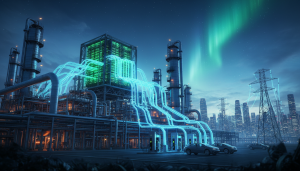
AI: The Catalyst Supercharging Oil & Gas Profits and Asset Valuations
The global energy sector, a foundational pillar of the world economy, is currently undergoing an unprecedented technological revolution. Artificial intelligence (AI), once a subject of speculative futurism, has rapidly emerged as an indispensable force, fundamentally reshaping operational paradigms, driving substantial profitability, and refining strategic decision-making across the entire hydrocarbon value chain. For discerning investors navigating the intricate landscape of energy markets, a granular understanding of AI’s pervasive applications and its profound financial implications—spanning from subsurface exploration to final market delivery—is absolutely critical.
This isn’t merely about automating routine, repetitive tasks; it signifies a fundamental re-engineering of how energy assets are managed, extracted, processed, and ultimately delivered. Enterprises that strategically embed AI capabilities are poised to unlock immense intrinsic value, directly translating into superior operational performance and, crucially, elevated financial returns for shareholders.
Unlocking Operational Excellence and Driving Down Costs
One of AI’s most immediate and tangible contributions to the oil and gas industry is its remarkable capacity to dramatically enhance operational efficiencies and instigate substantial cost reductions. Predictive analytics, powered by sophisticated machine learning algorithms, allows companies to anticipate equipment failures long before they occur, shifting from a reactive repair model to proactive, optimized maintenance schedules. This minimizes costly unplanned downtime, extends the operational lifespan of critical assets, and significantly reduces overall maintenance expenditures. In drilling operations, AI algorithms process vast, complex datasets—including geological surveys, seismic readings, and historical drilling logs—to identify optimal well placement, predict subsurface conditions with greater accuracy, and fine-tune drilling parameters in real-time. Such precision reduces non-productive time (NPT), mitigates inherent drilling risks, and lowers overall well construction costs, directly impacting capital expenditure efficiency and accelerating time to production.
Transforming Upstream Exploration and Production
Within the upstream segment, AI is revolutionizing the entire exploration and production lifecycle. In seismic data interpretation, AI-driven algorithms can analyze complex geological structures with unprecedented speed and accuracy, identifying potential hydrocarbon reservoirs more effectively than traditional methods. This significantly de-risks exploration efforts, reducing the likelihood of drilling unproductive wells and optimizing capital allocation for future projects. For reservoir management, AI models simulate intricate reservoir behavior under various production scenarios, enabling operators to optimize production rates, enhance recovery factors, and extend the economic life of mature fields. By analyzing real-time sensor data from wells, AI can identify opportunities for advanced enhanced oil recovery (EOR) techniques and predict optimal injection strategies, thereby boosting overall output and enhancing asset value. The financial implications are clear: higher success rates in exploration, optimized production profiles, and maximum recovery from existing assets, all contributing to superior return on capital employed.
Optimizing Midstream Transportation and Storage Networks
The midstream sector, responsible for the vast and complex network of pipelines, terminals, and storage facilities, benefits immensely from AI’s predictive and optimization capabilities. AI systems monitor pipeline integrity by continuously analyzing data from sensors for pressure, temperature, flow rates, and acoustic anomalies, proactively detecting potential leaks or structural weaknesses. This predictive maintenance approach averts environmental incidents, prevents catastrophic failures, and reduces expensive emergency repair costs, ensuring uninterrupted product flow and regulatory compliance. Furthermore, AI optimizes logistics and scheduling for crude oil and refined products, intelligently balancing inventory levels with transportation routes and fluctuating demand. This sophisticated optimization minimizes transportation costs, reduces demurrage charges, and maximizes throughput, thereby significantly enhancing the profitability and reliability of complex midstream infrastructure, providing a crucial competitive edge.
Enhancing Downstream Refining and Petrochemical Operations
In the downstream segment, AI stands as a powerful tool for maximizing profitability in refining and petrochemical operations. Advanced AI algorithms can optimize refinery processes in real-time, adjusting operating parameters to maximize yields of higher-value products while simultaneously minimizing energy consumption and waste generation. This includes everything from crude distillation unit optimization to catalytic cracking and product blending strategies. AI also significantly enhances demand forecasting for refined products, allowing refiners to align production schedules more closely with market needs, reducing storage costs, and capitalizing on favorable price differentials. For trading desks, AI-powered predictive analytics can identify subtle market trends, optimize hedging strategies, and execute trades with greater precision, adding considerable value to the overall downstream financial performance and contributing directly to the bottom line.
Elevating Shareholder Value and Strategic Positioning
The cumulative effect of AI integration across the entire oil and gas value chain is a profound enhancement in shareholder value. Companies leveraging AI effectively consistently demonstrate superior operational metrics, including reduced operating expenses, enhanced capital efficiency, improved environmental performance, and fortified safety records, which collectively boost net income and EBITDA. This technological edge translates into a stronger competitive position, attracting investor capital and potentially leading to higher valuations and robust stock performance. Furthermore, AI facilitates more informed strategic decision-making, from portfolio optimization and targeted mergers & acquisitions to sophisticated risk management and compliance adherence. Investors should meticulously evaluate the AI adoption strategies of energy companies, recognizing that a commitment to intelligent automation is now a key indicator of future resilience and sustainable growth potential in a dynamic global energy market.
Navigating the Future Landscape
While the pervasive adoption of AI presents its own set of challenges, including the imperative for robust data infrastructure, stringent cybersecurity protocols, and specialized talent acquisition, the trajectory of AI integration is clear and irreversible. The pioneering firms embracing AI are setting new benchmarks for operational excellence and financial performance across the industry. As AI technologies continue to mature and become more accessible, their integration will deepen, further cementing their role as a fundamental pillar of the modern energy enterprise. Companies that fail to adapt risk being left behind in terms of efficiency, cost competitiveness, and overall market relevance.
Conclusion: AI as a Core Investment Thesis
In conclusion, artificial intelligence is no longer an optional enhancement but a foundational imperative for the modern oil and gas industry. For investors, understanding AI’s transformative impact on efficiency, cost structures, and asset optimization across upstream, midstream, and downstream operations is paramount. Companies that successfully embed AI into their core strategies are not just adapting to the future; they are actively shaping it, delivering enhanced profitability, robust asset valuations, and sustainable long-term returns in an increasingly technology-driven energy landscape. The intelligent integration of AI is rapidly becoming the definitive differentiator for competitive advantage and superior investment performance within the global energy sector, marking a new era of technologically empowered energy investment.