Disruptive Battery Technology: A New Horizon for EVs and Oil Market Dynamics
The energy transition continues to accelerate, driven by relentless innovation across various sectors. A pivotal development on this front is the emergence of advanced battery chemistries, promising to redefine electric vehicle (EV) performance and, by extension, reshape global oil demand forecasts. A recent collaborative initiative, spearheaded by battery cell innovator Lyten and powertrain systems expert hofer powertrain, is bringing next-generation lithium-sulfur (Li-S) technology closer to industrial scale, with profound implications for mobility, energy storage, and the broader energy investment landscape.
This joint venture aims to deliver highly efficient battery solutions spanning diverse applications, from high-performance motorsport and mainstream automotive to marine, aerospace, and stationary energy storage. The partnership strategically combines hofer powertrain’s extensive experience with conventional battery systems and integrated powertrain solutions with Lyten’s cutting-edge Li-S cell technology. This synergy is designed to not only advance new innovations but also accelerate their adoption into commercial products, signaling a potentially significant shift in the battery market.
Lithium-Sulfur: A Paradigm Shift in Energy Density and Sustainability
The core of this transformative effort lies in lithium-sulfur (Li-S) battery technology. Unlike current industry-standard lithium-ion (Li-ion) batteries, Li-S cells offer a markedly more sustainable, lighter, and significantly higher energy-density solution. A key differentiator is the complete elimination of critical and often geopolitically sensitive materials such as nickel, cobalt, manganese, and graphite from the cell chemistry. This removal addresses major supply chain vulnerabilities and environmental concerns associated with traditional Li-ion production.
Lyten’s Li-S cells represent a genuine next-generation alternative. Projections indicate these cells can achieve energy densities twice as high as existing lithium-ion chemistries. This translates directly into extended range for electric vehicles, reduced weight for aerospace applications, and more compact, efficient energy storage systems across the board. Furthermore, the technology promises a wider operational temperature range, enhancing performance in both extreme cold and hot environments – a critical factor for global deployment and reliability in diverse climates.
The ongoing development by hofer powertrain focuses on integrating these advanced cells into robust battery modules and packs. This crucial step involves rigorously testing and validating the cells’ performance within a modular structure, paying close attention to critical parameters such as electrical load capacity and cycling stability. The ability to maintain performance over many charge-discharge cycles and under demanding electrical loads is paramount for commercial viability and long-term investor confidence.
Supply Chain Resilience and Environmental Advantages
From a supply chain perspective, the advantages of Lyten’s Li-S technology are compelling for investors scrutinizing geopolitical risks and ESG (Environmental, Social, and Governance) factors. By removing nickel, cobalt, manganese, and graphite, Lyten gains the strategic flexibility to source its raw materials locally within the United States and the European Union. This localized sourcing strategy drastically reduces reliance on complex, often volatile, global supply chains and mitigates the risks associated with critical mineral extraction and processing in distant regions.
Beyond geopolitical stability, the environmental benefits are substantial. Lyten’s potential for a simplified cell manufacturing process, combined with the inherently more abundant and less environmentally impactful raw materials, is projected to achieve CO₂ savings exceeding 60% at an industrial scale. For investors increasingly focused on decarbonization and sustainability, these figures underscore the technology’s potential to drive genuine environmental progress while offering a commercially attractive solution. The integration of this Li-S chemistry into hofer powertrain’s modules marks a significant stride toward delivering high-performance, safe, and truly more sustainable battery solutions at scale, applicable across a broad spectrum of industries.
Precision Engineering and Modular Integration
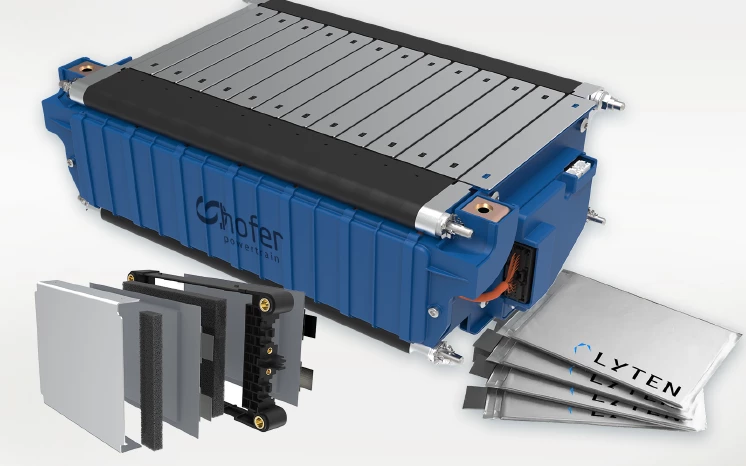
The collaborative framework sees Lyten providing the advanced lithium-sulfur battery cells, while hofer powertrain assumes responsibility for the complete system development and integration. This encompasses everything from the intricate module architecture design to rigorous functional validation. hofer powertrain’s dedicated battery engineering team has skillfully translated the unique Li-S cell chemistry into a modular battery concept, specifically tailored for pouch cells.
This newly developed system boasts a streamlined design that not only facilitates easy cell replacement but also comprehensively addresses all critical developmental aspects: mechanical integrity, thermal management, and electrical performance. The modular architecture is engineered to support applications demanding up to and beyond 800 volts, crucial for high-performance EVs and rapid charging infrastructure. Furthermore, it seamlessly incorporates hofer powertrain’s proprietary Cell Monitoring Unit (CMU), enabling precise and granular monitoring at the individual module level. This level of control and diagnostic capability is essential for ensuring battery safety, optimizing performance, and maximizing operational lifespan—factors that directly influence total cost of ownership and return on investment for end-users.
Johann Paul Hofer, CEO of hofer powertrain, articulates the market’s demand: “Our customers require technologically robust, future-proof solutions.” This sentiment resonates strongly with investors seeking long-term value in the rapidly evolving energy sector. The company’s decades-long track record of delivering unique battery concepts by harmoniously blending proven technologies with innovative breakthroughs underpins the strategic significance of this Li-S development.
Oil Demand Outlook: An Accelerating Shift
For oil and gas investors, the implications of such disruptive battery technology are profound and warrant close attention. A commercially viable Li-S battery, offering double the energy density, lighter weight, and a more robust supply chain, could significantly accelerate the adoption rate of electric vehicles across all sectors. Longer range, faster charging, and lower production costs for EVs directly diminish the competitive edge of internal combustion engine vehicles, leading to a faster erosion of demand for gasoline and diesel.
While the immediate impact on global crude oil consumption might be gradual, the long-term trajectory becomes clearer. As Li-S technology scales, its application in heavy-duty transport, marine vessels, and even short-haul aviation could begin to chip away at demand segments traditionally considered “hard to abate.” This technological leap could compress the timeline for peak oil demand, potentially bringing it forward in various market scenarios. Oil and gas companies must critically assess these developments, considering potential strategic shifts toward diversified energy portfolios, investing in carbon capture technologies, or focusing on high-value petrochemical feedstocks to navigate a future where transportation fuels face increasing pressure from electric alternatives. The ongoing evolution of battery technology serves as a potent reminder that the energy transition is not merely a forecast but a dynamic, technologically driven reality that will continue to reshape the global energy landscape.