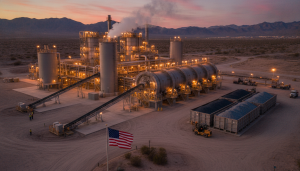
In the rapidly evolving landscape of energy transition investments, a significant development has emerged for American Battery Technology Company (ABTC). The company has secured a Letter of Interest (LOI) from the Export-Import Bank of the United States (EXIM) for a substantial $900 million. This potential financing is earmarked for ABTC’s Nevada Lithium Project, a critical endeavor poised to produce nearly 33,000 tons of lithium hydroxide annually. This move underscores a growing strategic emphasis on shoring up domestic critical mineral supply chains, a sentiment amplified by recent executive directives aimed at bolstering American mineral production. For investors keenly watching the intersection of energy security, technological advancement, and resource independence, this LOI represents a pivotal signal for the future of battery materials in North America.
The Strategic Imperative of Domestic Lithium Supply
The $900 million LOI, while not a binding commitment, serves as a powerful endorsement of ABTC’s Nevada Lithium Project. Its envisioned output of approximately 33,000 tons of lithium hydroxide per year would position it as a cornerstone of U.S. domestic lithium production. This scale is particularly relevant given the global competition for critical minerals essential to electric vehicles (EVs) and grid-scale energy storage. The timing of this LOI is no coincidence, aligning with a presidential executive order that mandates federal agencies to prioritize funding and support for domestic critical mineral manufacturing facilities. This directive reflects a broader national security concern: reducing reliance on foreign supply chains for materials vital to modern technology and defense. For investors, this translates into a potentially de-risked investment environment for projects that align with national strategic priorities, offering an additional layer of support beyond pure market economics. The successful securing of this financing would directly facilitate the construction of ABTC’s commercial-scale lithium mine and claystone-to-lithium hydroxide refinery near Tonopah, marking a tangible step towards energy independence.
Market Dynamics and the Critical Minerals Investment Landscape
Understanding the investment landscape for critical minerals requires acknowledging the broader energy market context. As of today, Brent crude trades at $95.19 per barrel, reflecting a modest gain of 0.42% within a daily range of $91 to $96.89. WTI crude also saw an uptick, reaching $91.74 per barrel. While these figures represent day-over-day movements, a look at the past two weeks reveals Brent’s price has softened, dropping from $102.22 on March 25th to $93.22 on April 14th, a decline of nearly 9%. This recent volatility in crude prices impacts the broader energy transition narrative. Sustained high oil prices can accelerate the shift towards EVs and renewable energy storage, thereby increasing demand for battery materials like lithium. Conversely, a softening crude market might ease some of the immediate pressure, yet the long-term structural demand for critical minerals remains robust. Investors are keenly observing these dynamics, understanding that the cost curves for traditional energy sources directly influence the adoption rates and economic viability of their renewable counterparts. Projects like ABTC’s, which promise domestic, sustainable supply, become increasingly attractive regardless of short-term energy price fluctuations, as they address a foundational need for the future energy economy.
Navigating Future Headwinds and Tailwinds: Upcoming Events and Investor Focus
Looking ahead, the next two weeks present several key energy events that will undoubtedly shape market sentiment and, by extension, the strategic context for critical mineral investments. The upcoming OPEC+ Joint Ministerial Monitoring Committee (JMMC) meeting on April 18th, followed by the Full Ministerial meeting on April 20th, will be closely watched. Any decisions regarding production cuts or increases could significantly impact crude prices, influencing the perceived urgency of the energy transition. Furthermore, the regular Baker Hughes Rig Count reports on April 17th and 24th, along with the API and EIA weekly crude inventory reports on April 21st/22nd and April 28th/29th, will offer crucial insights into supply-demand fundamentals. Investors, as evidenced by their recent inquiries, are particularly focused on building a base-case Brent price forecast for the next quarter and seeking consensus 2026 Brent forecasts. These questions highlight a keen interest in long-term stability and predictability in the energy markets. For critical mineral projects like ABTC’s, these macro energy signals provide a backdrop. A more volatile or higher-priced oil market could bolster the investment thesis for battery materials, while a stable, lower-priced environment might shift focus to efficiency and cost leadership within the battery supply chain. ABTC’s move towards commercialization is well-timed against this backdrop of ongoing energy market recalibration, positioning it to capitalize on sustained demand regardless of short-term oil price swings as the world continues its decarbonization efforts.
De-risking the Project: Partnerships and Technical Validation
Beyond the strategic national imperative and market tailwinds, ABTC has diligently worked to de-risk its Nevada Lithium Project through robust technical validation and strategic partnerships. The company’s collaboration with engineering firm Black & Veatch for design and construction activities is a critical component of this strategy. Such a partnership with an established industry player lends significant credibility to the project’s execution plan, essential for a large-scale mining and refining operation. Furthermore, ABTC’s amended Initial Assessment, released in April 2024 in accordance with SEC guidelines, provided a comprehensive technical and economic evaluation. This assessment confirmed the project’s immense potential, identifying it as one of the largest known lithium resources within the United States. Such detailed technical and economic validation is paramount for securing large-scale financing, like the EXIM LOI. As ABTC CEO Ryan Melsert articulated, this proposed financial support can “greatly accelerate the commercialization” of their domestic critical mineral mine and refinery. The demonstration of first-of-kind technologies over several years, coupled with rigorous independent assessment and strong engineering partnerships, indicates a mature and well-prepared project poised for commercialization, offering a compelling narrative for investors seeking to participate in the burgeoning battery materials sector.