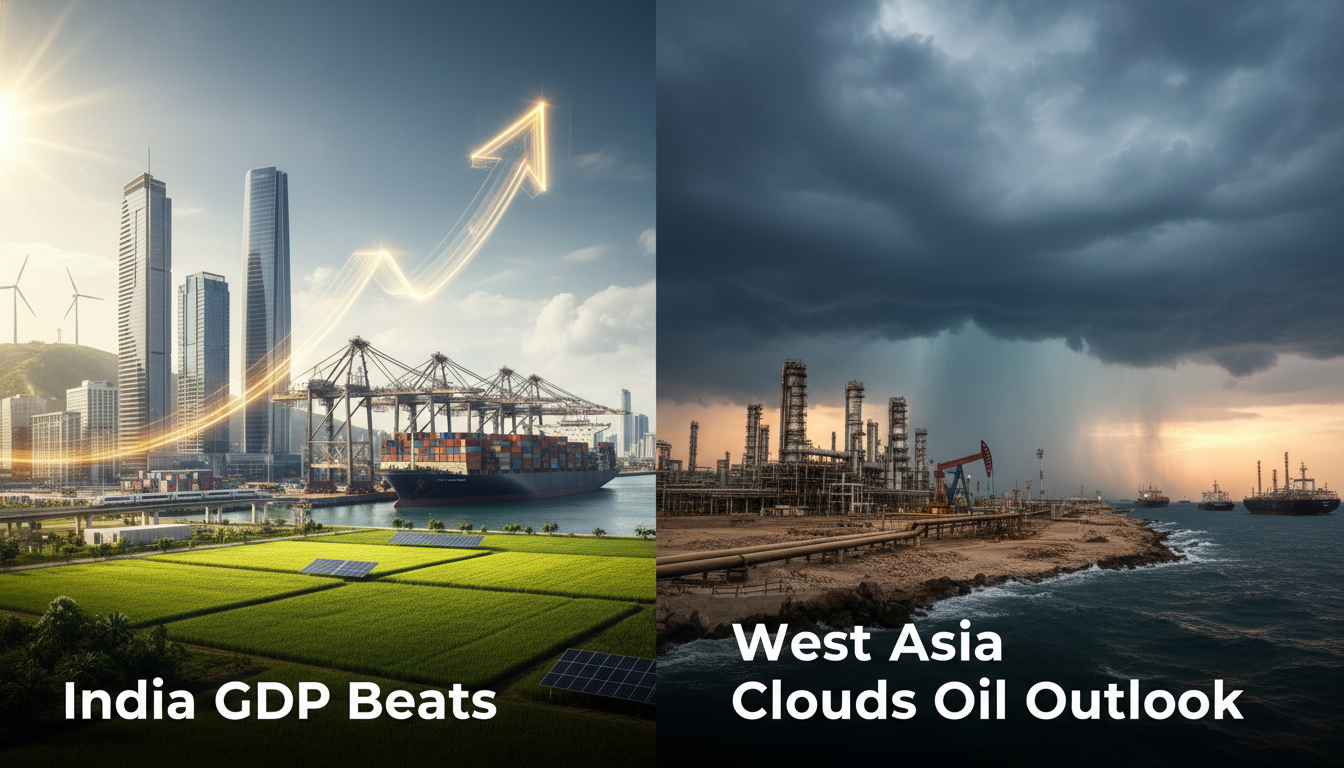
India’s Economic Engine Surges, But Oil Prices Threaten FY27 Outlook
India’s economy delivered a powerful performance in fiscal year 2026, expanding at a pace that surpassed market expectations. This robust growth, primarily fueled by strong internal demand and significant investment activity, has provided a critical buffer against escalating geopolitical tensions in West Asia. However, an emerging consensus among leading economists points to a deceleration in the coming fiscal year, largely due to persistent global uncertainties and the critical headwind of rising energy costs.
The latest figures from the National Statistical Office (NSO) paint a picture of impressive resilience. Gross Domestic Product (GDP) growth clocked in at an impressive 7.8 percent for the January-March quarter, a slight moderation from the 8.0 percent recorded in the preceding three months, but still strong enough to lift the full-year growth for FY26 to 7.7 percent. This final tally notably exceeded the second advance estimate of 7.6 percent, underscoring the underlying strength of the Indian market. Industry experts highlight that this acceleration occurred despite the conflict in West Asia intensifying during March, demonstrating the economy’s robust domestic foundation.
Domestic Demand and Production Fueling FY26 Strength
Analysts attribute this unexpected acceleration to several key factors. Resilient domestic demand, robust private consumption, and a surge in investment activity collectively enabled the Indian economy to weather the initial shocks emanating from geopolitical instability. Dharmakirti Joshi, Chief Economist at CRISIL, remarked on the “growth despite headwinds,” emphasizing that the fourth-quarter performance remained significantly above the average growth seen over the previous two and a half years.
The expansion was notably broad-based, according to Rumki Majumdar, an economist at Deloitte India. Gross Value Added (GVA) growth, which measures output across economic sectors, reached 7.9 percent, surpassing GDP growth. This suggests that India’s economic surge was not merely demand-driven but firmly supported by strong production momentum across services, manufacturing, and construction sectors, indicating a healthy and diversified economic base. This strong footing is particularly vital for investors evaluating India’s capacity to absorb potential future supply-side shocks impacting energy and commodity markets.
Navigating the FY27 Headwinds: The Crude Oil Conundrum
While the FY26 data offers reassurance, the outlook for fiscal year 2027 is undeniably more cautious. Market watchers are closely scrutinizing a confluence of factors expected to temper economic activity. Chief among these are the projected increases in crude oil and other commodity prices, a softening global growth trajectory, potential disruptions to global supply chains, and the critical risk of a below-normal monsoon season impacting agricultural output and rural demand.
Investment banks and research houses have already adjusted their FY27 forecasts downwards. CRISIL maintains its GDP growth projection at 6.6 percent, explicitly noting that risks are tilted to the downside. HDFC Bank echoes this sentiment with a 6.5 percent growth forecast, a figure predicated on an average crude oil price of approximately USD 95 per barrel. Both institutions warn that a squeeze in corporate margins due to rising input costs, a potential moderation in consumer demand spurred by higher inflation and possible interest rate hikes, and weaker export performance could significantly dampen economic momentum. For oil and gas investors, these forecasts underscore the direct correlation between global energy prices and India’s economic health, signaling potential inflationary pressures that could impact investment returns.
Geopolitical Risks and Policy Responses in Focus
DBS Bank highlighted that India enters the new fiscal year from a position of relative strength, yet cautioned that the full economic impact of the West Asia conflict is still to materialize. The lender flagged significant risks including disruptions in critical input supplies, elevated energy and food prices, and tighter financial conditions. These factors, if unchecked, could erode purchasing power and escalate the cost of doing business, directly affecting sectors reliant on imported crude and other commodities.
Policymakers in India are acutely aware of these downside risks. High-frequency data for rural and urban demand showed resilience in the January-March quarter, with corporates leveraging inventories to manage initial cost pressures. However, some manufacturing sectors, such as fertilizer and cement, did experience adverse effects. The Indian government has demonstrated proactive intervention, notably absorbing a significant portion of the Middle East crisis’s impact in March by maintaining stable pump prices for petrol and diesel, while ensuring an uninterrupted supply of LPG. This strategy, coupled with a front-loaded capital expenditure program and measures to boost foreign investment flows into equities and government securities, provides a crucial growth buffer amidst cautious private investment sentiment.
Investor Outlook: Cautious Optimism Amidst Energy Volatility
Despite the anticipated moderation, economists remain broadly optimistic about India’s fundamental, domestic-demand driven growth narrative. Rumki Majumdar of Deloitte India expresses cautious optimism, anticipating an easing of Middle East tensions and a gradual subsidence of supply-chain disruptions by year-end. She emphasizes that India’s robust domestic demand, supported by proactive government interventions, should help insulate the economy from external headwinds.
However, the investor community must remain vigilant. The full ramifications of geopolitical events on global energy markets, particularly crude oil, will be a dominant theme for FY27. HDFC Bank estimates nominal GDP growth at 11.5-12 percent for FY27, largely driven by higher inflation (WPI and CPI). This implies that while real growth may slow, the nominal expansion could still be substantial, offering opportunities in sectors that can pass on higher costs. Investors in the oil and gas sector, and those with significant exposure to energy-intensive industries, must meticulously monitor global crude price movements, geopolitical stability, and the Indian government’s ongoing policy responses to manage inflation and stimulate investment. The narrative for India in FY27 will be a testament to its ability to navigate a challenging global energy landscape while leveraging its inherent domestic strengths.


