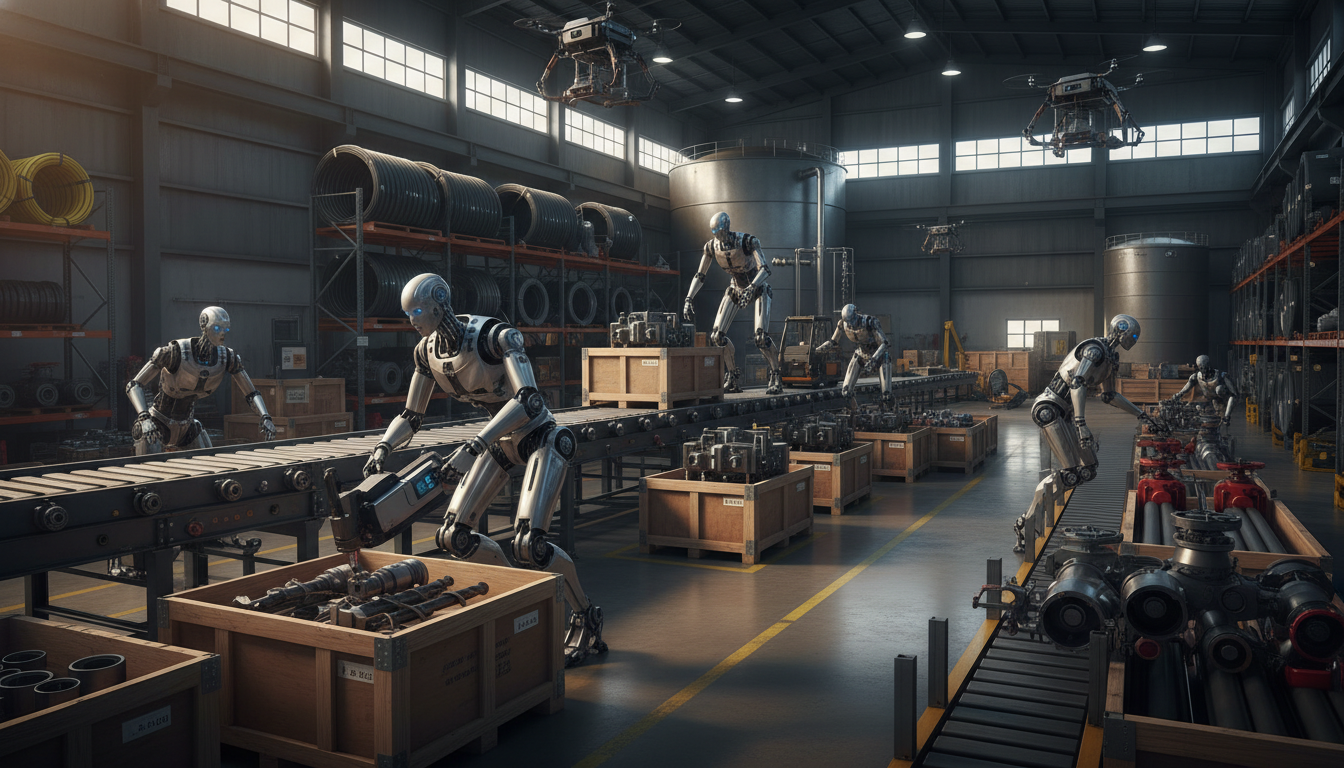
The latest spectacle capturing global attention isn’t unfolding in the volatile commodity markets, but on a warehouse floor in San Jose. A livestream featuring a humanoid robot diligently sorting packages has garnered millions of views, spotlighting a technological leap with profound implications for every heavy industrial sector, including the oil and gas industry. For investors in energy, this demonstration by Figure AI transcends mere novelty; it signals a potential paradigm shift in operational efficiency, labor dynamics, and even long-term energy demand.
Figure AI CEO Brett Adcock initiated the livestream to silence skeptics, aiming to prove his humanoid robots could perform eight continuous hours of autonomous labor. The internet responded with fascination. Millions watched a robot meticulously pick up small packages and place them on a conveyor belt, barcode down. In the background, two additional humanoids stood charged, ready to seamlessly take over if needed. The feed rapidly amassed over 1.5 million views on X within its initial eight hours, prompting viewers to affectionately name the robotic trio Bob, Frank, and Gary. This public audition, for a startup recently valued near $40 billion, offers a rare glimpse into the future of industrial automation.
Figure AI successfully achieved its primary objective, completing the eight-hour shift with “zero failures.” The company then extended the demonstration, with the humanoids ultimately sorting over 30,000 packages within a 24-hour period, accumulating over 3 million cumulative views. This viral event is more than just a robotics stunt; it’s a bold statement about the commercial viability of general-purpose humanoids for repetitive tasks in warehouses, factories, and, eventually, even homes. For oil and gas investors, this raises critical questions about how such autonomous capabilities could revolutionize safety, productivity, and cost structures across upstream, midstream, and downstream operations.
From Warehouse Floors to Rig Sites: Rethinking Industrial Operations
The core challenge Figure AI tackled—reliable, sustained autonomous labor—is directly relevant to the complex operational environments within the energy sector. Imagine humanoids capable of navigating the confined spaces of a refinery, performing routine inspections of valves and pipelines, or executing hazardous tasks on offshore platforms without direct human intervention. Such capabilities could dramatically reduce personnel exposure to dangerous conditions, a paramount concern for oil and gas companies, while simultaneously boosting operational uptime and efficiency.
Many tasks that seem straightforward for humans, like precise manipulation or navigating dynamic environments, remain complex for robots. Yet, the viral livestream, along with other recent demonstrations such as Figure AI’s robots making a bed or French startup Genesis AI’s robot cracking an egg, underscore rapid advancements in robotic dexterity, perception, and balance. For energy companies perpetually seeking to optimize production and logistics, these developments represent a tangible pathway to address persistent challenges, from asset integrity management to material handling in remote or hostile locations.
Figure AI investors and board members, Jesse Coors-Blankenship and Gregg Hill of Parkway Venture Capital, closely followed the livestream. Coors-Blankenship emphasized that the continuous, long-duration operation—including the potential for 24-hour shifts—demonstrated a new level of reliability previously confined to science fiction. “It’s so captivating,” he remarked, “because everyone’s realizing we’re moving into a whole new economy.” This sentiment resonates strongly with the oil and gas sector, which has historically embraced automation to enhance safety and efficiency, making the progression of humanoid robots a key area for strategic investment consideration.
A Competitive Arena: The Race for Robotic Supremacy and Energy Demand
Figure AI operates within a fiercely competitive landscape, facing off against giants like Tesla, established players such as Agility Robotics, and innovators like China’s Unitree. Agility Robotics, for instance, has already deployed its Digit humanoid robot with major customers, including Amazon, Schaeffler Group, and the logistics firm GXO. Jonathan Hurst, co-founder of Agility Robotics, pointedly remarked on Figure AI’s livestream, “Congratulations. We did that two years ago,” highlighting the intense pace of innovation and the ongoing race for commercial dominance. This competition ultimately benefits industrial users, driving down costs and accelerating technological maturity.
The widespread interest, exemplified by Hill’s speculation that “50,000 of the viewers are Tesla investors,” underscores the broader financial market’s recognition of automation’s transformative power. For oil and gas investors, the success of these humanoid platforms holds a dual significance: first, in their potential to enhance the operational profiles of energy companies themselves; and second, in their inherent demand for energy. The proliferation of advanced robotics, AI training models, and autonomous industrial infrastructure will inevitably drive increased electricity consumption, bolstering demand for primary energy sources, particularly natural gas for power generation. This creates a fascinating feedback loop where automation, while reducing direct labor, concurrently stimulates energy demand.
Beyond the Hype: Assessing Commercial Readiness for Critical Infrastructure
While Figure AI’s demonstration was largely successful, some experts caution against premature celebration regarding full commercial readiness. Roboticist Ayanna Howard, Dean of Ohio State University’s College of Engineering, acknowledged the impressive duration of the robot’s operation without failure. However, she characterized the humanoids as resembling a “science project” rather than machines ready for immediate widespread deployment in complex environments. She cited minor accuracy issues observed during the stream, such as occasional incorrect package placement or a package being knocked off the conveyor belt, alongside the fact that the robot was performing only a small part of the overall sorting process.
These observations highlight the gap between a controlled demonstration and the “messy reality” of industrial logistics, let alone the unforgiving conditions of an oil rig or processing plant. Adcock maintained that the robots operated fully autonomously, utilizing their AI models to trigger automatic resets when encountering issues and even autonomously seeking maintenance while another robot seamlessly takes over. He noted that Figure AI’s robots are nearing human parity in speed, averaging approximately three seconds per package, comparable to human sorters.
Yet, for an industry like oil and gas, where safety is non-negotiable and equipment failures can carry catastrophic consequences, reliability and adaptability far outweigh raw speed in initial deployment phases. The promise of these humanoids to tackle the rigorous demands of industrial environments, from corrosive atmospheres to extreme temperatures, remains an ongoing journey. As Figure AI’s humanoids continued their work for over 30 hours, even introducing a new member to the crew named Rose, the message for discerning energy investors is clear: the age of autonomous industrial labor is rapidly approaching, but the path to widespread, robust deployment in critical energy infrastructure requires continued innovation and meticulous validation.


