Abu Dhabi’s Strategic Pipeline Acceleration: Bolstering Global Oil Supply and Investor Confidence
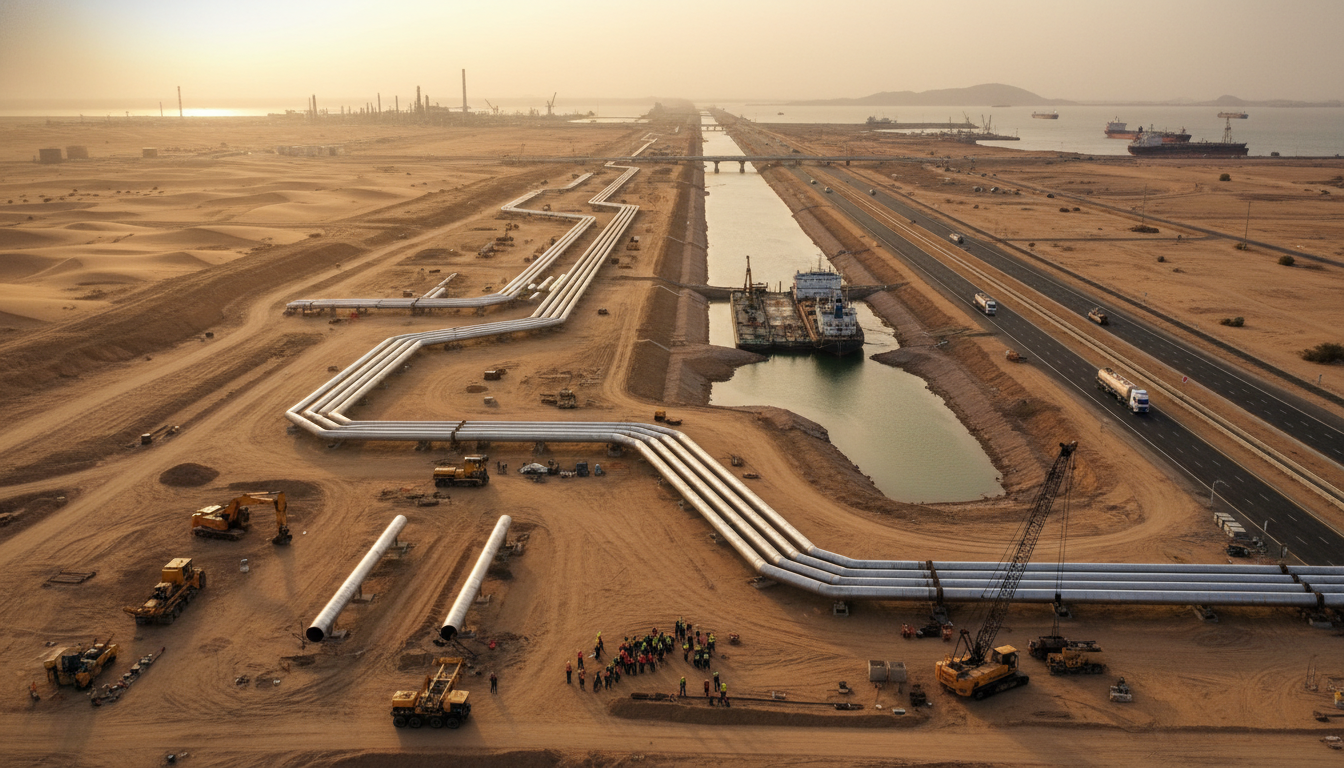
Abu Dhabi is rapidly advancing the construction of a critical new West-East oil pipeline destined for Fujairah, a move poised to significantly enhance its crude export capabilities and provide a vital bypass around the geopolitically sensitive Strait of Hormuz. This ambitious infrastructure project, anticipated to commence operations by 2027, is set to double the export capacity of the Abu Dhabi National Oil Company (ADNOC), signaling a robust commitment to securing and expanding the emirate’s role in global energy markets.
The urgency driving this development underscores the current volatility in global energy supplies. With flows through the Strait of Hormuz frequently constrained and recent attacks on energy infrastructure and shipping impeding the UAE’s ability to maintain consistent output, the imperative for redundant and secure export routes has never been clearer. For investors monitoring the stability of global oil supply chains, this pipeline represents a significant de-risking strategy, promising greater reliability and resilience against external disruptions.
Navigating Geopolitical Headwinds: The Hormuz Imperative for Energy Investors
The Strait of Hormuz, a narrow maritime chokepoint, remains a focal point of geopolitical tension, through which a substantial portion of the world’s seaborne oil transits daily. Abu Dhabi’s accelerated pipeline project directly addresses the inherent vulnerabilities associated with this route, offering a robust alternative for crude exports. By diverting a significant volume of oil away from the Strait, the UAE is proactively mitigating risks that could otherwise lead to supply shocks and price volatility, a key concern for any energy investor.
Crown Prince Sheikh Khaled bin Mohamed bin Zayed Al Nahyan’s recent directive to expedite the pipeline’s delivery highlights the strategic importance of this project in meeting surging global energy demand. During a meeting of ADNOC’s executive committee, the Crown Prince emphasized the company’s strong position as a “responsible and reliable global energy producer,” capable of leveraging its “operational flexibility to responsibly increase production to meet market needs when export constraints allow.” This statement reinforces ADNOC’s commitment to market stability and its proactive approach to enhancing its operational resilience, both attractive qualities for long-term energy investment.
ADNOC’s Ambitious Capacity Expansion and Strategic Positioning
ADNOC is in the midst of a significant growth phase, driven by substantial investments aimed at boosting its crude production capacity. This expansion strategy is integral to the UAE’s broader vision for its energy sector, which recently saw the nation announce its departure from the OPEC producer group, a membership it held since 1967. This pivot signifies the UAE’s intent to independently manage its production levels, unencumbered by cartel quotas, to better serve global demand and maximize its export potential.
Before recent global conflicts disrupted energy markets, the UAE was consistently producing just over 3 million barrels per day, aligning closely with its OPEC+ targets. However, current production has seen a notable reduction, ranging between 1.8 and 2.1 million barrels per day. The new pipeline directly supports ADNOC’s ambitious target of achieving a production capacity of 4.9 million barrels per day, demonstrating a clear trajectory for substantial output growth. For investors, this capacity expansion signals a commitment to becoming a more dominant and flexible player in the global oil supply matrix.
The existing Abu Dhabi Crude Oil Pipeline (Adcop), also known as the Habshan-Fujairah pipeline, currently serves as the UAE’s sole alternative export route, capable of transporting up to 1.8 million barrels. The new pipeline’s ability to double this bypass capacity is therefore not just an incremental improvement but a transformative leap in strategic flexibility and supply security, providing unparalleled access to global markets without reliance on the Strait of Hormuz.
Investment Implications and Future Outlook for Global Oil Markets
The acceleration of Abu Dhabi’s new West-East pipeline carries significant implications for investors in the oil and gas sector. Firstly, it substantially reduces geopolitical risk associated with the Strait of Hormuz, offering a more secure and predictable pathway for UAE crude exports. This enhanced security translates into greater reliability of supply, a critical factor for global energy markets and the stability of oil prices.
Secondly, the project directly supports ADNOC’s aggressive production capacity targets. As the UAE aims to significantly increase its output to 4.9 million BPD, the expanded export infrastructure will be essential to monetize this increased capacity. For investors, this translates into potential for increased export volumes and revenues for ADNOC, positioning it as a key driver of future global oil supply growth.
Lastly, the UAE’s strategic decision to depart from OPEC, coupled with its substantial infrastructure investments, underscores a long-term vision of market independence and flexibility. This approach allows the nation to respond dynamically to evolving global energy demands, enhancing its attractiveness as a stable and growing source of crude oil. Investors should view this pipeline not just as a piece of infrastructure, but as a cornerstone of Abu Dhabi’s strategy to solidify its position as a reliable, secure, and influential global energy power for decades to come.