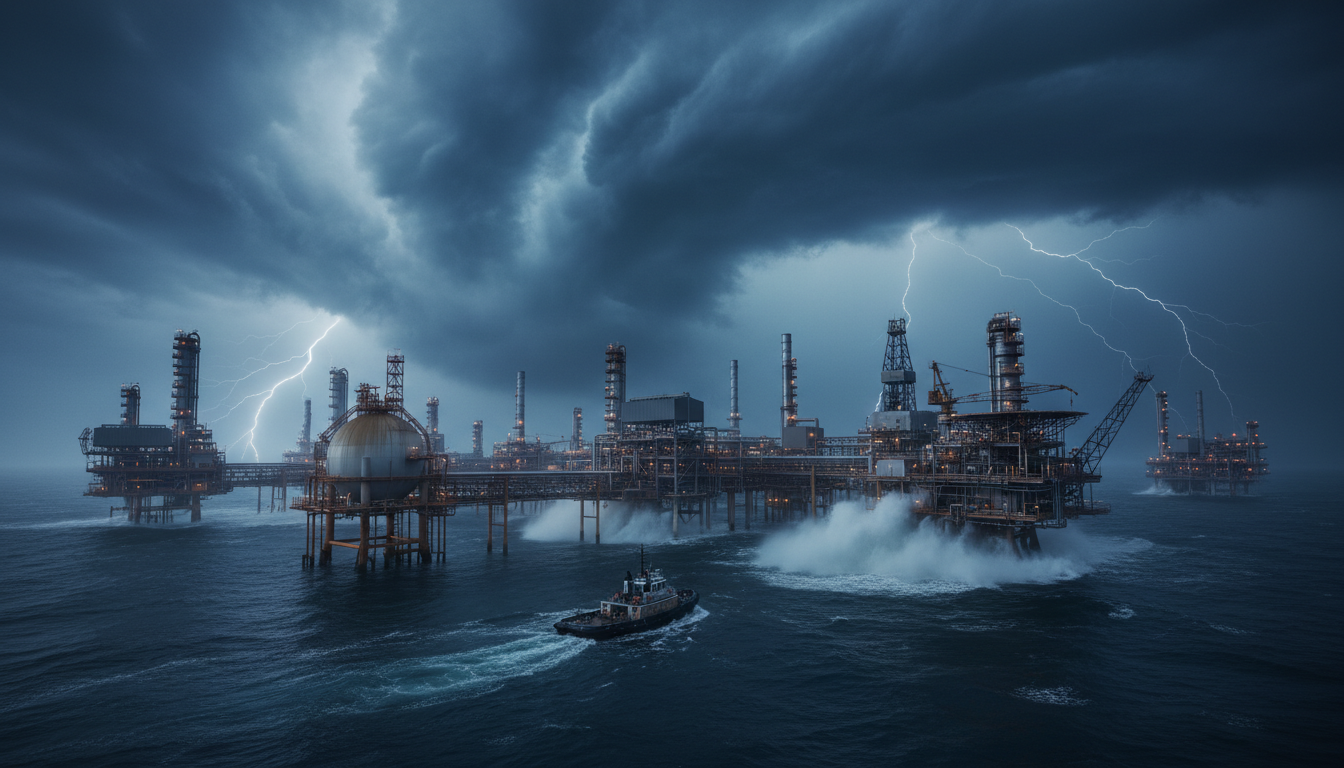
Extreme Weather Risks: A Growing Financial Storm for Energy Investors
The energy sector, long accustomed to navigating geopolitical complexities and market volatility, now confronts an increasingly urgent and tangible threat: extreme weather events. These are no longer distant climate projections but immediate operational disruptions and significant financial burdens already impacting production, forcing shutdowns, and damaging critical infrastructure across the global economy. For investors in oil and gas, understanding this evolving risk landscape is paramount to safeguarding asset value and ensuring long-term portfolio resilience.
Recent analysis from independent environmental disclosure systems reveals a concerning disparity between perceived and actual financial exposure. While a vast number of corporations provided comprehensive environmental data in 2025, a striking minority—just 35%—formally recognized extreme weather as a material financial risk. This lack of acknowledgment stands in stark contrast to the real-world consequences already being reported.
In 2025 alone, companies globally reported nearly $3 billion in direct financial losses attributable to extreme weather. Heavy rainfall emerged as the single largest culprit, responsible for a staggering $1.5 billion in damages across disclosing entities. Beyond direct costs, firms cited an additional $309 million in higher operational expenses and $266 million in losses from operational shutdowns. For the capital-intensive oil and gas industry, where downtime at a refinery or a pipeline disruption can cost millions per day, these figures underscore a critical governance challenge. Many boards and executive teams continue to treat physical climate risk as isolated incidents rather than a systemic, recurring factor demanding integrated financial planning.
Future Climate Impacts: A Potential $898 Billion Hit to Energy Assets
The projected financial exposure from extreme weather is exponentially larger, casting a long shadow over future investment horizons. Corporations anticipate a colossal $898 billion in future financial impacts linked to severe weather phenomena. Flooding alone is expected to account for a dominant share of this burden, estimated at $528 billion. Cyclones contribute an additional $161 billion to this grim forecast, while heavy rain, already a significant cost driver, is projected to cause another $86 billion in damages.
Alarmingly, nearly half of these disclosed extreme weather risks are forecast to materialize within the next two years. This timeline directly intersects with current capital expenditure cycles, insurance policy renewals, procurement strategies, and operational planning for energy companies. Investors must recognize that these are not distant threats but impending challenges that demand immediate strategic consideration.
The expected losses extend far beyond mere property damage to individual sites. Companies foresee reduced production capacity driving $326 billion in impacts, a direct hit to revenue streams and market supply. Furthermore, asset impairment or early retirement due to weather-related damage could add another $218 billion to the industry’s financial burden. For oil and gas investors, this fundamentally shifts the investment thesis from mere growth ambition to rigorous asset quality assessment. Physical risk directly influences earnings stability, the availability and cost of insurance, supply chain reliability, and prudent capital allocation. It also exposes weaknesses in corporate governance where climate hazards have not been fully integrated into enterprise-wide risk management systems.
Proactive Adaptation: A Financially Sound Investment
The financial argument for proactive adaptation and resilience investments is overwhelmingly clear. Analysis shows that the median cost of climate-related risks per company stood at an substantial $39.4 million. In stark contrast, the median cost to implement mitigation measures designed to reduce these risks was a mere $3.1 million. This thirteen-fold difference powerfully demonstrates that investing in resilience today can protect substantial enterprise value at a significantly lower cost than absorbing the inevitable impacts of delayed action.
For energy companies with vast, exposed infrastructure and complex global supply chains, the imperative for action is not just an environmental mandate; it is a critical operational, financial, and fiduciary responsibility. Boards have a duty to shareholders to evaluate these costs and benefits strategically.
These findings also carry profound implications for financial institutions, including lenders and insurers. As physical hazards intensify, the risk of uninsured or underpriced losses could permeate credit portfolios, destabilize public balance sheets, and disrupt local economies dependent on the energy sector. A comprehensive understanding of climate risk is becoming a prerequisite for sustainable lending and underwriting practices.
Systemic Challenges Demand Integrated Risk Management
The impact of extreme weather extends beyond individual corporations, affecting entire cities, states, and regions that host critical energy infrastructure. Over 1,000 subnational governments, reporting through various platforms, indicate that 62% are already significantly impacted by extreme weather. More than 60% anticipate hazards such as extreme heat, urban flooding, and drought to intensify in frequency or severity. Notably, almost a quarter of these entities identified financial and insurance sectors, which underpin energy projects, as highly exposed to these escalating climate hazards.
Local governments are increasingly transitioning from broad climate pledges to concrete adaptation projects. However, securing adequate funding remains a significant hurdle. Over 60% of these governments have at least one adaptation project requiring additional financing, with the global investment gap estimated to be no less than $34 billion. Budgetary constraints are reported by nearly half of subnational governments, further limiting their capacity to adapt and protect the critical services and infrastructure that the energy industry relies upon.
Experts emphasize the need for a collaborative approach, urging companies to treat extreme weather as a systemic business risk. This perspective necessitates looking beyond individual assets and assessing broader dependencies on public infrastructure, utilities, logistics networks, and essential public services. For the energy sector, this means evaluating the resilience of ports, power grids, transportation routes, and local workforces in regions where operations are concentrated.
Subnational governments, in turn, are encouraged to transparently disclose where hazard exposure, infrastructure vulnerabilities, and service disruptions intersect. National governments must align fiscal policies, adaptation strategies, and risk management frameworks to address shared economic exposure effectively. For financial regulators and central banks, the message is clear: physical climate risk is actively penetrating financial systems through uninsured losses, potentially stranding assets, and disrupting core economic activities. The global adaptation agenda has transcended its origins as purely an environmental priority to become a fundamental test of economic resilience and a critical factor for investor confidence in the energy market.


