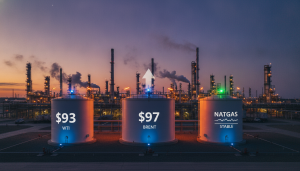
The global oil market stands at a precarious juncture. Should crude oil prices ascend into an elevated range before the broader investment community fully comprehends the magnitude of the current supply-side challenges, the resulting market response could be extraordinarily volatile. In a scenario marked by sustained supply constriction, a move toward $150 per barrel for crude oil becomes increasingly credible. Furthermore, under conditions of severe geopolitical escalation, the prospect of $200 per barrel for oil can no longer be dismissed as a remote impossibility.
Agricultural Supply Chain Disruption: A Market Blind Spot
The most profound implications of the unfolding global crisis might not manifest exclusively at the fuel pump, but rather within the aisles of grocery stores. A significant portion of the world’s fertilizer trade has historically transited through the Strait of Hormuz. Consequently, any prolonged interference in this vital waterway not only threatens global energy markets but also imperils the crucial agricultural supply chain responsible for feeding populations worldwide.
This is precisely where the most significant inflationary pressures are poised to emerge.
Elevated fertilizer costs do not immediately translate into higher food prices. Their impact propagates slowly through a complex web of agricultural decisions, influencing planting strategies, farm-level profit margins, financing arrangements for cultivators, freight expenses for distribution, and wholesale market dynamics. Only after this lengthy transmission process do these increased costs abruptly appear in official food inflation statistics, often long after the window for proactive investment positioning has closed.
Leading market strategists emphasize that the ripple effects of energy shortages can rapidly manifest as widespread food scarcity, frequently catching market participants unprepared. Higher costs for fuel and agricultural inputs exert considerable pressure on farmers, diminishing their incentives for production and ultimately increasing the fundamental cost of feeding the world. Historically, financial markets have consistently underestimated the profound and interconnected nature of this chain reaction.
Indeed, the initial tremors of this chain reaction are already evident.
Farmers globally are grappling with escalating operational expenses. Concurrently, climate-related risks are intensifying, with the current El Nino pattern introducing uncertainty and threatening hotter, drier conditions across essential agricultural regions. In this environment, soft commodities are increasingly attracting substantial institutional capital. Grains such as Wheat and Corn, along with Soybeans, Sugar, Coffee, and Cocoa, are no longer viewed as peripheral market segments. Instead, they are evolving into critical pressure points within a much larger, encompassing global commodity squeeze.
This is the characteristic genesis of a commodity supercycle: an initially gradual and quiet accumulation of pressures, culminating in a sudden and synchronized acceleration.
Shifting Political Dynamics: From TACO to NACHO
The geopolitical underpinnings of the current crisis are also undergoing a significant transformation. During earlier periods of trade disputes and tariff negotiations, Wall Street traders famously coined the acronym TACO – “Trump Always Chickens Out” – reflecting a prevailing expectation that aggressive governmental threats would eventually be softened, delayed, or outright reversed.
However, the escalating tensions surrounding the Strait of Hormuz have given rise to a new, more somber phrase circulating among trading desks: NACHO – “Not A Chance Hormuz Opens.”
While the acronym may possess a somewhat playful cadence, its underlying message is acutely serious. Market participants are increasingly expressing skepticism that Washington can swiftly de-escalate the confrontation with Iran, facilitate the rapid reopening of one of the world’s most critical energy arteries, and restore normalized supply flows before the extensive damage permeates global inventories, refined fuel markets, consumer food prices, and international trade networks.
Should market sentiment solidify around the improbability of a swift resumption of normal traffic through Hormuz, experts contend that current crude oil valuations, and indeed the wider commodity spectrum, fundamentally misrepresent the true supply-demand dynamics. Once this critical psychological shift takes hold, institutional capital will not hesitate. It will reposition with remarkable speed and aggression.
This reality represents a significant hazard for investors who remain on the sidelines, holding substantial cash reserves and awaiting perfect clarity. Financial markets do not provide advance warnings before undergoing a regime change. Instead, they undergo a rapid repricing, with the broader investment crowd only comprehending the implications long after the initial moves have occurred.
Scarcity: The Ultimate Bullish Catalyst in Commodities
The most powerful and enduring bull markets in commodities are not fueled by an abundance of optimism, but rather by the stark reality of scarcity. And indeed, scarcity is rapidly emerging as the defining characteristic of the contemporary global economy.
Governments worldwide are actively engaged in stockpiling strategic resources. Export restrictions are becoming more prevalent. Crucial trade routes are being strategically leveraged as geopolitical tools. Energy security has become inextricably linked to national security. Food security is now a paramount political concern. Access to vital metals is a foundational pillar of industrial security.
Consequently, commodities such as Crude Oil, Gold, Silver, Copper, Natural Gas, Uranium, Wheat, Soybeans, Corn, Coffee, Cocoa, and Sugar are no longer merely raw materials. They have ascended to the status of strategic hard assets in an evolving global landscape where obtaining sufficient supply is increasingly challenging, transporting these resources is becoming prohibitively expensive, and their availability is progressively dictated by governmental control rather than free market forces.
Momentous shifts in commodity valuations typically occur when the broader investment community belatedly grasps the enduring nature of supply constraints, long after initial movers have established their positions. By that point, early capital is already strategically deployed, and late-arriving funds are compelled to chase higher prices.
This precise market setup is currently materializing.
The situation transcends any single conflict, specific blockade, or individual inventory report. It signals the advent of a new global paradigm where the foundational resources that power economies, sustain populations, and build essential infrastructure are becoming fundamentally more difficult to access at scale.
This is not a temporary trading opportunity; it represents a fundamental regime change in global economics and investment.
A Generational Wealth Transfer Unfolding?
While history rarely repeats itself verbatim, its patterns often echo through time. In 2008, millions of investors overlooked the profound opportunities presented by the Global Financial Crisis, paralyzed by fear and uncertainty. Similarly, in 2020, countless individuals missed the pandemic-driven commodity boom, choosing instead to wait for absolute certainty in a chaotic environment.
Those who recognized the impending shifts early in each instance were positioned to capture substantial, life-altering wealth. Conversely, those who delayed action, waiting for official headlines to confirm what was already in motion, were left to pursue missed opportunities at significantly higher entry points.
Today, the world may be standing on the precipice of the third great wealth transfer of our lifetime. A confluence of crises is accumulating: heightened war risks, severe energy market disruptions, critical fertilizer shortages, accelerating food inflation, escalating climate stress, fragmentation of global supply chains, strategic government stockpiling, and intense international competition for vital hard assets.
For the majority, this complex array of challenges signals danger and instability. However, for astute and disciplined investors, it represents something entirely different: a succession of compounding opportunities.
The message for serious investors is unequivocal. This is not the moment for passive observation from the sidelines. It is not the time to await confirmation from mainstream financial narratives. Nor is it prudent to assume a return to the old paradigm of inexpensive energy, frictionless trade, and abundant global supply.
Instead, this is the critical period to discern the overarching pattern, comprehend the profound regime shift underway, and strategically position capital before the broader consensus awakens to the new reality.
Because once the permanence of scarcity becomes undeniably apparent, capital will move with unprecedented speed and aggression. It will relentlessly pursue crude oil, gold, silver, copper, natural gas, and agricultural commodities with the same urgency that characterized the defining inflation trades of previous eras.
The window of opportunity is open now. However, it is imperative to recognize that this window will not remain accessible indefinitely.
There are rare moments in financial markets when fortunes are not forged by those who prioritize comfort and certainty, but rather by those who act decisively before the masses fully grasp the profound shifts taking place.
This current environment possesses all the hallmarks of such a moment.
For investors who perhaps overlooked the opportunities of 2008, who subsequently missed the powerful commodity rally of 2020, and who are determined not to miss the next generational opportunity, the market’s signals could not be clearer.
The most significant commodity squeeze in modern history may already be in full motion.
The fundamental question now confronting every investor is whether they will strategically position themselves before this profound wealth transfer accelerates, or whether they will observe from the sidelines as the greatest hard asset trade of the decade unfolds without their participation.