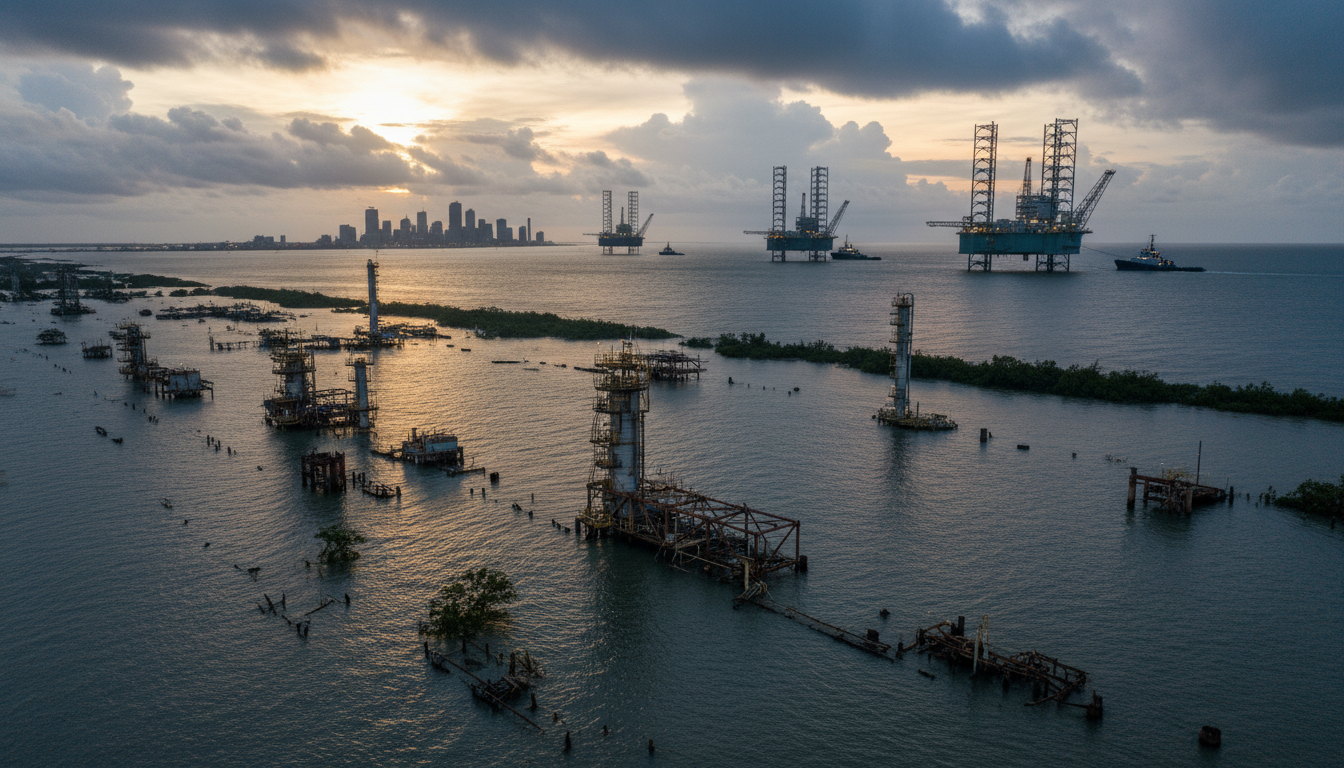
New Orleans Faces Terminal Outlook: Deepening Risks for Energy Investors
A sobering new study delivers a stark warning to investors with stakes in the Gulf Coast region: New Orleans has reached a “point of no return,” facing inevitable inundation by the Gulf of Mexico within decades due to escalating climate impacts. The implications for critical energy infrastructure and regional economic stability are profound, demanding immediate attention from portfolio managers and corporate strategists.
The research forecasts that unchecked sea level rise, coupled with the relentless erosion of southern Louisiana’s vital coastal wetlands, will effectively isolate the New Orleans area within a few generations. Experts project the city could become an island, potentially surrounded by the Gulf of Mexico before the close of this century. This alarming assessment underscores a rapidly evolving environmental and financial risk landscape.
The Vanishing Coastline: A Direct Threat to Energy Infrastructure
Southern Louisiana, a lynchpin for U.S. oil and gas operations, confronts a complex array of environmental threats. Global heating drives significant sea level increases, predicted to reach between three and seven meters. This surge is exacerbated by increasingly intense hurricanes – another facet of the climate crisis – and the ongoing subsidence of a coastline extensively modified by decades of industrial activity, including oil and gas development.
The study projects a staggering loss of three-quarters of the region’s remaining coastal wetlands. This catastrophic land degradation will force the shoreline to recede as much as 100 kilometers (62 miles) inland, effectively stranding major population centers like New Orleans and Baton Rouge. For energy investors, this means direct threats to pipelines, refining capabilities, export terminals, and logistical networks that rely on a stable, accessible coastline. The research, which draws parallels between current global temperature trends and a similar period 125,000 years ago that triggered comparable sea level rises, labels southern Louisiana as the “most physically vulnerable coastal zone in the world.”
Investment Dilemma: Billions, But No Solution
Post-Hurricane Katrina in 2005, billions of dollars were poured into fortifying New Orleans with an expansive system of levees, floodgates, and pumps. However, the latest analysis indicates these monumental defenses, already requiring substantial upgrades to maintain their efficacy, cannot provide a long-term safeguard for the city. The escalating environmental pressures mean existing protective measures are ultimately insufficient.
Jesse Keenan, a climate adaptation expert at Tulane University and a co-author of the paper, offers a blunt assessment: “In paleo-climate terms, New Orleans is gone; the question is how long it has.” He predicts the city’s timeline is likely “decades rather than centuries.” Even a halt to climate change today would not alter New Orleans’ fate, as sustaining a below-sea-level island surrounded by open water is an insurmountable challenge, regardless of capital investment. This perspective necessitates a complete re-evaluation of long-term asset viability and risk exposure for any entity operating within the region.
Accelerated Erosion and Policy Setbacks
Louisiana’s land is receding at an alarming pace. Since the 1930s, the state has forfeited 2,000 square miles of land to coastal erosion, an area roughly equivalent to the size of Delaware. Projections indicate another 3,000 square miles will vanish over the next half-century, with land disappearing at a rate equivalent to a football pitch every 100 minutes. This rapid geographical transformation directly impacts property values, insurance markets, and the stability of onshore infrastructure.
A proposed solution, the Mid-Barataria Sediment Diversion project, broke ground in 2023. This ambitious plan aimed to restore the Mississippi River’s natural ability to rebuild land, which has been stifled by extensive levee systems pushing sediment directly into the Gulf of Mexico. The project sought to create more than 20 square miles of new land over 50 years by allowing sediment to replenish coastal wetlands. Funded by a settlement from BP following the 2010 Deepwater Horizon disaster, the project represented a significant investment in coastal resilience.
However, Louisiana’s Republican Governor, Jeff Landry, abruptly scrapped the $3 billion project last year, citing unsustainable costs and potential harm to the state’s fishing industry. This decision has been widely criticized by proponents, including Garret Graves, a former Congressman who once led the state’s coastal restoration agency, calling it a “boneheaded decision” that represents a major setback. From an investment standpoint, the abandonment of such a critical land-building initiative accelerates the timeline of risk for properties and infrastructure in the New Orleans area, ensuring that existing levees will likely fail repeatedly as floodwaters have nowhere else to dissipate.
Legal Battles and Industry Liability
Further complicating the landscape for energy investors, a significant legal battle over corporate responsibility for coastal damage remains contentious. The U.S. Supreme Court recently allowed the fossil fuel industry to federally challenge a state jury decision that required Chevron to pay $740 million for damage to wetlands caused by dredging canals, drilling wells, and disposing of wastewater. The outcome of such legal contests holds immense financial implications, potentially setting precedents for environmental liabilities across the sector and demanding close monitoring by investors.
The combination of these policy decisions and legal uncertainties, according to the new research, “effectively means giving up on extensive portions of coastal Louisiana, including the New Orleans area.” This accelerates the timeline of inevitable infrastructure failure and heightened risk exposure for all commercial interests in the region.
The Unavoidable Retreat: Economic and Social Exodus
With a population of approximately 360,000, New Orleans faces unprecedented challenges. A separate study recently highlighted that 99% of its population lives at major risk of severe flooding, making it the most exposed U.S. city. Wanyun Shao, a geographer at the University of Alabama and co-author of this study, concurs that relocation is ultimately inevitable, stating, “managed retreat, no matter how unappealing it may be, is the ultimate solution at some point.”
While the U.S. lacks a precedent for the wholesale relocation of a major city, communities have historically moved for economic reasons, and increasingly, due to climate change. Experts suggest coordinated planning for a strategic relocation northward, perhaps across Lake Pontchartrain, could offer an opportunity for sustainable long-term infrastructure investment. However, as Keenan notes, “if nothing is done, people will just trickle out over time and it will be an uncoordinated mess.” The market itself will enforce this exodus, with insurance becoming unobtainable, effectively dictating which areas are no longer viable for habitation or business operations. This signals a critical lack of proactive governance, leaving businesses and property owners to navigate an escalating crisis without a clear strategy.
Timothy Dixon, a coastal environments expert at the University of South Florida, emphasizes that while New Orleans may not disappear in a decade, policymakers should have initiated relocation planning a century ago. Despite the political and emotional complexities, voluntary migration is already underway and will only accelerate. The current political system, however, appears ill-equipped to make the necessary difficult decisions, leaving investors to grapple with the significant, unmitigated risks inherent in Louisiana’s coastal energy footprint.


