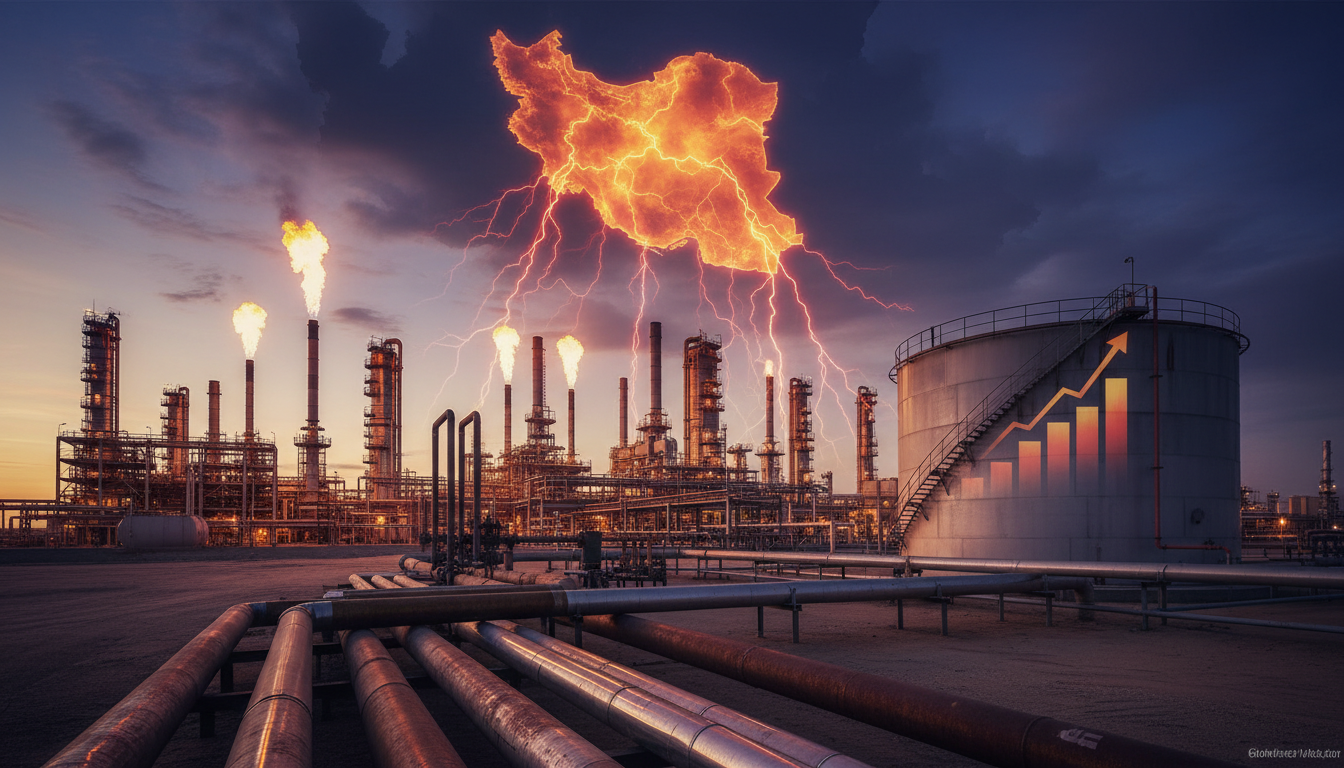
Strait of Hormuz Tensions Ignite Oil Market Volatility
The global energy landscape finds itself on edge this week as escalating geopolitical friction in the Middle East has sent crude oil benchmarks surging. A direct confrontation between United States military objectives and stern warnings from Iran regarding the crucial Strait of Hormuz has injected a significant risk premium into the market, catching the attention of every serious oil and gas investor.
On Monday morning, Middle Eastern time, the U.S. launched an operation dubbed “Project Freedom,” a strategic initiative intended to safeguard international maritime traffic through the Strait of Hormuz. This critical waterway, a vital artery for global crude shipments, immediately became the focal point of heightened tensions, sending ripples across the futures markets.
“Project Freedom” Underway: US Military Mobilizes
President Donald Trump had announced the preceding Sunday that “Project Freedom” would commence on May 4. The stated objective was to provide escort for vessels that had become stranded within the Gulf region, specifically those ships originating from “areas of the world that are not in any way involved” with the ongoing regional conflicts. This move underscores a concerted effort by the U.S. to ensure freedom of navigation through one of the world’s most strategically important maritime choke points.
U.S. Central Command (CENTCOM) swiftly confirmed its operational support for this mission, outlining a substantial commitment of military resources. Admiral Brad Cooper, the CENTCOM commander, underscored the imperative nature of this defensive undertaking, stating its critical role in bolstering regional security and safeguarding the global economy, all while simultaneously maintaining an existing naval blockade. CENTCOM’s deployment for Project Freedom is formidable, involving guided-missile destroyers, more than one hundred land and sea-based aircraft, a diverse array of multi-domain unmanned platforms, and a contingent of 15,000 service members. This significant show of force is designed to project capability and ensure the secure transit of commercial shipping.
Iran’s Defiant Stance and Direct Threat
However, the commencement of Project Freedom was met with an immediate and unequivocal rebuke from Tehran. Simultaneously with the U.S. operation getting underway, Iran’s military issued a stark warning to U.S. forces, advising them to remain clear of the Strait of Hormuz. Ali Abdollahi, who heads the Iranian armed forces’ unified command, conveyed a defiant message, stating that any foreign armed forces, particularly the “aggressive U.S. army,” would be subject to attack should they attempt to approach or enter the Strait of Hormuz.
Abdollahi reiterated Iran’s long-held position, asserting that the security of the Strait lies solely within Iran’s control and that any safe passage for vessels must be coordinated directly with the Iranian armed forces. This declaration directly challenges the U.S. initiative, setting the stage for a potentially perilous standoff in a region already fraught with instability. The implications for global energy supply security are profound, as investor confidence hinges on the unhindered flow of oil through this narrow passage.
Market Reaction: Oil Prices Surge on Escalation Fears
The financial markets reacted sharply to this escalating rhetoric. Initially, President Trump’s announcement of Project Freedom had placed some downward pressure on crude prices, perhaps due to an expectation of reduced uncertainty or increased supply security. However, this sentiment quickly reversed course following Iran’s aggressive counter-declaration. The immediate threat of military engagement instantly introduced a substantial geopolitical risk premium into oil benchmarks.
In response to Iran’s warning, crude oil futures experienced a significant rebound. Brent crude, the international benchmark, climbed a robust 1.52%, pushing its price to trade at $109.80 per barrel. Concurrently, West Texas Intermediate (WTI), the U.S. benchmark, also saw a notable increase, rising 1.56% to reach $103.50 per barrel. This sharp upward movement underscores the market’s sensitivity to potential supply disruptions in the Middle East, particularly concerning the Strait of Hormuz, through which roughly one-fifth of the world’s petroleum and other liquids pass daily.
Investor Outlook: Navigating Heightened Geopolitical Risk
For investors focused on the oil and gas sector, these developments highlight the enduring impact of geopolitical events on commodity prices. The Strait of Hormuz remains an irreplaceable choke point for global energy trade, making any threat to its stability a direct and immediate concern for supply chains and ultimately, crude valuations. The current situation demands vigilant monitoring, as the interplay between U.S. strategic interests and Iranian territorial claims could lead to sustained volatility in energy markets.
The significant military presence now established by the U.S., coupled with Iran’s unyielding stance, means that the risk of miscalculation or accidental escalation remains high. Investors should factor in this elevated geopolitical risk when assessing their portfolios, considering potential hedges or adjusting exposure to energy-related assets. The coming days will be critical in determining whether a tense equilibrium can be maintained, or if further confrontations will drive oil prices even higher, reflecting a deeper and more entrenched risk premium.
The current environment clearly illustrates that while fundamental supply and demand dynamics are crucial, the unpredictable nature of geopolitics can often be the most potent driver of short-to-medium-term price movements in the volatile world of oil and gas investing.