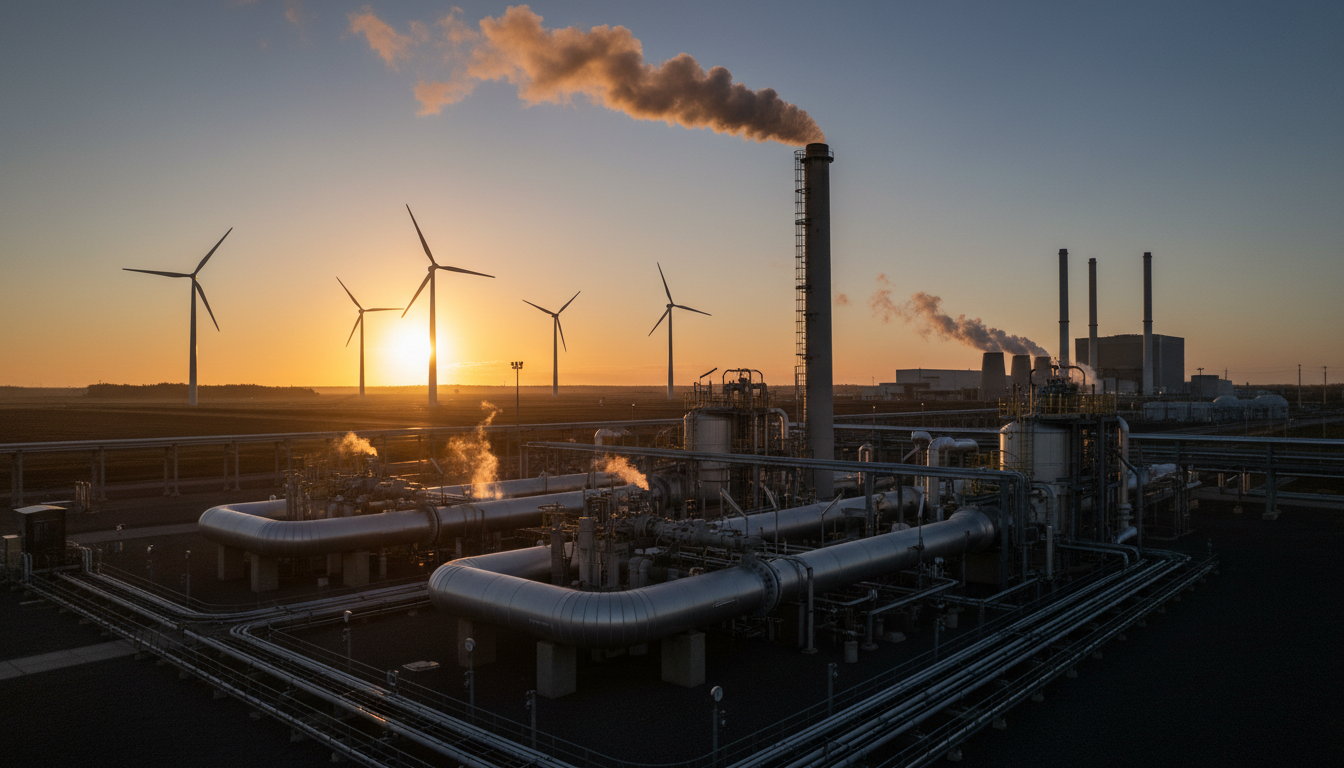
The traditionally serene Nordic energy landscape, once lauded for its abundant renewable power and stable climate, now faces an unprecedented surge in electricity demand, primarily driven by the exponential growth of data centers. This escalating “power hunger” is compelling nations like Denmark to re-evaluate their energy policies and grid capacity, posing significant implications for energy investors closely monitoring regional infrastructure and market stability.
At the heart of this unfolding energy dilemma is Denmark, which has quickly become the focal point of the Nordic region’s struggle to balance green ambitions with soaring demand. The recent formation of a new government, coupled with an explosion in grid access requests from power-intensive facilities, has precipitated a critical pause on new data center projects, sending ripples of uncertainty through the investment community.
This challenge extends far beyond Denmark’s borders. Data centers globally are encountering growing resistance due to their voracious energy consumption. In the United States, states like Maine have narrowly avoided outright construction bans, while Pennsylvania grapples with mounting public opposition that could sway upcoming elections. Other key tech hubs, including Virginia and Oklahoma, are actively contemplating moratoriums on new data center developments. Within Europe, only the Netherlands and Ireland have previously implemented comprehensive moratoriums, though both have since eased restrictions under specific conditions. However, the underlying grid pressures are intensifying across the continent, fueled by the accelerating AI boom, the broader drive towards electrification, and pervasive digitalization efforts.
The Investor’s Dilemma: Navigating Europe’s Energy “Hunger Games”
In a move that caught many by surprise, Denmark’s state-owned grid operator, Energinet, initiated a temporary halt on new grid connection agreements in March. A spokesperson described this action as a response to an “explosion” of capacity requests. Astoundingly, projects totaling approximately 60 GW are currently awaiting grid connections – a figure that dwarfs Denmark’s peak electricity demand, which hovers around 7 GW. Data centers alone represent a substantial segment of this backlog, accounting for nearly a quarter, or 14 GW, of the potential new grid connection projects. This colossal disparity highlights an immediate and pressing infrastructure bottleneck for energy investors.
Industry leaders are voicing concerns over the sustainability of this situation. Henrik Hansen, CEO of the Data Center Industry Association (DDI), warns that an extension of the current three-month moratorium remains a distinct possibility. Hansen describes the current queue of applications as a “fantasy” given the sheer gap between available power and requested capacity. He stresses the need for the industry to adopt greater discipline and for regulators to establish clearer criteria for prioritizing grid access. This could involve stringent requirements for project maturity, confirmed investment decisions, customer commitments, and demonstrated societal value. For investors, this translates into increased regulatory risk and the potential for capital deployment delays, impacting project viability and returns.
Sebastian Schwartz Bøtcher, Country Sales Director at energy management specialist Schneider Electric, characterized the debate as the “energy policy hunger games” between competing industrial sectors. He advocates against singling out specific industries, a sentiment echoed by Tobias Johan Sørensen, a senior analyst at think tank Concito, who suggests differentiated queues based on predefined criteria rather than outright exclusion.
Energinet’s temporary pause is set to last for three months, or until the operator can complete a comprehensive overview and implement new capacity-enhancing measures. However, crucial political agreements and adjusted regulatory frameworks are prerequisites for making definitive decisions on prioritizing the clogged access requests. With Denmark currently in the throes of forming a new government following a general election, political decision-making on energy policy remains stalled, contributing to heightened investor uncertainty.
Prior to the elections, former Energy Minister Lars Aagaard indicated he would explore prioritizing grid access for Danish domestic consumers, effectively relegating data centers to a lower tier. Aagaard had previously noted in January that data centers and battery storage facilities were consuming a significant portion of the available grid capacity. This backdrop of policy deliberation and political flux heavily influenced discussions at the recent Data Centers Denmark conference in Copenhagen, where the core issues of moratoriums and energy access priority dominated the agenda for industry stakeholders and potential investors alike.
The Cost of Delay: Risk of Losing Critical Investment
The era of quietly constructing massive data center facilities is over, according to Joana Reicherts, EMEA Datacenter Government Affairs Director at Microsoft. This sentiment, shared by other hyperscale operators, underscores a new reality where engagement with local communities, increasingly aware of the substantial energy footprint of these server warehouses, is paramount. For investors, this signals increased scrutiny on Environmental, Social, and Governance (ESG) factors in data center projects.
Denmark’s installed data center capacity stood at approximately 398 MW in 2026, with an additional 208 MW currently under construction. Projections from the DDI Association anticipate a dramatic increase of 1.2 GW by 2030, with hyperscale operators already accounting for 60% of Denmark’s existing capacity. These figures highlight the immense capital being poured into this sector and the potential for substantial returns, provided the energy infrastructure can keep pace.
However, the lack of certainty surrounding the moratorium threatens this investment flow. Diana Hodnett, Global Director of Data Center Public Affairs, Partnerships, and Economic Development at Google, emphasizes that prolonged uncertainty compels operators to rapidly pivot to other markets. “You can only wait so long,” Hodnett stated, cautioning that governments and transmission system operators (TSOs) may underestimate the speed at which capital and projects can relocate to more stable environments. This underscores a critical risk for energy infrastructure investors: if a region cannot provide reliable, timely energy connections, it will simply lose out on high-value technology investments.
Pernille Hoffmann, Managing Director of Nordics at data center services firm Digital Realty, echoed these concerns, noting a significant shift from the past where power abundance was a given. “If you cannot get your AI workloads located in Denmark, you’ll just move them somewhere else,” Hoffmann warned, a prospect that has profound implications not just for Denmark, but for the entire Nordic region’s competitiveness in the global digital economy. This direct threat of capital flight should be a major consideration for energy policy makers and investors alike.
Optimistically, some view the current Danish situation as an opportunity. Soren Dupont Kristensen, Chief Operating Officer at Energinet, suggested during a panel discussion that the temporary pause offers a “window of opportunity” to fundamentally rethink energy regulation. Ireland’s recent easing of its moratorium, which led to the implementation of “one of the most comprehensive regulatory frameworks in Europe for managing large energy users,” offers a potential blueprint.
Microsoft, for example, is committed to investing $3 billion in Danish data center capacity between 2023 and 2027. Alistair Speirs, General Manager at Microsoft’s Azure Infrastructure, stated that these investments are driven by demand from Danish customers who require localized data storage and processing under EU law. He underscored the critical nature of these facilities as essential modern infrastructure. For energy investors, this ongoing demand confirms the underlying market opportunity, but also highlights the need for robust and adaptable energy policy. Speirs succinctly summarized the prevailing challenge: “The key question isn’t whether demand for compute power slows – it’s how quickly infrastructure and policy can catch up.”
The Nordic energy market, once a beacon for green data center investment, now stands at a critical juncture. The resolution of Denmark’s grid bottleneck and the development of forward-looking energy policies will not only determine the region’s future as a digital hub but also significantly impact investment flows into its energy infrastructure, shaping the broader European energy transition for years to come.


