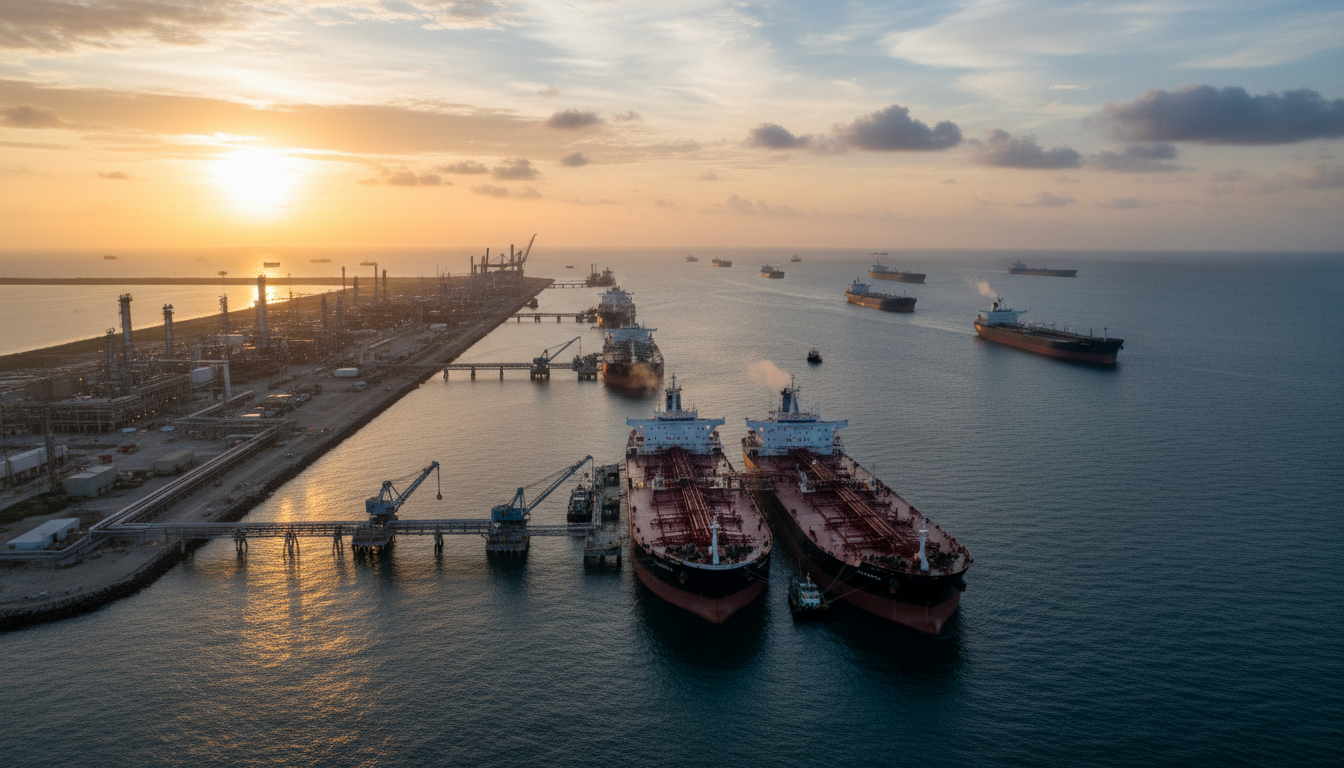
The global energy landscape is undergoing a profound reorientation, with the U.S. Gulf Coast emerging as a pivotal hub for crude oil exports as geopolitical tensions in the Middle East escalate. Investors in the oil and gas sector are closely monitoring the dramatic shift in shipping patterns, particularly the unprecedented activity at the Port of Corpus Christi, which now stands at the forefront of supplying international markets.
A recent snapshot captures this dynamic perfectly: the crude oil tanker Perseus Star departing from Corpus Christi, Texas, in late February 2026. This image encapsulates the surging demand that has transformed the Texas port into a critical artery for global energy flows, responding directly to the supply disruptions emanating from the Iran conflict.
Corpus Christi: A New Global Energy Anchor
Before the current conflict, the Port of Corpus Christi had already established itself as a significant player, ranking as the third-largest oil export terminal worldwide. Its stature was only surpassed by Saudi Arabia’s Ras Tanura and Iraq’s Basra. However, the ongoing hostilities and Iran’s effective blockade of the Strait of Hormuz have fundamentally altered this hierarchy, largely severing the critical Persian Gulf ports from the world market.
This geopolitical upheaval has propelled U.S. crude oil exports to record levels, underscoring the indispensable role of the Gulf Coast. Data from Kpler reveals a staggering increase, with U.S. oil exports climbing to 5.2 million barrels per day (bpd) in April. This represents a robust increase of over 30% compared to the 3.9 million bpd exported in February, prior to the war’s escalation.
Kent Britton, CEO of the Port of Corpus Christi, confirmed the extraordinary operational intensity. March marked the busiest single month in the port’s history, contributing to its most active first quarter ever. Since the onset of the conflict, oil exports from Corpus Christi alone have surged to approximately 2.5 million bpd, a notable rise from the 2.2 million bpd recorded during the same period last year. The port’s vessel traffic mirrored this growth, with over 240 ships calling in March, a significant jump from its typical monthly average of around 200 vessels. Britton characterized the scene as a “constant parade of tankers,” vividly illustrating the relentless pace of operations.
Asian Demand Drives Tanker Traffic to U.S. Shores
The U.S. Gulf Coast has become the destination of choice for a burgeoning fleet of Very Large Crude Carriers (VLCCs), each capable of transporting up to 2 million barrels of oil. Kpler’s data indicates that between 50 and 60 VLCCs are currently en route to U.S. ports on any given day, a volume that has doubled compared to the previous year. This dramatic increase highlights the unprecedented demand for U.S. crude.
Corpus Christi has spearheaded this export surge, accounting for roughly half of total U.S. crude oil exports in April, with Houston handling the majority of the remaining volume. A significant portion of these tankers originates from Asian nations, which traditionally relied heavily on Middle Eastern crude supplies. With the Strait of Hormuz effectively closed to conventional trade routes, these Asian buyers are now turning to the U.S. Gulf Coast as a crucial alternative source.
Matt Smith, director of commodity research at Kpler, noted that Asian markets are exhibiting a fervent appetite for available crude, readily purchasing large volumes of light sweet crude. This underscores the urgency of their supply needs in the face of Middle East disruptions. Furthermore, Corpus Christi has observed a substantial uptick in refined product exports directed toward the Middle East itself, with the first quarter of the year already exceeding the total volume exported throughout the entirety of the previous year. This two-way trade highlights the complex reordering of global supply chains under duress.
Navigating Export Limits and Long-Term Realities
While the U.S. Gulf Coast’s surge in exports provides a critical lifeline, energy market analysts widely view this re-routing of global oil trade as a crisis-driven, rather than permanent, realignment. Several factors suggest that this temporary pivot may face significant limitations.
One primary challenge lies in the nature of the crude itself. The light sweet crude produced in the U.S. is not an ideal substitute for the heavier, sourer barrels typically sourced from the Middle East. Many Asian refineries are specifically configured and optimized to process heavier feedstocks, making the transition to U.S. light sweet crude less efficient and potentially more costly. This forces refiners to adapt their processes, impacting profitability and operational throughput.
Moreover, physical infrastructure imposes definitive constraints on U.S. export capacity. Smith projects that total U.S. oil exports are likely capped just above 5 million bpd due to existing dock infrastructure limitations. Specifically, Corpus Christi’s export capacity maxes out at approximately 2.6 million bpd, primarily constrained by pipeline access. While CEO Britton suggested that expanding pipeline infrastructure could potentially add another 500,000 bpd to the port’s capacity, such projects require significant time and capital investment.
Ultimately, analysts concur that while the U.S., along with incremental supplies from Latin America and West Africa, can help mitigate some of the supply shortfall for Asian buyers, these regions simply cannot replace the sheer volume historically provided by the Middle East. Before the current conflict, roughly 20% of global oil supplies transited through the Strait of Hormuz. This monumental volume represents a void that cannot be fully plugged by alternative sources.
The consensus among experts is clear: the current situation reveals an unfillable gap in global supply that necessitates a return to stability. Ensuring secure and consistent supply from the Middle East remains the only sustainable long-term solution for global energy markets, underscoring the profound vulnerability introduced by geopolitical instability in the region.


