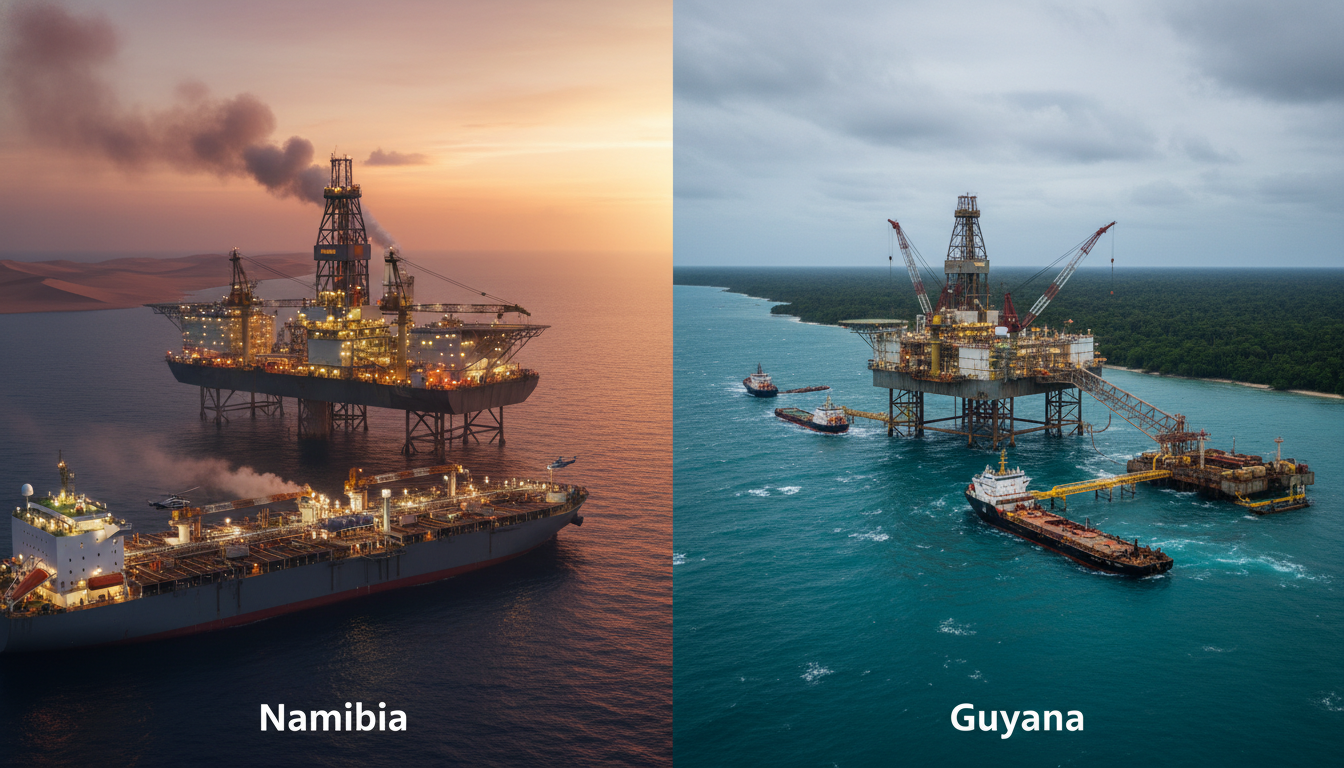
The Dual Horizons: Guyana and Namibia Reshaping Global Oil Supply Dynamics
Investors tracking the global upstream sector are keenly focused on two burgeoning regions that stand to define the next wave of petroleum supply: Guyana and Namibia. These two nations, each boasting significant offshore discoveries, have successfully drawn the attention and capital of the world’s largest integrated oil companies. Their emergence marks a pivotal moment in how capital flows into frontier exploration, yet their investment profiles and timelines diverge dramatically, presenting distinct opportunities and considerations for those navigating the energy markets.
Guyana: A Proven Benchmark for Oil & Gas Development
Guyana has swiftly transitioned from a frontier exploration hotspot to a firmly established, world-class oil province. Its trajectory since the initial major discovery in 2015 within the prolific Stabroek Block represents one of the most remarkable oil development success stories in recent history. Production has witnessed an extraordinary ramp-up, escalating from an initial zero to now well over 600,000 barrels per day. The clear operational roadmap projects an output exceeding 1 million barrels per day before the end of this decade, underscoring the basin’s immense potential and the operators’ ambitious yet achievable targets.
What truly distinguishes Guyana is the exceptional speed and efficiency of project execution. Discoveries have moved to full-scale development with unparalleled alacrity. Development costs have remained highly competitive, enhancing the profitability of new projects. Furthermore, critical infrastructure has expanded seamlessly alongside the rapid increase in production capacity. The consortium operating the Stabroek Block, spearheaded by industry titans ExxonMobil, Hess, and CNOOC, has established a consistent and repeatable development model that minimizes risks and maximizes returns. This demonstrable success has attracted tens of billions of dollars in investment, as capital reliably follows certainty and a proven path from subsurface resources to significant revenue streams.
Namibia: The Early-Stage Opportunity with Multi-Billion-Barrel Potential
While Guyana sets the pace, Namibia stands earlier on its developmental curve, yet it holds no less compelling a narrative for future growth. Recent offshore discoveries in the promising Orange Basin, notably by TotalEnergies, Shell, and Galp, have unequivocally confirmed the presence of a new, highly prospective petroleum system. Industry analysts frequently draw parallels between Namibia’s current geological promise and the nascent stages of Guyana’s remarkable journey, pointing to potential reserves in the multi-billion-barrel range.
However, it is crucial for investors to recognize that Namibia currently remains firmly in the appraisal phase. The country has not yet commenced large-scale oil production, nor does it possess established export infrastructure ready to support significant output. A fully defined development timeline is still taking shape. What currently defines Namibia’s investment landscape is a palpable sense of momentum and high expectation surrounding these significant finds. Capital is indeed flowing into the region, though with a more measured approach compared to Guyana’s advanced stage. If Guyana epitomizes proven execution, Namibia represents substantial upside potential, albeit with the inherent risks of earlier-stage exploration and appraisal.
Divergent Investment Narratives: Execution vs. Discovery
The operational strategies of leading oil majors distinctly highlight the differing investment profiles of these two nations. In Guyana, ExxonMobil strategically secured a dominant position early on, driving aggressive development that established the basin’s stability and amplified investor confidence. The scale of success has reinforced this operational model, making it a compelling investment case for those seeking predictable returns from a maturing basin.
Conversely, Namibia’s narrative is more distributed. While the involvement of global powerhouses like TotalEnergies and Shell signals robust confidence in the resource, these companies, alongside others, are still actively engaged in defining the precise scale and commercial viability of the discoveries. Their current activities are essentially exploration and appraisal bets, carrying a higher risk profile but also offering potentially transformative rewards should these prospects transition to full development.
This fundamental distinction in development stage translates directly into differing capital allocation strategies. Guyana now presents a compelling development story, attracting investment directed towards critical infrastructure, expanded production capacity, and predictable cash-flow generation. Here, the investment risk is comparatively lower, returns are more visible, and project timelines are clearly delineated, making it attractive for investors focused on harvesting stable, long-term returns.
Namibia, on the other hand, embodies a pure discovery story. Capital commitment flows predominantly into drilling programs and appraisal activities. While the upside potential is significant, investors must also account for a meaningful degree of uncertainty. In essence, Guyana offers scale with clear visibility, while Namibia offers comparable scale but with elevated exploration and development risk.
Geopolitics, Infrastructure, and Growth Trajectories
Geopolitical stability, though often understated, plays a significant role in dictating the pace and nature of oil and gas development. Guyana has notably benefited from its relative internal stability and strong alignment with Western international partners, which has actively supported the rapid build-out and operational success of its energy sector. Namibia, while also a stable nation, faces the task of constructing its comprehensive regulatory framework, developing extensive export infrastructure, and establishing commercial systems largely from the ground up, all while carefully balancing domestic development priorities and stakeholder expectations.
The growth trajectories of these two dynamic regions further clarify their contrasting positions. Guyana is already making substantial contributions of crude oil to global supply and is firmly on track to emerge as one of the world’s fastest-growing hydrocarbon producers. Its impact on the international energy market is both immediate and profound.
Namibia’s projected impact, however, remains firmly in the future. Should the current development timelines hold, and assuming successful appraisal, positive final investment decisions (FIDs), a substantial build-out of infrastructure, and sustained capital commitment, Namibia possesses the potential to evolve into a major offshore producer within the next decade. This aspirational timeline underscores the patience required for investors eyeing this promising region.
A Strategic View for Oil & Gas Investors
Collectively, the rise of Guyana and Namibia signals a significant evolution in global oil supply, characterized by a renewed focus on large-scale, offshore basins that demonstrate competitive cost structures and strong backing from major international operators. Their emergence also highlights a broader, defining trend in contemporary energy finance: capital remains available for oil and gas ventures, but it is increasingly concentrating in projects that either boast a track record of proven execution or demonstrate clear, world-class potential.
Guyana has unequivocally delivered on its promise, providing a compelling model for how quickly a frontier basin can transition from initial discovery to robust, large-scale production. Namibia, in contrast, is still actively proving its commercial viability, serving as a critical test case for replicating such rapid success. For astute investors, the choice is not necessarily between one or the other but rather about precise timing and strategic positioning. Investing in Guyana today is about harvesting well-established returns and participating in a predictable growth story. Investing in Namibia is about positioning for the significant upside that lies ahead, tapping into the next frontier of major resource development. In the evolving landscape of global energy, both strategies hold undeniable relevance and merit.