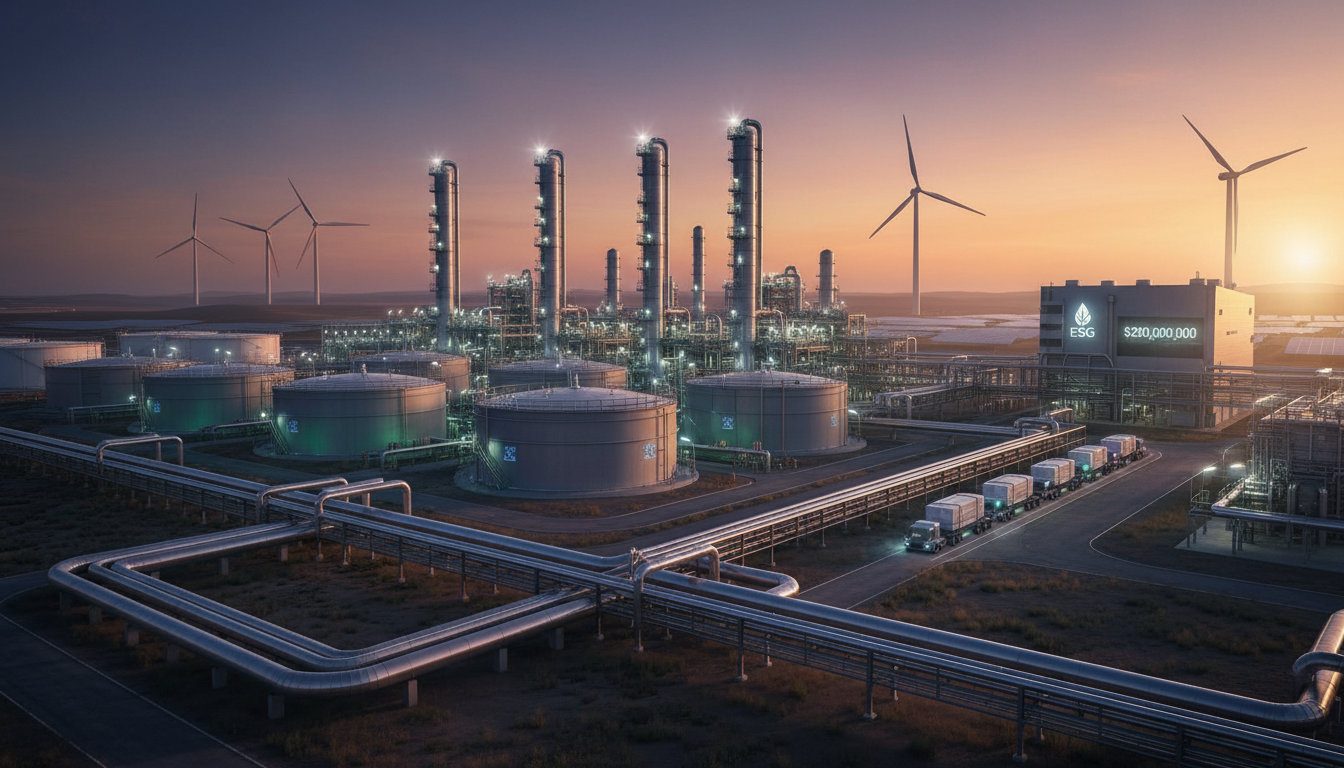
In a significant move underscoring the accelerating shift in corporate finance towards sustainability, MAIRE has successfully secured a €185 million ($200 million) sustainability-linked Schuldschein loan. This strategic financing initiative not only bolsters the company’s balance sheet but critically ties its borrowing costs directly to tangible emissions reduction targets. For investors in the dynamic oil and gas sector, this transaction offers a crucial insight into how leading firms are integrating environmental, social, and governance (ESG) metrics into their core financial strategy, navigating the complexities of energy transition while optimizing capital structure. This analysis delves into the mechanics of this groundbreaking deal, its implications for MAIRE, and the broader signals it sends to the market.
Strategic Financing Aligns Capital with Decarbonization Goals
MAIRE’s latest financing comprises a privately placed, senior unsecured loan structured across two tranches, offering three- and five-year maturities. The pricing is set at competitive margins of 1.50% and 1.70% over six-month Euribor, respectively. What truly differentiates this facility, however, is the direct linkage of these margins to the company’s ability to achieve specific emissions targets. This innovative structure effectively embeds climate accountability directly into MAIRE’s capital costs, creating a powerful financial incentive for decarbonization.
The proceeds from this sustainability-linked loan are primarily earmarked for refinancing existing facilities. This move is anticipated to improve the group’s average cost of debt while simultaneously enhancing its liquidity flexibility. By replacing conventional debt with a sustainability-linked instrument, MAIRE is not just optimizing its financial health but is also reinforcing its commitment to its Sustainability-Linked Financing Framework, initially introduced in October 2025. This framework establishes a clear connection between access to capital and measurable environmental outcomes, setting a precedent for responsible corporate finance in the energy sector.
Under the terms of the agreement, MAIRE faces a margin step-up if it fails to meet two pivotal targets by the end of 2028. These include a substantial 28% reduction in Scope 1 and Scope 2 emissions, measured against a 2024 baseline. Furthermore, the company commits to ensuring that 20% of its suppliers, calculated based on emissions from purchased goods and services, adopt science-based targets. This dual focus on direct operational emissions and supply chain decarbonization highlights a comprehensive approach to climate risk management, reflecting a broader trend in credit markets where lenders are increasingly incorporating ESG performance into their pricing models.
Market Confidence Amidst Evolving Energy Dynamics
The successful closure of this €185 million facility signals robust market confidence in MAIRE’s strategy and the growing appetite for sustainability-linked debt. The transaction attracted significant participation from a diverse range of banks and financial institutions spanning Europe, Asia, and the Middle East. This global demand underscores the resilience and increasing mainstream acceptance of ESG-linked instruments, even amidst periods of tighter financing conditions. Notably, the involvement of Italy’s state-backed lender, Cassa Depositi e Prestiti, further emphasizes the policy alignment and strategic importance behind such deals, linking corporate financing strategies with national sustainability agendas.
This strong demand for green financing is particularly noteworthy when viewed against the backdrop of the broader energy market. As of today, Brent Crude trades at $100.99, marking a 1.88% increase, while WTI Crude stands at $95.92, up 1.61%. This upward trend for Brent, which has seen prices climb from $94.75 on April 8 to $101.28 on April 26, represents a 6.9% gain over the past two weeks. The continued strength in traditional crude markets, alongside the robust demand for sustainability-linked debt, paints a complex but clear picture for investors: capital is flowing into both short-term energy security and long-term decarbonization efforts. MAIRE’s move demonstrates a strategic ability to tap into the capital pools dedicated to the energy transition, positioning the company for growth in a dual-track energy future where both conventional and renewable energy solutions play critical roles.
Investor Focus: Decoding Future-Proofing in Energy
Our proprietary reader intent data reveals that investors are keenly focused on understanding the future trajectory of energy markets. Key questions this week revolve around developing a base-case Brent price forecast for the next quarter, identifying catalysts that could push Brent below $80 or above $120, and critically, assessing the long-term impact of electric vehicle (EV) adoption on oil demand projections. MAIRE’s sustainability-linked loan directly addresses these forward-looking concerns by demonstrating a proactive approach to future-proofing its business model.
For investors grappling with the implications of EV adoption and the broader energy transition, MAIRE’s strategic financing provides a compelling example of how companies in the extended energy value chain are adapting. By tying financing costs to emissions reductions, MAIRE signals its commitment to mitigating climate-related risks and capitalizing on opportunities arising from decarbonization. This not only enhances the company’s ESG profile but also potentially lowers its cost of capital over the long term, offering a more attractive investment proposition in a world increasingly scrutinizing carbon footprints. It suggests that while investors are still navigating the immediate volatility of crude prices, they are simultaneously prioritizing companies that are actively managing their transition risks and securing competitive financing for a less carbon-intensive future.
Forward Outlook and Upcoming Market Catalysts
MAIRE’s successful securing of this sustainability-linked loan provides a stable financial foundation as the energy sector continues its evolution. This proactive financing strategy enables the company to pursue its growth initiatives, particularly in areas related to sustainable technology solutions, with greater certainty regarding capital costs. The ability to lock in favorable rates tied to ESG performance now could prove a significant competitive advantage in the coming years, especially as global interest rates and financing conditions remain dynamic.
While MAIRE’s long-term strategy is firmly set, the broader energy market will continue to provide immediate catalysts. Investors will closely watch upcoming data releases that influence short-term market sentiment and supply-demand balances. The API Weekly Crude Inventory report on April 28, followed by the EIA Weekly Petroleum Status Report on April 29, will offer fresh insights into U.S. crude stockpiles and refinery activity. The Baker Hughes Rig Count on May 1 will provide a pulse on North American drilling activity. Perhaps most impactful for forward-looking analysis will be the EIA Short-Term Energy Outlook released on May 2, which will offer updated supply, demand, and price forecasts for crude oil and natural gas. These events, recurring again with API and EIA reports on May 5 and May 6, and another Baker Hughes count on May 8, serve as critical short-term market indicators. MAIRE’s strategic financing, however, positions it to weather these short-term market fluctuations more effectively, focusing on long-term value creation through sustainable growth and a resilient capital structure.


