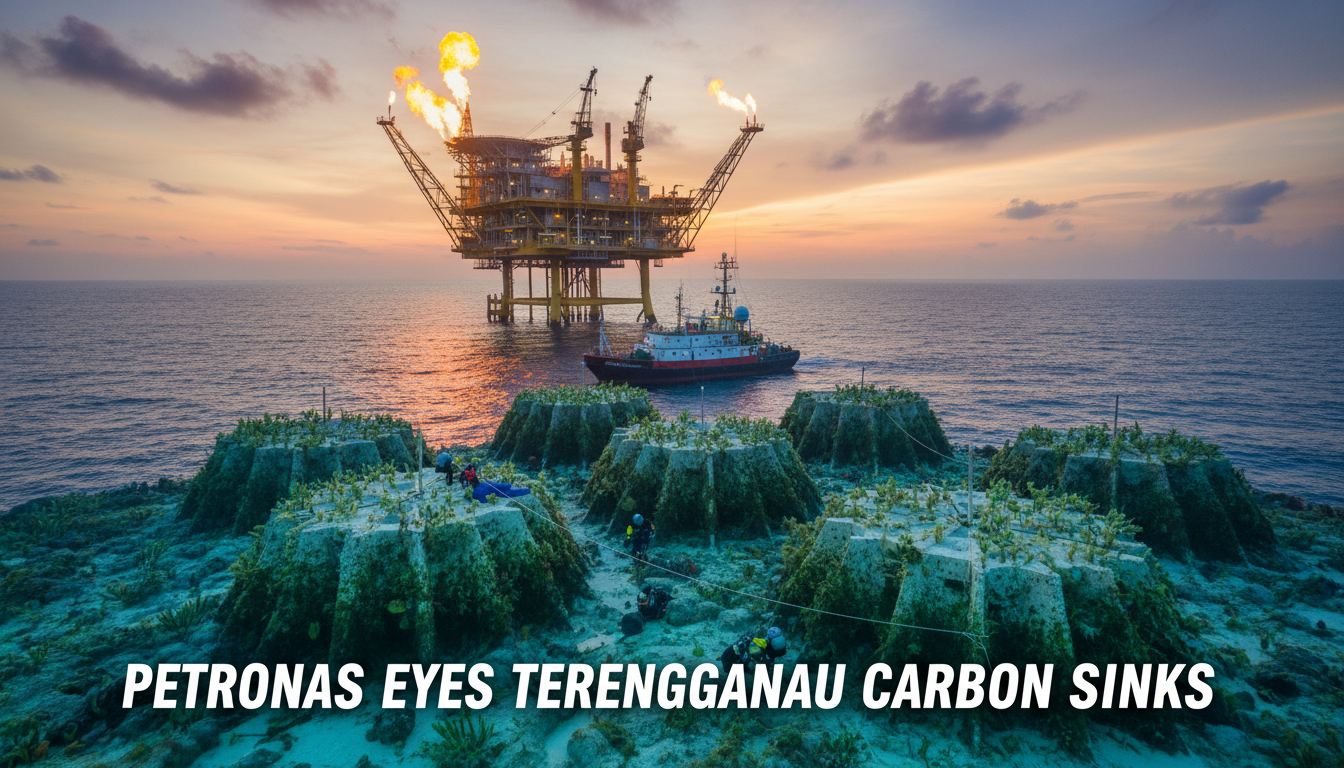
Malaysia’s national oil and gas giant, Petronas, is strategically expanding its portfolio beyond traditional hydrocarbons, making significant strides into the rapidly evolving carbon management sector. This dual-pronged approach, encompassing both nature-based solutions (NbS) in Terengganu and pioneering Carbon Capture, Utilization, and Storage (CCUS) projects offshore, signals a clear commitment to its Net Zero Carbon Emissions by 2050 pathway. For investors, these initiatives represent not just a compliance exercise, but a calculated move to diversify revenue streams, mitigate future climate-related risks, and establish Malaysia as a regional leader in the burgeoning carbon economy. As the global energy landscape continues its dynamic shift, understanding these strategic pivots is crucial for assessing long-term value.
Terengganu’s Green Capital: Nature-Based Carbon Solutions
Petronas recently formalized a memorandum of understanding (MoU) with the state of Terengganu, a move designed to leverage the state’s rich natural ecosystems for generating high-quality carbon credits. This collaboration focuses on identifying and assessing potential sites across Terengganu for nature-based carbon projects. The underlying goal is two-fold: to create internationally recognized carbon credits and to deliver tangible benefits directly to local communities, while simultaneously bolstering environmental conservation efforts. This strategy is more than just an offset mechanism; it’s an investment in ecological preservation that yields verifiable carbon assets.
For Petronas, these nature-based carbon credits are an integral component of its broader strategy to address residual and hard-to-abate emissions, aligning directly with its ambitious Net Zero Carbon Emissions by 2050 target. The emphasis on “high-quality” credits suggests a focus on projects that meet stringent international certification standards, which is vital for their market liquidity and investor confidence. This initiative positions Terengganu, and by extension Malaysia, as a significant player in the nature-based carbon market, a sector expected to see substantial growth as more corporations commit to decarbonization.
Malaysia’s CCUS Ambition: The Duyong Pioneer Project
Parallel to its nature-based endeavors, Petronas is making significant headway in industrial-scale carbon capture. A landmark development occurred last year when Petronas received regulatory approval for a permit to evaluate the potential of the Duyong field, located offshore Peninsular Malaysia. This is a critical milestone, being the inaugural permit issued under Malaysia’s newly enacted Carbon Capture, Utilization and Storage Act (Act 870), which became effective on October 1, 2025. This legislative framework provides the necessary regulatory certainty for substantial investments in CCUS technology.
The permit empowers Petronas, in partnership with Mitsui & Co Ltd and TotalEnergies SE, to conduct comprehensive offshore geological assessments at Duyong. This forms part of the planned offshore Southern CCS hub and is a direct follow-up to a key principles agreement (KPA) signed in July 2025. This partnership is laying the groundwork for the front-end engineering design (FEED) phase for the Duyong area, signaling concrete progress toward deployment. The ultimate vision for this collaboration is to establish the first-of-its-kind integrated CCS solution for industries across the Asia Pacific region, positioning Malaysia as a regional leader in cross-border CO2 collaboration and a responsible energy transition.
Navigating Volatility: Strategic Imperatives in a Shifting Market
The strategic pivot by Petronas into carbon management is particularly pertinent against the backdrop of current market dynamics and investor sentiment. As of today, Brent Crude trades at $99.13, reflecting a -0.22% movement for the day within a range of $97.55 to $101.32. WTI Crude is at $94.4, down -1.51%, fluctuating between $92.68 and $97.85. This immediate market snapshot follows a notable trend: Brent has experienced a decline of approximately 8.7% over the past 14 days, moving from $109.27 on April 7, 2026, to $99.78 on April 24, 2026. This recent bearish pressure underscores the inherent volatility in crude markets, a key concern for investors.
Our proprietary reader intent data reveals that investors are keenly focused on these price movements, frequently asking about the immediate trajectory of WTI crude and the drivers that could push Brent below $80 or above $120. Beyond short-term fluctuations, a more profound concern is the long-term impact of EV adoption on future oil demand projections. Petronas’s investments in NbS and CCUS directly address these strategic anxieties. By diversifying into carbon credits and storage, the company is building resilience against potential future reductions in fossil fuel demand and hedging against the increasing cost of carbon. This proactive stance is crucial for maintaining long-term shareholder value in a decarbonizing global economy, offering a strategic layer of insulation from purely commodity-driven revenue.
The Road Ahead: Upcoming Catalysts and Long-Term Value
While the immediate market will be influenced by upcoming data releases such as the API Weekly Crude Inventory on April 28, 2026, and May 5, 2026, the EIA Weekly Petroleum Status Report on April 29, 2026, and May 6, 2026, and the Baker Hughes Rig Count on May 1, 2026, and May 8, 2026, these are short-term indicators. For investors evaluating Petronas, the longer-term strategic narrative built around carbon management holds significantly more weight.
The EIA Short-Term Energy Outlook, due on May 2, 2026, might offer some perspective on near-term demand, but it’s Petronas’s foundational investments in carbon infrastructure that are truly future-proofing its business model. The successful implementation of the Duyong CCUS project, particularly as it moves from geological assessment to the FEED phase, will serve as a significant catalyst, demonstrating tangible progress in establishing a viable carbon capture ecosystem. Similarly, the identification and certification of nature-based projects in Terengganu will translate into verifiable carbon credit generation, adding a new, sustainable revenue stream. These initiatives, supported by progressive legislation like the CCUS Act 2025, position Petronas not just as an energy producer, but as a comprehensive energy and carbon solutions provider, creating durable value for investors well into the future.


