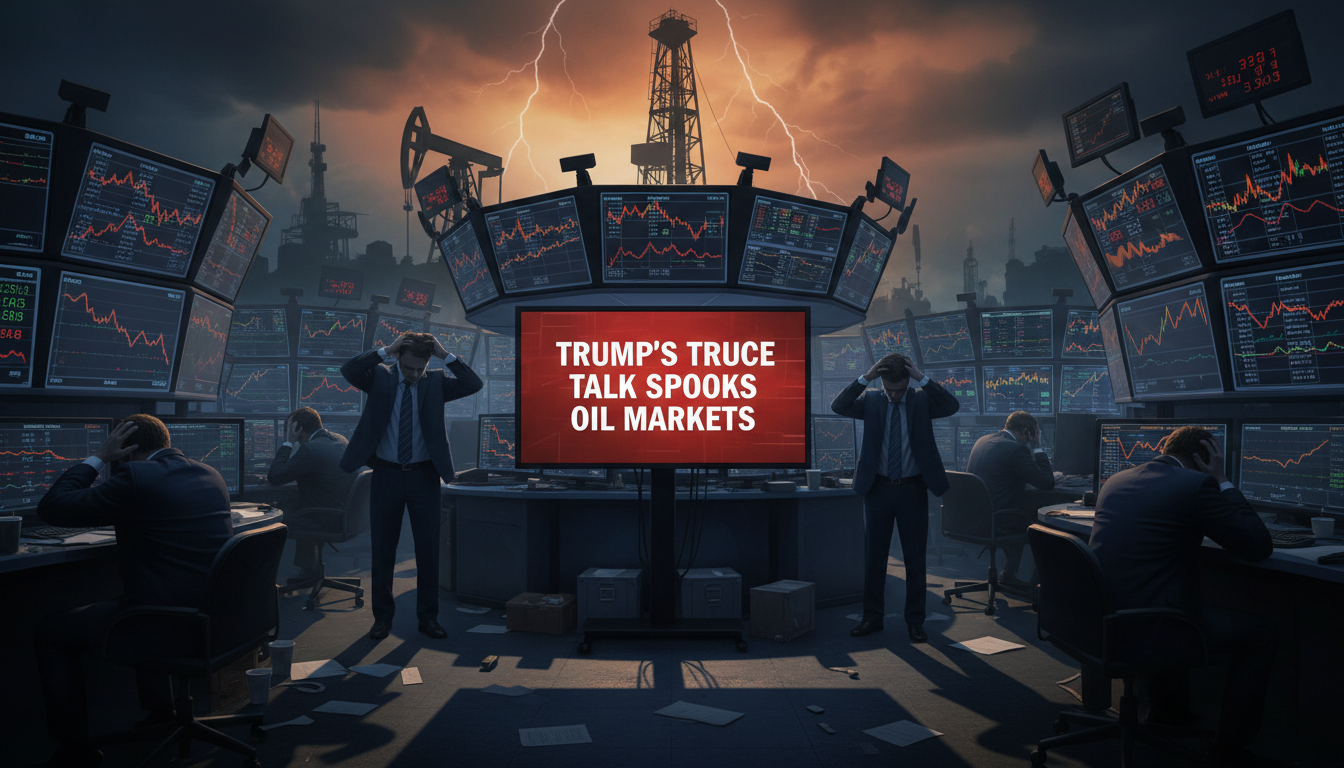
Trump’s Ceasefire Warning Jolts Oil Futures: Navigating Geopolitical Headwinds
The global oil market finds itself at a critical juncture, as statements from U.S. President Donald Trump regarding the imminent expiration of the U.S.-Iran ceasefire inject a fresh wave of geopolitical uncertainty into an already volatile landscape. Investors are now closely scrutinizing every development, weighing the potential for renewed tensions in the Middle East against prevailing demand-side concerns. This analysis delves into the implications of the expiring truce, the market’s immediate reaction, and what energy investors should monitor in the coming days, leveraging proprietary market data and forward-looking event insights.
The Geopolitical Pressure Cooker: Ceasefire Nears Expiration
President Trump’s declaration that it is “highly unlikely” the U.S.-Iran ceasefire will be extended beyond its “Wednesday evening Washington time” deadline has sent a clear signal of escalating risk. The truce, initially announced on April 7, was widely expected to conclude earlier, but the President’s clarification pushes the deadline slightly, offering a brief, tense reprieve. Crucially, President Trump emphasized that he is “not going to be rushed into making a bad deal” and that the U.S. has “all the time in the world,” indicating a firm negotiating stance. A central point of contention remains the Strait of Hormuz, the world’s most vital oil shipping lane. The U.S. maintains its naval blockade, with President Trump stating it will not be opened “until a deal is signed.”
This hardline position directly clashes with Iran’s demands. Iran’s First Vice President, Mohammad-Reza Aref, recently underscored the principle that “The security of the Strait of Hormuz is not free. One cannot restrict Iran’s oil exports while expecting free security for others.” Aref’s stark warning – “The choice is clear: either a free oil market for all, or the risk of significant costs for everyone” – highlights the potential for Iranian retaliation if its oil exports remain constrained. The closure of the Strait, even temporarily, could immediately remove a substantial portion of global crude supply, triggering a sharp price surge.
Market’s Muted Reaction: A Tense Pause
Despite the explicit warnings and the looming deadline, the immediate market reaction has been surprisingly subdued, reflecting a cautious optimism or perhaps a wait-and-see approach among traders. As of today, Brent Crude trades at $99.13, registering a slight decline of 0.22% within a day range of $97.55 to $101.32. Similarly, WTI Crude stands at $94.4, down 1.51% for the day, fluctuating between $92.68 and $97.85. Gasoline prices also saw a minor dip, trading at $3.33, down 0.3%.
This current price action, while showing modest downward pressure, stands in contrast to the significant geopolitical risk unfolding. The 14-day trend for Brent crude reveals a more notable decline, dropping from $109.27 on April 7 to $99.78 on April 24, a decrease of approximately 8.7%. This broader trend suggests that while current events are a concern, other factors, perhaps related to global demand outlooks, have been exerting downward pressure. However, the comments from ING’s commodity strategists, Warren Patterson and Ewa Manthey, who noted “Too much hope, perhaps” regarding market expectations for resumed U.S.-Iran talks, resonate strongly. This muted response could be a calm before a potential storm, underscoring the market’s delicate balance between hopeful diplomacy and the very real threat of supply disruption.
Investor Crossroads: Navigating Supply Risk and Demand Signals
The current U.S.-Iran dynamic directly addresses core investor questions regarding oil price trajectories. Many investors are asking what factors could push Brent below $80 or above $120. The impending expiration of the ceasefire and the standoff over the Strait of Hormuz represent a clear and immediate catalyst for significant upside price movement. A full closure or even sustained disruptions in the Strait of Hormuz could easily push Brent well above $120, as millions of barrels of crude are transported through this choke point daily. The threat to Iran’s oil exports, coupled with the potential for regional instability, creates a potent supply-side risk that cannot be ignored.
Conversely, a peaceful resolution, perhaps an eleventh-hour deal or a significant de-escalation, could alleviate this immediate geopolitical premium, potentially allowing Brent to drift lower, especially if global demand concerns persist. While long-term factors like EV adoption certainly influence extended demand projections, the short-to-medium term volatility for oil prices, particularly WTI, will remain heavily influenced by these geopolitical flashpoints. The current market sentiment reflects a precarious balance, where the absence of a deal could quickly flip the narrative from cautious optimism to genuine fear of supply shocks.
Forward Watch: Key Calendar Events and Market Volatility
As the U.S.-Iran ceasefire teeters on the brink, investors must also keep a keen eye on the upcoming energy calendar, though any major geopolitical development could easily overshadow these scheduled reports. This week brings the API Weekly Crude Inventory report on Tuesday, April 28, followed by the crucial EIA Weekly Petroleum Status Report on Wednesday, April 29. These reports will provide vital insights into U.S. supply and demand dynamics, including inventory levels, refinery utilization, and product supplied, offering a snapshot of domestic market health.
Looking ahead, the Baker Hughes Rig Count on Friday, May 1, will shed light on U.S. drilling activity and future production trends. The EIA’s Short-Term Energy Outlook on Saturday, May 2, will offer a broader perspective on supply, demand, and price forecasts. These will be followed by another round of API and EIA inventory data on May 5 and May 6, respectively, and another Baker Hughes report on May 8. While these are essential data points for understanding fundamental market drivers, any significant escalation or de-escalation in the U.S.-Iran situation could instantly shift market focus, leading to rapid price swings that override the impact of inventory changes. Investors should be prepared for heightened volatility, especially around the Wednesday evening deadline.


