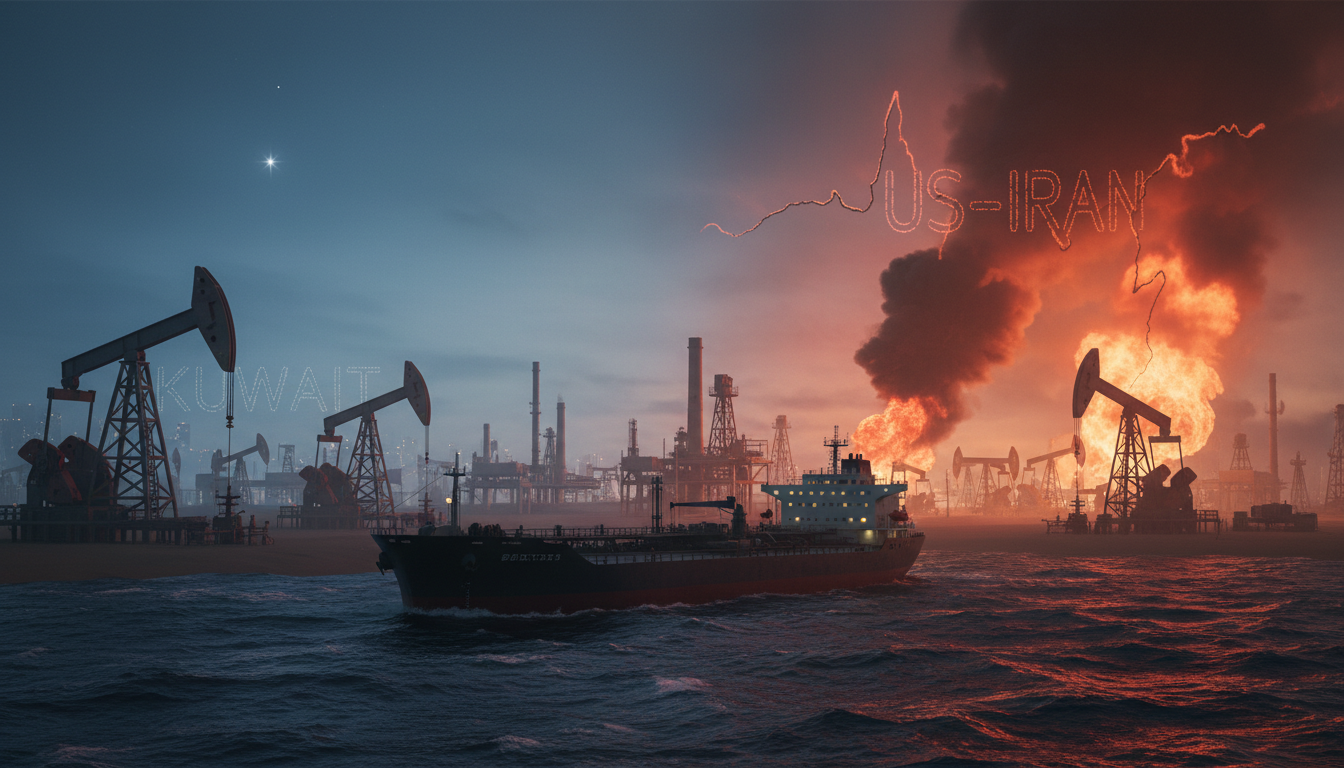
The global oil market is once again confronting a significant supply shock, as recent geopolitical developments in the Persian Gulf have triggered Kuwait’s declaration of force majeure on crude oil and refined product shipments. This critical action, driven by disruptions within the Strait of Hormuz, underscores the persistent fragility of Middle Eastern oil flows and sends a clear signal to investors about escalating risk premiums. While oil prices have seen some intra-day volatility, the underlying current of supply fear is now undeniable, demanding close attention from market participants.
Escalating Tensions and Supply Chain Vulnerabilities
Kuwait Petroleum Corporation (KPC) has officially invoked contractual clauses, notifying its customers of the need to withhold certain scheduled deliveries. This move follows an intensification of tensions within the Strait of Hormuz, a vital chokepoint for global oil trade. The direct catalyst for this latest escalation was the U.S. seizure of an Iranian-flagged cargo vessel in the waterway, which Iran views as a provocative act. While KPC’s force majeure is not anticipated to result in a complete cessation of supply, it signifies a tangible disruption to the established flow of crude and products from a major OPEC producer.
The situation has been exacerbated by Iran’s resolute stance, linking the security of shipping in the Strait of Hormuz directly to the ongoing pressure on its own crude exports. Iran has explicitly warned that it cannot guarantee safe passage if its oil exports remain restricted, rejecting immediate prospects for new negotiations following the U.S. vessel seizure. This diplomatic impasse, despite President Donald Trump’s efforts to send a delegation led by Vice President JD Vance to Islamabad for talks, perpetuates an environment of high uncertainty. Shipping operators are already reassessing transit risks and altering routes, highlighting the operational impact of this renewed volatility on one of the world’s most critical maritime pathways for energy.
Market Reaction Amidst Broader Volatility
The immediate market response to these supply disruptions has been complex, playing out against a backdrop of recent price trends. As of today, Brent Crude trades at $99.13, reflecting a modest intraday decline of 0.22%, with its daily range spanning $97.55 to $101.32. Similarly, WTI Crude is at $94.4, down 1.51% for the day, having traded between $92.68 and $97.85. Gasoline prices also registered a slight dip, standing at $3.33, down 0.3%.
However, it is crucial for investors to contextualize these intraday movements within a broader trend. Over the past two weeks, Brent crude experienced a notable depreciation, falling by 8.7% from $109.27 on April 7th to $99.78 on April 24th. This significant retreat had established a bearish momentum, driven by various factors prior to the current Strait of Hormuz crisis. The latest force majeure declaration and heightened geopolitical risks are now introducing a powerful counter-force, potentially arresting or even reversing this downtrend. The rebound observed in early trading sessions following the news, despite today’s slight correction, suggests that the market is quickly repricing the elevated supply risk, indicating that fundamental geopolitical concerns are once again taking precedence over other bearish drivers.
Geopolitics and the Investment Horizon: What’s Next?
Investors are keenly observing how these geopolitical tremors will influence future price trajectories, with many asking what factors could push Brent below $80 or above $120. The current standoff in the Strait of Hormuz provides a direct answer to the latter. Continued friction and the explicit threat of further export restrictions from Iran, coupled with actions like Kuwait’s force majeure, significantly inflate the geopolitical risk premium embedded in crude prices. Should the situation escalate further, leading to more prolonged or severe disruptions, the probability of Brent crude pushing towards or even exceeding the $120 mark becomes substantially higher. This scenario hinges on the durability of Iran’s resolve and the lack of a diplomatic breakthrough in the broader US-Iran negotiations, which remain stalled as Iran insists on the lifting of U.S. blockades on its ports as a precondition for any comprehensive ceasefire discussions.
Conversely, a swift de-escalation or a return to diplomatic channels that meaningfully reduce tensions could see this risk premium dissipate, potentially allowing prices to retreat. However, the current rhetoric and actions suggest a protracted period of elevated risk. The market will be watching closely for any signs of progress or further deterioration in the diplomatic efforts, including those initiated by Vice President Vance, as these will be critical determinants for crude’s near-term direction. For the bullish case, the persistence of supply interruptions combined with strong global demand could be the catalyst to drive prices significantly higher, while a resolution to the geopolitical tensions combined with a demand slowdown would be required to see prices dip below current levels.
Upcoming Catalysts and Inventory Watch
Beyond the immediate geopolitical headlines, investors must also monitor a series of upcoming energy events that will provide crucial insights into the market’s fundamental balance. Next week brings the API Weekly Crude Inventory report on April 28th, followed by the authoritative EIA Weekly Petroleum Status Report on April 29th. These reports will offer the first quantifiable data on how recent events, including any initial impacts from the Hormuz disruptions, are affecting U.S. crude stockpiles and overall petroleum product supplies.
Further into the first week of May, the Baker Hughes Rig Count on May 1st will shed light on North American drilling activity, signaling future supply expectations. This is swiftly followed by the EIA Short-Term Energy Outlook on May 2nd, which will provide revised forecasts for global supply and demand dynamics, potentially incorporating the heightened Middle East risks into its projections. The cycle repeats with new API and EIA reports on May 5th and 6th, and another Baker Hughes Rig Count on May 8th. In an environment of elevated supply concern, a significant draw in U.S. crude inventories reported by EIA or API would likely amplify price spikes, as it would underscore the market’s tightness at a time of geopolitical uncertainty. Conversely, a surprising build could offer some short-term relief, though likely temporary given the strategic nature of the current disruptions.
Beyond Hormuz: The Expanding Threat Landscape
While the Strait of Hormuz remains the immediate focal point, investors must also consider the broader regional risk landscape. The Iran-aligned Houthis have intensified threats to target the Bab el-Mandeb Strait, another critical chokepoint connecting the Red Sea to the Gulf of Aden. This development introduces additional layers of complexity and risk to global oil flows, potentially impacting alternative export routes for Middle Eastern crude that seek to bypass the Strait of Hormuz. A disruption in Bab el-Mandeb would not only constrain maritime trade but also exacerbate the perception of supply fragility across the entire Middle East. This expanding threat map underscores that the current geopolitical instability is not isolated but rather a systemic challenge to global energy security, demanding a holistic risk assessment from discerning investors.


