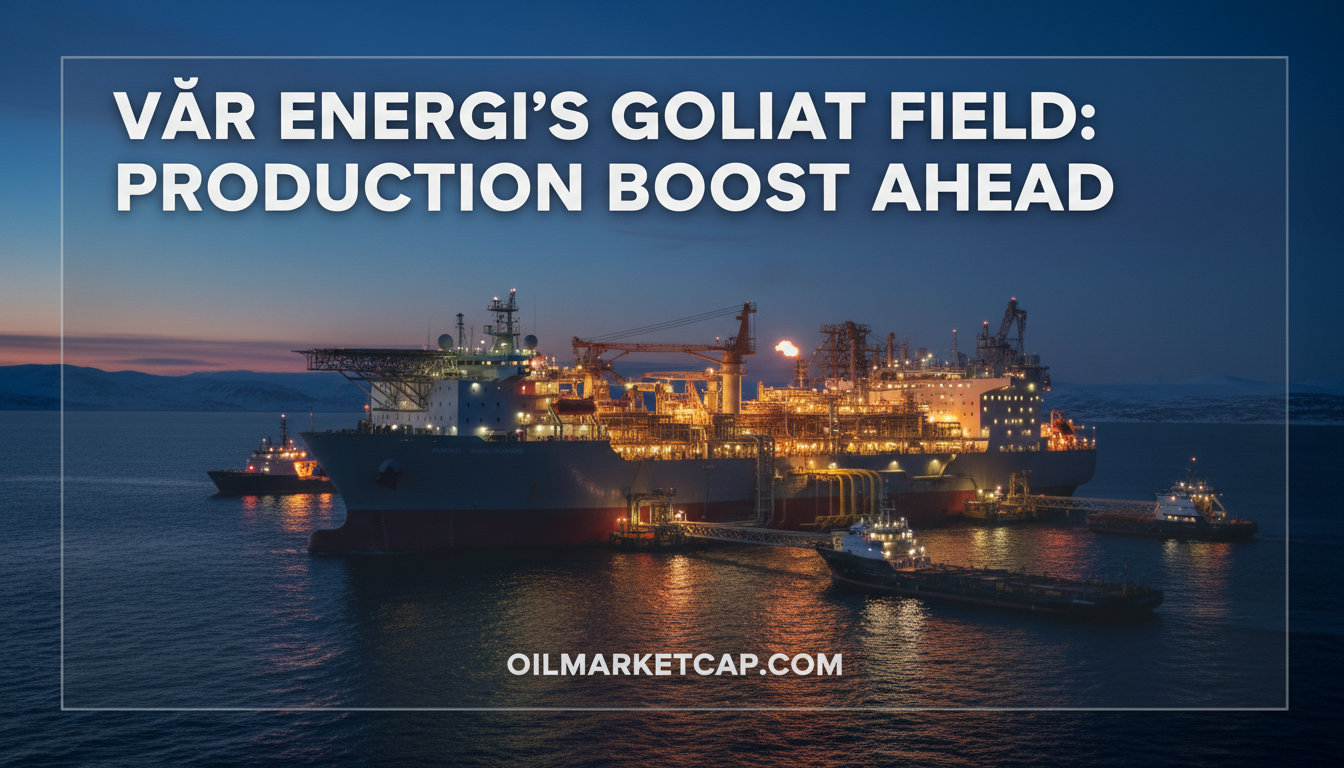
Vår Energi has signaled a significant long-term commitment to its Barents Sea operations by submitting an amended Plan for Development and Operation (PDO) for the Goliat Gas Export (GGE) project. This strategic move, undertaken in partnership with Equinor, aims to unlock substantial incremental value from the Goliat field. Investors should view this not merely as an expansion, but as a multi-faceted initiative designed to boost oil recovery, extend the field’s operational life by approximately a decade to 2050, and establish critical infrastructure for future regional developments. With an estimated gross investment of $360 million, this project reflects a calculated bet on the enduring profitability of Barents Sea resources, even as global energy markets navigate complex short-term dynamics.
Goliat Gas Export: A Blueprint for Enhanced Value
The core of Vår Energi’s latest filing centers on monetizing associated gas that is currently reinjected into the Goliat reservoir. By enabling the export of this gas, the GGE project facilitates optimized reservoir management, which in turn is expected to support higher oil production volumes from the field. This dual benefit of increased oil recovery and gas monetization underscores a prudent approach to maximizing asset value. The project targets the development of approximately 112 million barrels of oil equivalent (2P) reserves, a substantial addition that underpins the field’s extended lifespan. Gas will be transported via new subsea infrastructure, including a 12-kilometer gas export pipeline, connecting the Goliat FPSO to the existing Snøhvit system. This innovative approach leverages a gas bank arrangement to process and sell volumes through the Hammerfest LNG facility as capacity becomes available, ensuring efficient resource utilization. First production from the GGE project is slated for the third quarter of 2029, setting a long-term horizon for these returns.
Navigating Market Volatility with Long-Term Vision
Vår Energi’s investment decision comes at a time of considerable flux in the global energy markets. As of today, Brent crude trades at $95.01 per barrel, marking a robust 5.12% increase for the day, while WTI crude sits at $86.92, up 5.24%. These gains follow a period of significant downward pressure, with Brent having declined by nearly 20% from $112.78 on March 30, 2026, to $90.38 just last Friday, April 17th. This volatility highlights the challenges and opportunities facing oil and gas producers. For investors, the question of “is WTI going up or down” or “what do you predict the price of oil per barrel will be by end of 2026?” remains a constant preoccupation. However, Vår Energi’s Goliat project, with its 2029 startup and projected operational life to 2050, demonstrates a strategic perspective that transcends short-term price swings. A $360 million investment aligned with company economic targets suggests a firm conviction in the long-term demand for both oil and gas, underpinning the project’s viability even amidst day-to-day market gyrations. Furthermore, the project’s fully electrified status from shore means it will not add incremental CO₂ emissions, a critical factor for investors increasingly scrutinizing environmental performance.
Anticipating Future Market Catalysts and Investor Sentiment
The coming weeks present several key events that could influence the broader market sentiment, indirectly impacting the perceived value and future trajectory of projects like Goliat. The OPEC+ Joint Ministerial Monitoring Committee (JMMC) meeting today, April 20th, followed by the full OPEC+ Ministerial Meeting on April 25th, will be closely watched for any signals regarding production policy. Decisions from these gatherings often trigger significant price movements, which in turn shape investor confidence in the sector. Additionally, weekly data releases such as the API Crude Inventory on April 21st and 28th, and the EIA Weekly Petroleum Status Report on April 22nd and 29th, provide crucial insights into short-term supply and demand dynamics. The Baker Hughes Rig Count on April 24th and May 1st will offer an indication of North American production activity. While investors are keenly focused on questions like “how well do you think Repsol will end in April 2026,” reflecting a desire for immediate market direction, Vår Energi’s long-term play in Goliat illustrates a strategy that acknowledges the market’s cyclical nature. The project’s success hinges on a sustained favorable environment for energy prices over decades, rather than being solely dependent on the outcomes of the next few inventory reports or OPEC+ meetings. It’s a testament to the belief that, despite daily fluctuations, the fundamental demand for hydrocarbons will remain robust for decades to come.
Barents Sea Expansion and Future Growth Potential
Beyond the immediate benefits to the Goliat field, the GGE project carries significant strategic implications for the broader Barents Sea region. Vår Energi explicitly stated that the new infrastructure will support future tie-in opportunities in the area, specifically mentioning the Goliat Ridge development. This indicates that the $360 million investment is not a standalone venture but a foundational step towards unlocking further potential in a frontier region. By expanding critical export infrastructure, the project reduces the hurdles for future discoveries and developments, effectively de-risking prospective investments for Vår Energi and its partners. This forward-thinking approach aligns with the long-term energy transition narrative, ensuring that while the world moves towards cleaner energy, critical oil and gas resources are developed responsibly and efficiently. For investors, this creates optionality and potential for additional value creation beyond the initial project scope, positioning Vår Energi as a key player in the strategic development of the Barents Sea’s substantial energy endowment.