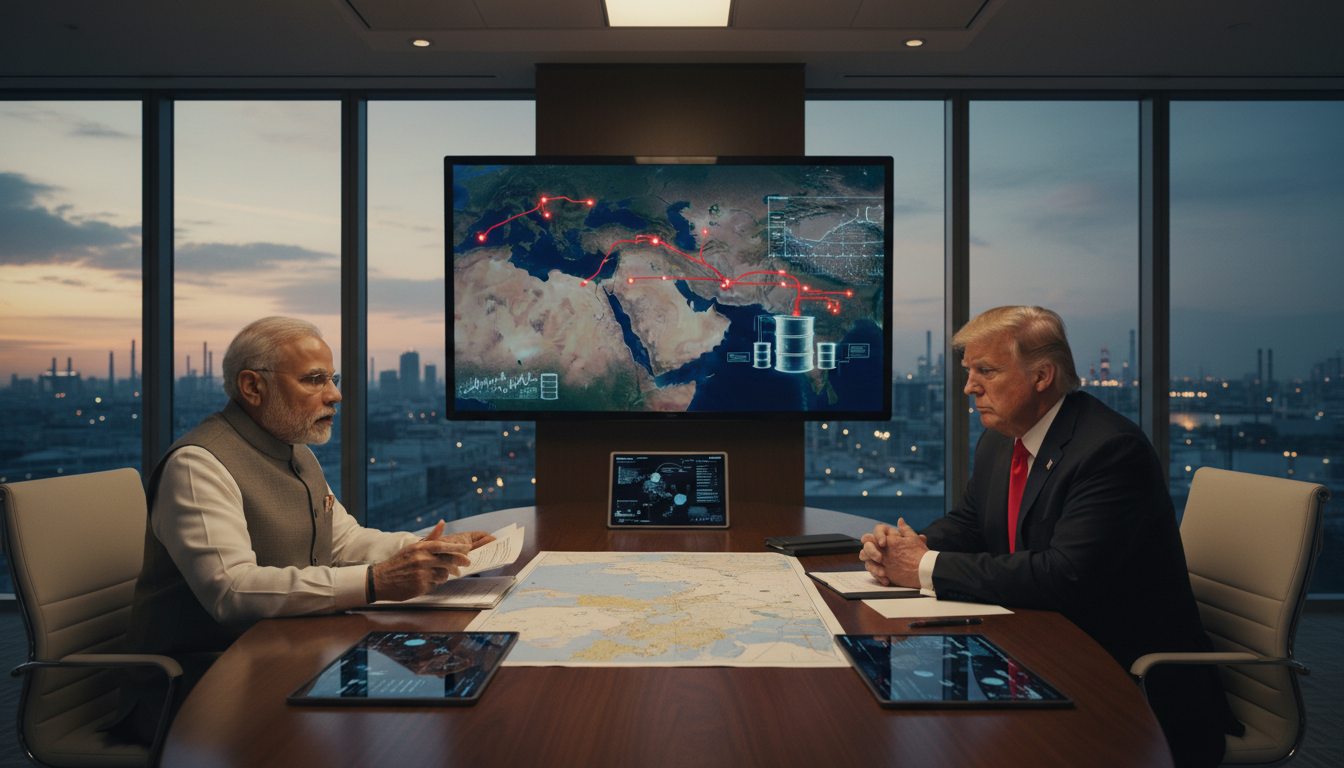
Global energy markets are once again proving their profound sensitivity to geopolitical currents, with a recent high-level telephonic discussion between Indian Prime Minister Narendra Modi and US President Donald Trump sending significant ripples through the sector. This candid 40-minute exchange centered primarily on the escalating complexities of the West Asia conflict and the critical imperative of safeguarding the Strait of Hormuz. For investors tracking the intricate dance between diplomacy, regional stability, and energy supply chains, this engagement underscores the persistent volatility inherent in the global oil and gas landscape, demanding astute analysis of both immediate events and forward-looking indicators.
Geopolitical Flashpoints Drive Volatility: The Hormuz Imperative
Prime Minister Modi’s confirmation of the productive dialogue, emphasizing mutual commitment to bolstering bilateral ties and their “Comprehensive Global Strategic Partnership,” held particular weight for energy markets. The leaders’ unequivocal focus on maintaining an open and secure Strait of Hormuz is a direct acknowledgment of its indispensable role in global energy security. This maritime chokepoint, through which approximately 20% of the world’s daily crude oil consumption and a substantial portion of liquefied natural gas (LNG) transits, is a non-negotiable artery for stable international energy prices and uninterrupted supply to key demand centers, especially across Asia.
The market’s reaction to perceived threats to this lifeline is immediate and pronounced. As of today, Brent crude trades at $95.07, marking a significant 5.19% rise from its opening. WTI crude similarly saw a strong upward movement, sitting at $86.9, up 5.22%. This daily surge provides a stark contrast to the broader 14-day trend, which saw Brent decline nearly 20% from $112.78 on March 30th to $90.38 on April 17th. This sharp rebound, following a period of decline, underscores the extreme sensitivity of prices to perceived supply risks and geopolitical developments. Gasoline prices have also followed suit, trading at $3.03, up 3.41% today. This immediate response demonstrates that geopolitical risk premiums remain a significant component of current price discovery, even as broader market forces exert downward pressure.
Failed Truce Talks Fuel Market Uncertainty and Investor Questions
The timing of the Modi-Trump call was particularly salient, occurring merely two days after high-stakes US-Iran truce negotiations in Islamabad faltered. The breakdown of these talks introduces renewed uncertainty into an already volatile region. As US Vice-President JD Vance, head of the American delegation, stated, “The bad news is that we have not reached an agreement, and I think that’s bad news for Iran much more than it’s bad news for the United States of America.” This statement carries significant weight for oil and gas investors, as continued tensions between the US and Iran directly impact the perceived risk of supply disruptions from the Persian Gulf.
In this environment of heightened geopolitical risk, our reader intent data shows that investors are keenly focused on market direction. Many are asking, “Is WTI going up or down?” and seeking predictions for the “price of oil per barrel by end of 2026.” The failure of these talks certainly injects upward pressure into the short-term outlook, as a prolonged standoff or any escalation could see immediate spikes in crude oil benchmarks. This directly impacts refining margins, profitability for exploration and production (E&P) companies, and even the cost structures for tanker operators and commodity traders due to increased maritime security measures and potential sanctions enforcement. The market is now left to grapple with an increased probability of continued, rather than de-escalated, tensions, making the short-term price trajectory highly dependent on subsequent diplomatic moves or military posturing.
Strategic Energy Partnerships and Upcoming Market Catalysts
Beyond the immediate geopolitical concerns, the dialogue between Modi and Trump also signaled promising avenues for future collaboration. US Ambassador to India, Sergio Gor, conveyed optimism regarding the impending finalization of substantial agreements between the two nations, specifically highlighting the energy sector. This points to a strategic imperative to diversify energy supply chains and secure reliable sources for rapidly growing economies like India. Such long-term partnerships, focusing on strategic energy reserves, technology transfer, and potentially even joint ventures in upstream or downstream projects, could gradually reshape global energy flows and enhance overall market stability.
Against this backdrop of high-level diplomatic engagement and regional instability, investors must keep a close eye on the upcoming energy calendar for crucial short-term signals. The OPEC+ Joint Ministerial Monitoring Committee (JMMC) is scheduled to meet on April 20th, followed by a full OPEC+ Ministerial Meeting on April 25th. These gatherings are critical for assessing global supply discipline and any potential adjustments to production quotas, which could significantly impact market balance. Furthermore, weekly data points like the API Weekly Crude Inventory reports (April 21st, April 28th) and the EIA Weekly Petroleum Status Reports (April 22nd, April 29th) will provide crucial insights into demand trends and inventory levels in key consumption regions, directly influencing short-term price movements. The Baker Hughes Rig Count on April 24th and May 1st will offer a glimpse into future production capacity, particularly in the US shale patch, which remains a swing producer.
Navigating the Path Forward: Vigilance for Oil and Gas Investors
The confluence of heightened geopolitical risk, the failure of critical diplomatic talks, and the persistent need for energy security underscores a complex and dynamic environment for oil and gas investors. While predicting the exact price of oil by the end of 2026 is inherently challenging given the multitude of interacting variables, the current geopolitical premium, coupled with the potential for demand recovery and ongoing supply management from OPEC+, suggests a resilient floor for prices. However, significant upside is simultaneously constrained by global economic growth concerns and the ongoing energy transition.
For integrated majors and E&P firms, navigating this landscape means prioritizing operational efficiency, disciplined capital allocation, and strategic hedging to mitigate volatility. Companies that can demonstrate resilience in the face of supply chain disruptions and adapt to evolving demand patterns will be best positioned. Investors should closely monitor not just headline geopolitical events, but also the granular data from upcoming inventory reports and rig counts, as these provide concrete indicators of the market’s fundamental health. The ability to discern genuine supply threats from transient political rhetoric will be paramount for informed investment decisions in the coming months.


