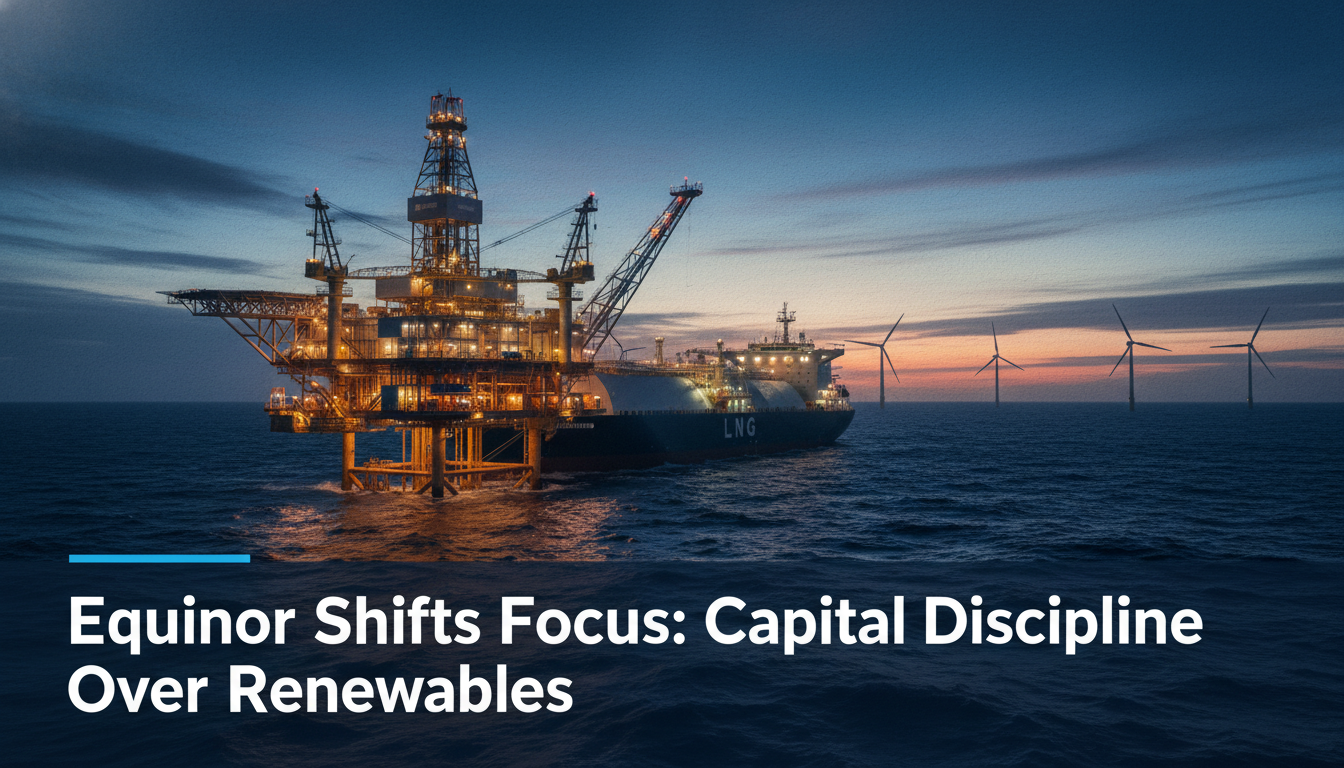
Equinor, the Norwegian energy powerhouse, recently executed a strategic divestment of a significant portion of its stake in renewable energy firm Scatec ASA, signaling a clear intensification of its capital discipline and a refined focus on shareholder value creation. This move, which saw the sale of 8.07% of its holdings, brought in gross proceeds of approximately NOK 1.6 billion, equivalent to about $150 million, at a price of NOK 125 per share. While Equinor retains an 8.05% ownership stake and has committed to a 90-day lock-up period for its remaining shares, the transaction underscores a calculated shift in its energy transition strategy – one that prioritizes agile portfolio management and optimized capital deployment in an increasingly volatile global energy market.
Capital Reallocation Amidst Market Swings
Equinor’s decision to trim its Scatec stake arrives at a crucial juncture for global energy markets, characterized by both geopolitical uncertainty and fluctuating commodity prices. As of today, Brent Crude trades at $95.07, showing a robust 5.19% gain for the day within a range of $92.77 to $97.81. WTI Crude mirrors this upward momentum, currently at $86.9, up 5.22%, trading between $85.45 and $89.6. This recent bullish sentiment, however, stands in stark contrast to the preceding fortnight, which witnessed Brent Crude plummet from $112.78 on March 30th to $90.38 by April 17th – a significant 19.9% decline. Such pronounced shifts in crude benchmarks underscore the imperative for energy majors to maintain exceptional capital flexibility. Equinor’s partial divestment is a testament to this principle, allowing the company to reallocate capital to projects offering higher strategic alignment or more immediate returns, whether in its core oil and gas operations or in selected, high-impact renewable ventures. This isn’t a retreat from green energy, but rather a sophisticated adjustment of exposure, ensuring capital works harder for shareholders.
A Profitable Exit and Investor Confidence
The financial mechanics of this divestment highlight Equinor’s astute portfolio management. Having initially acquired a minority stake in Scatec in 2018 and incrementally building its position to 16.12% between 2019 and 2023, Equinor’s average entry cost is estimated around NOK 80 per share, factoring in dividends received. Selling at NOK 125 per share represents a substantial capital appreciation and a profitable exit. This favorable transaction not only bolsters Equinor’s balance sheet but also sends a strong signal to investors regarding the company’s commitment to financial discipline. Our proprietary reader intent data reveals a keen investor focus on market direction and future performance, with common queries including “is WTI going up or down” and “what do you predict the price of oil per barrel will be by end of 2026?”. Equinor’s ability to execute a profitable divestment amidst such uncertainty directly addresses these concerns, demonstrating proactive management that secures tangible returns and strengthens financial resilience, positioning the company favorably regardless of short-term market volatility.
Strategic Partnerships Endure, Future Events Loom Large
Crucially, this divestment is not a repudiation of renewable energy collaboration. Scatec has confirmed that the ownership adjustment will not impact the ongoing operational or strategic partnerships, specifically highlighting the continued success of the Apodi and Mendubim solar power projects in Brazil. This selective approach underscores Equinor’s strategy: shedding passive equity exposure while diligently safeguarding key project-level alliances that align with its long-term objectives and provide tangible operational returns. Looking forward, the immediate energy calendar presents several critical junctures that will shape market sentiment and investment decisions. The OPEC+ JMMC Meeting is scheduled for April 20th, immediately followed by the API Weekly Crude Inventory report on April 21st and the EIA Weekly Petroleum Status Report on April 22nd. Later in the week, the Baker Hughes Rig Count on April 24th and the full OPEC+ Ministerial Meeting on April 25th will offer further insights into supply dynamics and industry activity. Equinor’s bolstered capital flexibility, achieved through this divestment, provides it with enhanced agility to respond to potential policy shifts from OPEC+ or significant changes in inventory data, enabling swift tactical adjustments to its investment strategy in the coming weeks and months.
Implications for Integrated Energy Majors
Equinor’s calculated move reverberates beyond its immediate balance sheet, offering a compelling case study for other integrated energy majors navigating the complex energy transition. This isn’t a wholesale retreat from renewables, but rather a sophisticated evolution of strategy: optimizing the portfolio by divesting non-core equity stakes while retaining and strengthening strategic operational partnerships. In a landscape where capital is increasingly scrutinized for both financial returns and sustainability alignment, companies like Equinor are demonstrating a pragmatic path. By realizing substantial gains from earlier renewable investments, they free up capital that can be redeployed into new, high-conviction projects—whether these are next-generation low-carbon solutions or high-return conventional oil and gas developments that underpin immediate cash flow. This approach emphasizes that the energy transition is not a monolithic shift, but a dynamic, multi-faceted process demanding continuous portfolio optimization and disciplined capital allocation to maximize shareholder value in both traditional and emerging energy sectors.


