The geopolitical landscape of global energy markets has once again demonstrated its inherent volatility, with recent developments in a critical maritime chokepoint sending ripples across the oil and gas sector. The Strait of Hormuz, a conduit for a significant portion of the world’s seaborne oil, now faces a complex and precarious situation characterized by dual pressures that, despite their divergent origins, converge to create a singular outcome: heightened risk and market uncertainty. This environment demands acute attention from investors, as the long-term implications for supply security, shipping logistics, and crude pricing could be profound and enduring.
The Perverse Symmetry of Strait Pressures and Immediate Market Reaction
The Strait of Hormuz is currently navigating an unprecedented scenario where two distinct forces are effectively constraining oil transit. One stems from the strategic actions of a regional power, while the other arises from efforts by an international coalition ostensibly aimed at ensuring free passage. This creates a challenging paradox: efforts to secure the Strait are, in the immediate term, contributing to its constriction. The result is a bottleneck that significantly amplifies the risk premium on global crude benchmarks, leaving ship owners, insurers, and commodity traders in a state of elevated apprehension.
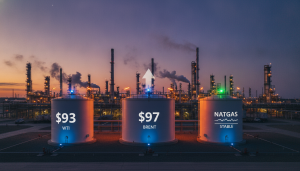
Investors are already witnessing the immediate impact of this uncertainty. As of today, Brent Crude trades at $95.19 per barrel, marking a robust +5.32% increase, with a day range between $92.77 and $97.81. Similarly, WTI Crude has seen a significant jump to $87.05, up +5.4% for the day, fluctuating between $85.45 and $89.6. Gasoline prices have also responded, climbing to $3.04, a +3.75% rise within a $2.99-$3.08 daily range. This upward momentum stands in stark contrast to the recent trend; over the past two weeks, Brent crude had experienced a notable correction, falling from $112.78 on March 30th to $90.38 by April 17th, representing a nearly 20% decline. Today’s sharp rebound underscores the market’s sensitivity to supply disruption fears and the immediate repricing of geopolitical risk in a major chokepoint.
Asia’s Critical Stake and Investor Sentiment
The strategic importance of the Strait of Hormuz is underscored by its role as a primary artery for energy supply to Asian markets. Proprietary shipping data reveals that nearly 90% of all oil transiting this narrow waterway is ultimately destined for Asian economies. A substantial portion of this, approximately one-third, flows directly to China, highlighting Beijing’s profound reliance on this route for its energy security. Consequently, any sustained disruption, particularly one that curtails Iranian oil shipments, can be interpreted not just as a regional pressure point, but as a calculated geopolitical maneuver with global ramifications, directly impacting major consuming nations that have called for de-escalation.
This evolving situation directly addresses core concerns we’ve observed from our readership. OilMarketCap’s first-party intent data indicates that investors are keenly focused on directional price movements for benchmarks like WTI and are actively seeking long-term price predictions for the end of 2026. The current state of flux in the Strait of Hormuz introduces an extraordinary level of complexity to these forecasts. The ‘unintended alliance’ of blockading forces makes it exceptionally difficult to model future supply scenarios, forcing investors to grapple with a significantly wider range of potential outcomes. While specific price predictions are challenging in such dynamic conditions, the prevailing sentiment points towards continued volatility and a structural upward pressure on risk premiums until clarity emerges.
The Protracted Road to Normalization and Strategic Re-evaluation
Even if a resolution to the current tensions in the Strait were to materialize swiftly, the path to full normalization in global energy markets would be arduous and potentially incomplete. The notion that conditions could simply revert to a pre-crisis state overlooks fundamental shifts in strategic thinking. Ship owners, now acutely aware of the vulnerability of this critical chokepoint, will undoubtedly factor this elevated risk into future operational planning. This will likely manifest in higher insurance premiums, altered shipping routes where feasible, and increased logistical costs. Furthermore, any damage to energy infrastructure, whether ports, pipelines, or storage facilities, could necessitate extensive repair efforts, potentially taking months or even years to fully restore capacity. This long recovery timeline means that the market will likely contend with a structural re-evaluation of supply chain resilience, potentially accelerating investments in alternative routes and energy sources.
The uncertainty surrounding resolution mechanisms and the lasting impact on shipping strategies keep market participants on edge. The psychological impact alone could lead to a persistent “Hormuz premium” embedded in crude prices, reflecting the ongoing risk of disruption. Investors should prepare for a landscape where the cost of doing business through this vital passage remains elevated, impacting margins for refiners, shippers, and ultimately, consumers.
Navigating Near-Term Volatility: Key Calendar Events on the Horizon
Against this backdrop of heightened geopolitical risk, specific upcoming energy events will serve as critical indicators for investors seeking to gauge market direction and policy responses. The OPEC+ Joint Ministerial Monitoring Committee (JMMC) Meeting on April 20th, followed by the full OPEC+ Ministerial Meeting on April 25th, will be particularly crucial. These gatherings will provide direct insight into how major producers plan to address the global supply implications arising from the Strait’s precarious state. Any shifts in production quotas or rhetoric will be closely scrutinized for their potential to either stabilize or further destabilize crude prices.
Furthermore, weekly inventory reports will offer vital snapshots of supply and demand dynamics under stress. The API Weekly Crude Inventory reports on April 21st and April 28th, alongside the EIA Weekly Petroleum Status Reports on April 22nd and April 29th, will reveal how current disruptions are impacting stock levels in key consumption centers. Significant draws could signal an accelerating supply deficit, further bolstering prices. Finally, the Baker Hughes Rig Count reports on April 24th and May 1st will indicate producer confidence and drilling activity, providing a forward-looking perspective on potential future supply. Investors must monitor these events closely, as each piece of data will contribute to an evolving understanding of a market fundamentally reshaped by the Strait of Hormuz’s ongoing challenges.