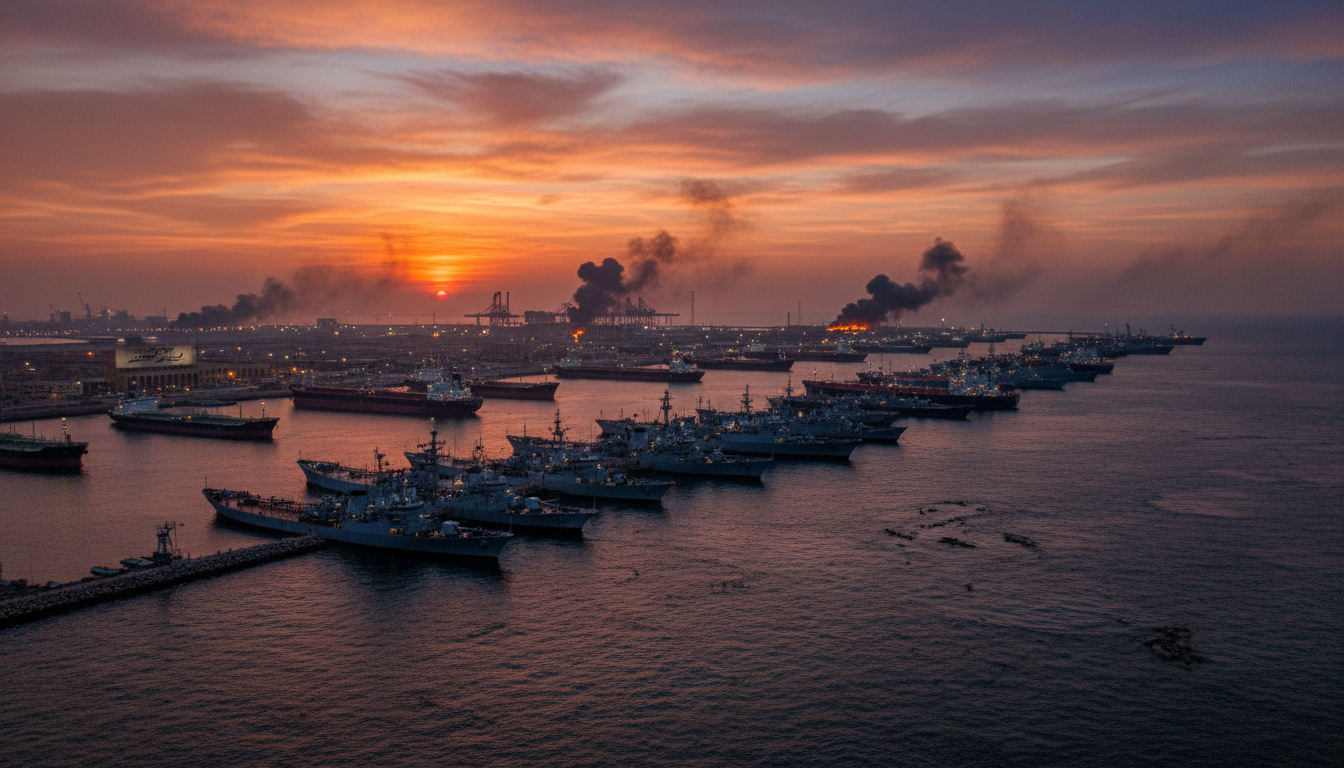
Global energy markets are confronting a new paradigm of volatility as the United States initiates a “close blockade” targeting Iranian ports within the Persian Gulf. This assertive measure, immediately implemented, directly impacts the critical Strait of Hormuz, a maritime chokepoint through which a significant portion of the world’s oil and gas transits. For investors in the energy sector, the implications for crude prices, global supply security, and regional stability are profound and demand immediate attention. This strategic maneuver by the U.S. administration marks a significant escalation, introducing a substantial risk premium into an already complex market landscape.
Geopolitical Strategy and Immediate Market Response
The U.S. administration’s strategy appears to be a direct and forceful response to Iran’s prior actions, which included weeks of restricting passage through the Strait of Hormuz amidst broader geopolitical tensions. This earlier interference had already created bottlenecks, stressing economies reliant on unhindered oil flow. The blockade’s primary objective, as articulated by analysts like Michael Horowitz, a senior fellow specializing in technology and innovation, is to apply immense economic pressure on Iran’s leadership. By preventing ships from entering or leaving Iranian ports, the U.S. aims to strip Tehran of crucial financial gains from its oil sales, thereby compelling a de-escalation of aggressive postures and a reaffirmation of freedom of navigation in the Strait.
The market’s reaction has been swift and decisive. As of today, Brent Crude is trading at $95.32 per barrel, marking a robust 5.47% gain for the day, with an intraday range of $92.77 to $97.81. This sharp upward movement stands in stark contrast to the recent 14-day trend, which saw Brent decline from $112.78 on March 30th to $90.38 on April 17th, a nearly 20% drop. The immediate surge underscores the market’s sensitivity to supply disruption risks emanating from such a critical region. Similarly, WTI Crude has climbed to $87.23, up 5.62%, while gasoline prices have also seen a significant bump, now at $3.04, reflecting the broader impact across refined products.
Iran’s Production and Global Supply Implications
Iran holds a substantial position in the global energy matrix, ranking among the top-10 oil-producing nations and accounting for approximately 4% of the world’s total oil production. The overwhelming majority of these exports are destined for China, making any disruption to Iranian crude shipments a direct threat to a key global demand center. Severing Iran’s ability to ship its crude via the Strait of Hormuz would inflict a severe blow to its economy, directly targeting its primary source of revenue and placing immense strain on its domestic stability.
The broad application of this blockade is particularly concerning. U.S. Central Command has clarified that the enforcement will extend “against vessels of all nations entering or departing Iranian ports and coastal areas, including all Iranian ports on the Arabian Gulf and Gulf of Oman.” This expansive scope highlights the potential for a significant and sustained reduction in global oil supply. A prolonged removal or severe curtailment of 4% of global production would inevitably tighten the market considerably, making it challenging for other producers to quickly compensate for the shortfall, thus supporting higher prices for an extended period.
Investor Sentiment and the Forward Price Outlook
A key question dominating investor discussions this week, as indicated by our proprietary reader queries, revolves around the trajectory of crude oil prices: “is WTI going up or down?” and what the “price of oil per barrel will be by end of 2026.” The imposition of this blockade fundamentally alters the short-to-medium term outlook, introducing a substantial geopolitical risk premium that was not fully priced into the market just days ago. While WTI currently trades at $87.23, the potential for upward movement is significant, driven by the perceived threat to supply. Investors are now grappling with the prospect of sustained higher prices as the market seeks to balance potential supply losses with demand. Predicting the exact price by year-end 2026 becomes even more complex under these circumstances, as it hinges on the duration and eventual resolution of this blockade, as well as the broader regional response. However, the current environment points towards elevated volatility and a strong bias for crude prices to trend higher as long as the blockade remains in effect and tensions persist.
Navigating the Upcoming Energy Event Calendar
In this heightened geopolitical environment, the upcoming energy event calendar takes on magnified importance. Investors will be scrutinizing every data point for clues on how global supply and demand dynamics might shift. On Monday, April 20th, the OPEC+ JMMC Meeting is scheduled, followed by the full OPEC+ Ministerial Meeting on Saturday, April 25th. These gatherings will be critical. Should Iranian supply be severely curtailed, the market will look to OPEC+ for any potential announcements regarding production adjustments to stabilize prices or mitigate supply shortfalls. Any indication of a willingness to increase output would temper price spikes, while inaction could exacerbate them.
Furthermore, the weekly inventory reports will be closely watched. The API Weekly Crude Inventory reports are due on Tuesday, April 21st, and Tuesday, April 28th, with the EIA Weekly Petroleum Status Report following on Wednesday, April 22nd, and Wednesday, April 29th. These reports will provide crucial insights into the immediate tightness or slack in the U.S. and, by extension, global markets. Any drawdowns, especially larger than anticipated, will reinforce the narrative of a tightening market. Finally, the Baker Hughes Rig Count, scheduled for Friday, April 24th, and Friday, May 1st, will offer an indication of future supply capacity. While rig counts react slower to price signals, a sustained increase in crude prices due to the blockade could eventually incentivize higher drilling activity, though this would provide relief only in the longer term. For now, the focus remains firmly on immediate supply-side risks and OPEC+’s response.