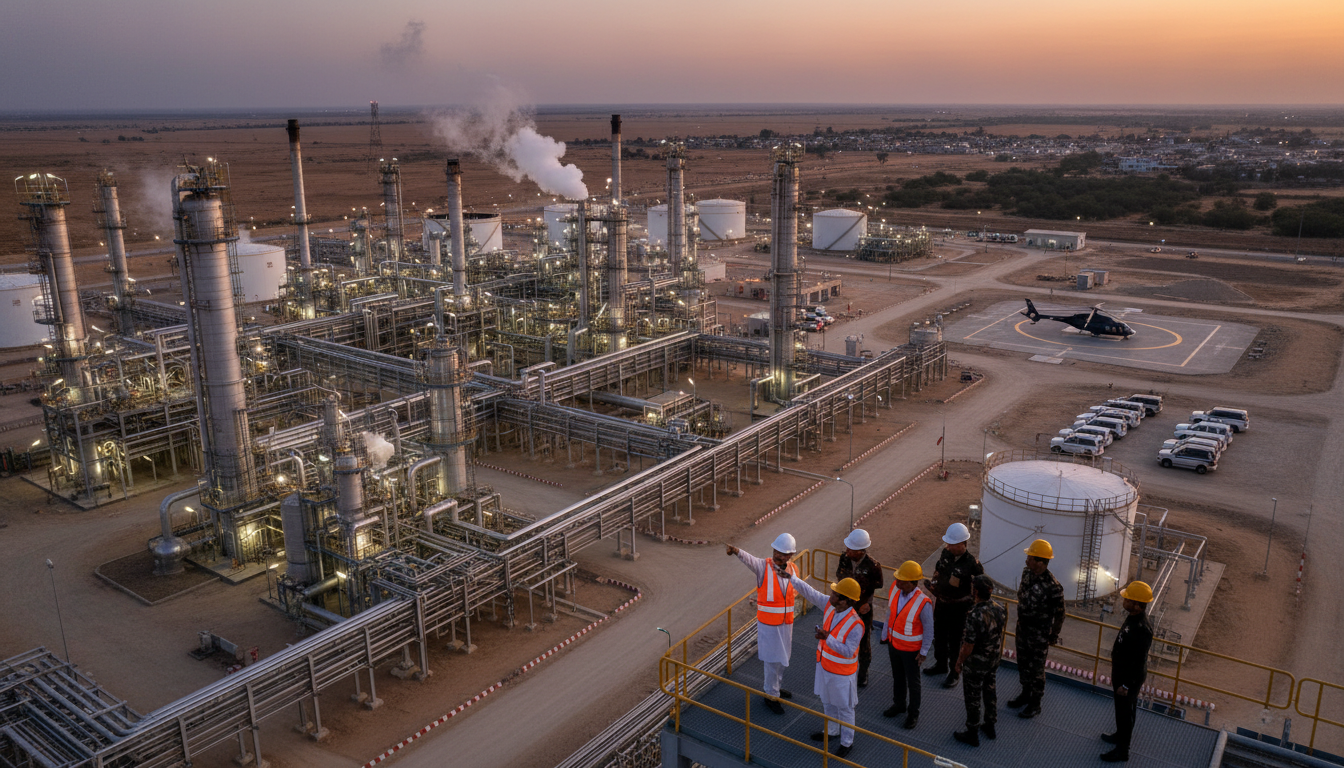
The energy investment landscape in India is heating up, literally, as the Hindustan Petroleum Corporation Ltd (HPCL) Rajasthan Refinery at Pachpadra in Balotra gears up for its grand inauguration. This facility, touted as the country’s first integrated refinery-cum-petrochemical complex, represents a significant leap in India’s downstream capacity and strategic energy independence. With Prime Minister Narendra Modi slated to officially inaugurate the complex on April 21st, investors are keenly watching the implications of this massive project on regional economic development, employment generation, and, crucially, the broader dynamics of refined product markets. This development comes at a pivotal time for global energy, with crude prices exhibiting considerable volatility and the demand for refined products showing robust growth in emerging economies.
India’s Downstream Ambitions: HPCL’s Strategic Expansion
The commissioning of HPCL’s integrated refinery-cum-petrochemical complex is more than just a new facility; it’s a strategic pillar in India’s long-term energy security and industrial growth strategy. Positioned in Rajasthan, a state poised for significant economic expansion, the project is designed to bolster local energy production and catalyze industrial development across the region. The integration of refining and petrochemical operations is particularly noteworthy, allowing for greater efficiency and value addition from crude feedstock. This complex is expected to strengthen the state economy considerably, creating numerous employment opportunities for local youth and fostering a new industrial hub. For HPCL, this represents a substantial expansion of its refining footprint, enhancing its capacity to meet India’s burgeoning demand for fuels and petrochemical derivatives, a critical consideration for investors tracking the nation’s energy trajectory.
Navigating Volatile Crude Markets and Refining Margins
The operational readiness of a major new refinery like HPCL’s naturally prompts investors to scrutinize the current market environment for crude oil and refined products. As of today, Brent crude trades at $95.32 per barrel, marking a notable 5.47% increase for the day. Similarly, WTI crude has seen a significant jump, now sitting at $87.23, up 5.62%. This recent upward swing contrasts sharply with the broader trend observed over the past two weeks, where Brent crude saw a substantial decline of nearly 20%, plummeting from $112.78 on March 30th to $90.38 on April 17th. Such volatility underscores the dynamic nature of crude markets and directly impacts the profitability of refining operations.
For a new facility, managing feedstock costs against product pricing is paramount. While crude prices have rebounded today, the longer-term trajectory remains a key question for many of our readers, who are actively asking whether WTI is poised for sustained gains or further corrections. Strong demand for gasoline, currently priced at $3.04 per gallon and up 3.75% today, provides a positive signal for refined product margins. However, refiners must continually balance the cost of crude inputs with the revenue generated from selling products like gasoline and petrochemicals. The HPCL refinery’s integrated nature could offer some resilience against margin compression by allowing for greater flexibility in product slate optimization, but the overarching direction of crude prices will remain a dominant factor in its financial performance.
Forward Outlook: Geopolitical Currents and Supply-Demand Dynamics
The inauguration of the HPCL complex on April 21st coincides with a period of intense activity in the global energy calendar, requiring investors to maintain a keen eye on upcoming events that could influence the market for crude and refined products. Just prior to the refinery’s official launch, the OPEC+ Joint Ministerial Monitoring Committee (JMMC) is scheduled to meet on April 20th. This will be followed by the full OPEC+ Ministerial Meeting on April 25th. Decisions from these gatherings regarding production quotas or supply adjustments could significantly impact crude prices, directly affecting the input costs for HPCL’s new facility.
Beyond OPEC+, weekly data releases will provide crucial insights into supply and demand balances. The API Weekly Crude Inventory report on April 21st, and the subsequent EIA Weekly Petroleum Status Report on April 22nd (with follow-ups on April 28th and 29th, respectively), will offer a snapshot of U.S. crude stocks and product demand. These reports are often market movers and will factor into the operational environment for a new, large-scale refinery. Furthermore, the Baker Hughes Rig Count on April 24th and May 1st will indicate future drilling activity, signaling potential shifts in crude supply. For investors wondering about the price of oil per barrel by the end of 2026, the long-term demand growth from India, fueled by projects like the HPCL refinery, will be a critical demand-side factor, balanced against global supply responses and the ongoing geopolitical landscape. The successful ramp-up and sustained profitability of the HPCL refinery will be a direct reflection of how effectively it navigates these complex, interconnected market forces.


