Shifting Tides: U.S. Resource Plays Navigate New Energy Market Dynamics
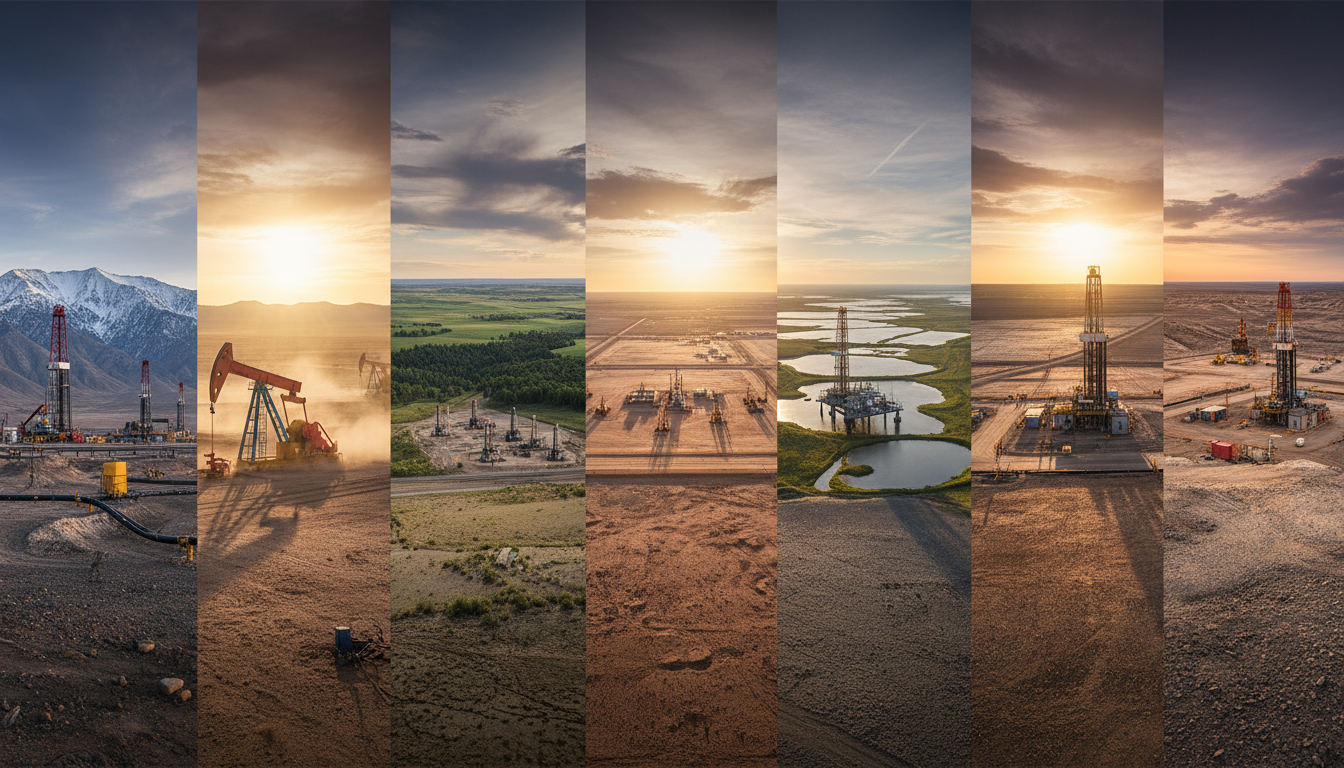
The landscape of U.S. shale plays is undergoing a profound transformation, driven by escalating liquefied natural gas (LNG) and power demands for gas-rich regions, while oil-focused basins prioritize capital efficiency and robust inventory depth. A recent in-depth analysis spotlighting seven premier U.S. resource plays reveals this strategic pivot, underscoring their critical role in both domestic and global energy supply.
These powerhouse plays—Appalachia, Haynesville, the Permian (spanning both Delaware and Midland sub-basins), Bakken, Eagle Ford, and SCOOP/STACK—now collectively account for a staggering 65% of America’s oil production and 80% of its natural gas output. This represents a monumental increase from just 10% in 2010, cementing their status as indispensable pillars for energy investors observing the U.S. oil and gas sector.
Natural Gas: A Surge Fueled by LNG and Data Centers
U.S. natural gas demand is accelerating at an unprecedented pace. Projections indicate a need for at least an additional 20 billion cubic feet per day (Bcfpd) over the next five years, significantly outpacing the 16 Bcf/d growth observed in the preceding half-decade. This surge is predominantly fueled by two key drivers: approximately 70% stems from the burgeoning capacity of LNG export facilities, with the remainder primarily allocated to near-term natural gas-fired power generation essential for servicing rapidly expanding data centers.
Oil Production: Capital Discipline and Global Supply
Over the past five years, U.S. oil volumes expanded by approximately 2.3 million barrels per day (MMbbl/d), contributing roughly 50% to global oil growth. The Permian Basin stood out as the primary catalyst, boosting output by an impressive 1.5 MMbbl/d, or 65% of the total U.S. increase. While global oil demand was tracking for continued growth pre-geopolitical tensions, the prevailing view of a plateau in U.S. shale oil production at $60 oil prices is rapidly shifting as market dynamics and higher price points alter development economics.
Beyond geological potential, access to end-markets is now a crucial determinant for growth across these core plays. Appalachia, despite its vast and economic resources, has faced growth limitations due to takeaway capacity. Conversely, associated gas from the Permian currently contends with negative cash market pricing, a situation poised for significant improvement by late 2026. The Whitewater Blackcomb and Energy Transfer Hugh Brinson’s 42-inch pipelines are set to add 3.7 Bcf/d of capacity, with a further 11.0 Bcf/d of Permian takeaway scheduled to come online by year-end 2029. Meanwhile, the Haynesville is re-accelerating its output to supply new Gulf Coast LNG export projects.
Appalachia: Gas Giant Poised for Rebound
As the nation’s largest natural gas-producing basin, Appalachia currently delivers around 35 Bcf/d and is preparing for a new growth phase. Analysts expect the basin to add 5–8 Bcf/d by 2030, marking a substantial re-acceleration after several years of constrained expansion. Appalachia boasts the lowest cost for new gas supply, with breakevens consistently below $2.25/MMBtu. The Mountain Valley Pipeline (MVP) is a game-changer, projected to add 2.5 Bcf/d of takeaway capacity by Q2 2026, which should significantly bolster local gas prices.
Merger and acquisition (M&A) activity in the region is intensifying, with 2025 seeing $11.5 billion in deals. Noteworthy transactions include EOG’s $5.6 billion acquisition of Encino in the Utica play, alongside Antero’s strategic pivot to a pure-play West Virginia operator. Looking ahead, Ascent Resources, the fourth-largest operator in Appalachia, represents a prime M&A target, having received a $6 billion offer from Kimmeridge late in 2025. Furthermore, the Utica is emerging as an unexpected oil growth story within Appalachia, with volumes soaring over 40% year-over-year to 130,000 b/d.
Haynesville: LNG Export Catalyst
The Haynesville Basin’s strategic location near Gulf Coast LNG facilities positions it as a direct beneficiary of rising LNG export demand. The basin has demonstrated its efficiency in executing short-cycle projects tailored to LNG export requirements. Expand Energy, a top operator, significantly improved its 2025 performance, reducing its breakeven price by 15% to $2.75/MMBtu through enhanced drilling efficiencies and the capability to source its own sand for completions.
A prominent trend in Haynesville is the increasing involvement of international capital. Japanese firms now command approximately 30% of the basin’s production, notably led by Mitsubishi following its $7.5 billion acquisition of Aethon. This reflects a broader structural shift where LNG offtake buyers are moving upstream to secure reliable, long-term gas supply, highlighting the basin’s critical role in the global energy market.
Delaware Basin: Premier Oil Growth Engine
The Delaware Basin solidifies its position as the leading U.S. oil-producing play, delivering approximately 3.4 MMbopd, while also generating substantial associated gas volumes of roughly 16.6 Bcf/d. Unlike the more mature Midland Basin, the Delaware still possesses extensive Tier 1 inventory, estimated at over 15,000 drilling locations. This positions it as the primary remaining scalable oil growth engine for the United States. EOG, the second-largest operator, entered 2026 with strong operational momentum, reporting returns exceeding 100% at $55 oil prices.
While Permian (Waha) gas currently faces near-term pricing pressure due to takeaway constraints, planned pipeline expansions are expected to alleviate these issues starting in November 2026. The Delaware Basin is also ripe for further consolidation. The merger between Devon and Coterra, which created a new basin leader, is likely just the precursor to a fresh wave of major deal-making opportunities involving both public and private entities.
Midland Basin: Maturing Core, Deeper Horizons
The Midland Basin has transitioned into a more mature development phase, with oil production stabilizing around 2.5 MMbbl/d since 2023, even as gas output continues its ascent. With Tier 1 inventory becoming increasingly scarce, operators are actively exploring deeper unconventional zones, including the Barnett and Woodford formations. Exxon and Diamondback, collectively controlling about 50% of the Midland Basin’s production, are at the forefront of this deeper exploration. Diamondback, for instance, reports continuous efficiency gains and requires only a 20% reduction in well costs to make the Barnett bench competitive with its core Midland inventory.
Across the Midland Basin, the emphasis remains on enhancing operational efficiencies and maximizing hydrocarbon recoveries. Exxon leads the charge with improved recovery rates reaching 15–20%. Large-scale M&A activity likely peaked in 2023–2024, exceeding $100 billion. However, 2025 still saw $5.4 billion in deals, highlighted by Diamondback’s $4.1 billion acquisition of Double Eagle IV, an asset widely described as “the most attractive asset remaining in the Midland Basin.”
Bakken: Efficiency and Maintenance Mode
The Bakken has reached maturity, with production plateauing around 1.2 MMbbl/d. Operators in this region are strictly adhering to capital discipline, with some, like Continental, temporarily halting drilling operations in response to lower oil prices. Activity primarily focuses on sustaining current production levels through extended laterals (3–4 miles) and applying enhanced oil recovery techniques. Gas production is on the rise due to increasing gas-to-oil ratios, necessitating further investments in midstream infrastructure.
M&A in the Bakken saw only two deals totaling $1.0 billion in 2025. The most recent significant transaction was Devon’s $5.0 billion acquisition of Grayson Mills Energy in 2024, which tripled Devon’s Bakken volumes. Following Devon’s recent merger with Coterra, the Delaware Basin now stands as the company’s anchor asset. Future plans for Devon’s Bakken holdings remain unannounced at this time.
Eagle Ford: Hybrid Play with Robust Gas Growth
The Eagle Ford continues to deliver stable oil production, hovering around 1.1 MMbbl/d, but is increasingly recognized as a significant gas growth story, currently producing approximately 8.5 Bcf/d. Its premium access to Gulf Coast markets provides Eagle Ford gas with favorable wellhead pricing dynamics compared to other basins. The Dorado gas play, led by EOG, is a key growth driver, with production projected to reach 1 Bcf/d by 2026, marking a 33% increase. Notably, Dorado boasts impressive breakeven costs below $2.00/MMBtu.
The Eagle Ford remains an active hotbed for M&A, particularly for assets focused on proved developed producing (PDP) reserves. Transactions such as Stone Ridge’s $2.3 billion acquisition of Baytex assets, strategically leveraged with ABS financing, underscore the competitive nature of deal-making in this hybrid play.
SCOOP/STACK: Private Equity Revitalization
The SCOOP/STACK play has experienced a notable resurgence in deal-making, largely driven by private capital and attractive gas economics, even as the basin settles into a long-term maintenance mode. Stone Ridge, for example, deployed over $4 billion to acquire assets from Ovintiv and ConocoPhillips exits. This trend suggests more deals are on the horizon, as the top operator landscape is increasingly dominated by private and private equity-backed players. Current production stands at approximately 4.5 Bcf/d of gas and 200,000 bbl/d of oil, with activity predominantly focused on optimizing existing assets rather than aggressive new drilling. While Tier 1 inventory is constrained, the presence of stacked pay zones and continuous improvements in drilling efficiency offer ongoing opportunities for value creation within the basin.