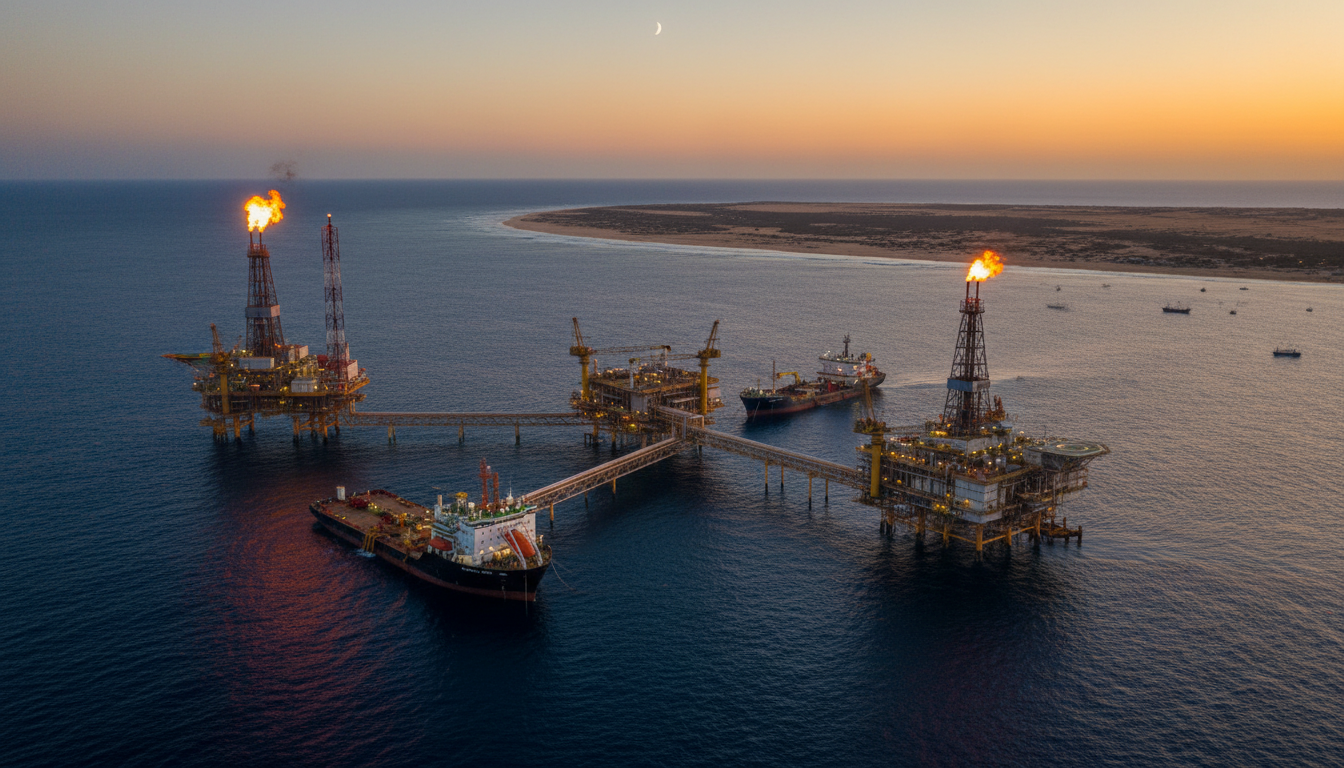
A new chapter in East African energy exploration has officially commenced as Somalia welcomes its inaugural offshore oil drilling operation. The arrival of the Turkish drillship Çagir Bey in Somali waters on Friday signals the start of a high-stakes venture poised to redefine the nation’s economic trajectory and reshape regional energy dynamics.
This deep-water drilling vessel, owned by the Turkish Petroleum Corporation (TPAO), is undertaking its maiden international assignment off the coast of Somalia. Investors are keenly watching as drilling is slated to begin this month at the Curad-1 well, a prospect that sits within offshore basins believed to harbor an extraordinary 30 billion to 40 billion barrels of oil and gas equivalent, according to extensive seismic data analysis.
Somalia’s Untapped Potential and Turkey’s Strategic Foothold
The journey to this pivotal drilling phase was meticulously prepared. Prior to the Çagir Bey‘s deployment, Türkiye utilized its Oruç Reis vessel to conduct comprehensive 3D seismic surveys, meticulously mapping the subsurface to pinpoint these massive potential reserves. This ambitious drilling program follows a significant 2024 hydrocarbon cooperation agreement forged between the governments of Somalia and Türkiye, an accord that underpins this transformative endeavor.
Should this offshore drilling initiative prove successful, the economic ramifications for Somalia would be profound. The influx of hydrocarbon revenue promises to fund critical infrastructure development, catalyze economic diversification, and firmly establish Somalia as a prominent regional energy player in East Africa. For investors eyeing frontier markets, the sheer scale of the estimated reserves presents a compelling, albeit speculative, opportunity in a region often overlooked for its energy potential.
Navigating the Contested Revenue-Sharing Framework
However, this landmark hydrocarbon agreement has not been without its detractors. Critics have voiced considerable concern over the revenue-sharing terms, labeling them as disproportionately favorable to the investing party. Under the initial phase of the agreement, TPAO, as the Turkish state-owned operator, is permitted to retain up to 90% of the revenue to recoup its upfront costs. In stark contrast, Somalia is set to receive a mere 5% royalty during this crucial initial period.
Opponents have characterized this structure as an “unfair” and even “neo-colonial” arrangement, arguing that it does not adequately benefit the resource-rich host nation. Further complicating matters, the agreement grants Türkiye the authority to deploy its own military forces to safeguard these energy projects. Some fear this provision could pave the way for a form of economic hegemony, raising geopolitical tensions in an already sensitive region.
Conversely, proponents of the agreement firmly contend that its structure is a standard and necessary model for high-risk, unproven frontier markets. They argue that where the investor shoulders the entirety of the financial risk associated with exploration and development, such terms are essential to attract the requisite capital. From this perspective, the arrangement represents a pragmatic and strategic decision for Somalia, a nation currently lacking the indigenous human and financial capital required to independently develop its vast offshore resources. Crucially, supporters highlight that once initial costs are fully recovered, Somalia’s profit share will escalate significantly, reaching up to 70%, offering a substantial long-term economic upside.
Türkiye’s Expanding Geopolitical and Economic Influence in Africa
This energy venture with Somalia is deeply embedded within Türkiye’s broader “Africa Opening strategy,” a meticulously crafted diplomatic and economic initiative. Somalia holds particular strategic importance due to its critical maritime location in the Horn of Africa and its enormous, largely untapped energy potential. Following a significant diplomatic pivot in 2011, Türkiye has systematically cultivated major influence in the region, securing not only energy exploration deals and deep-water oil drilling agreements but also providing extensive military training and development aid.
The extent of Türkiye’s commitment is underscored by the 2017 inauguration of Camp TURKSOM in Mogadishu, which stands as its largest overseas military base. This facility plays a crucial role in training elite Somali military units, further cementing Türkiye’s security footprint. Beyond military support and energy partnerships, Türkiye has actively engaged in substantial infrastructure development across Somalia and the wider African continent. This comprehensive engagement has seen Türkiye’s total trade with African nations soar to over $40 billion by 2023, showcasing a multifaceted approach to bolstering its geopolitical and economic presence.
Investment Implications: High Reward, Elevated Risk
For savvy energy investors, Somalia’s nascent offshore oil sector presents a classic frontier market scenario: the tantalizing prospect of massive, undiscovered wealth balanced against considerable geopolitical and operational risks. The successful development of 30 to 40 billion barrels of oil and gas equivalent could indeed transform Somalia into a significant global energy player, offering long-term growth opportunities for those willing to engage with complex political landscapes.
However, the controversies surrounding the revenue-sharing agreement and the implicit security concerns highlighted by military involvement necessitate careful due diligence. Investors must weigh the potential for substantial returns against the political stability, regulatory frameworks, and social acceptance of such large-scale, foreign-led resource extraction. As the Çagir Bey spuds the Curad-1 well, the world watches not just for oil, but for the unfolding narrative of economic transformation and geopolitical maneuvering in one of Africa’s most promising, yet challenging, energy frontiers.


