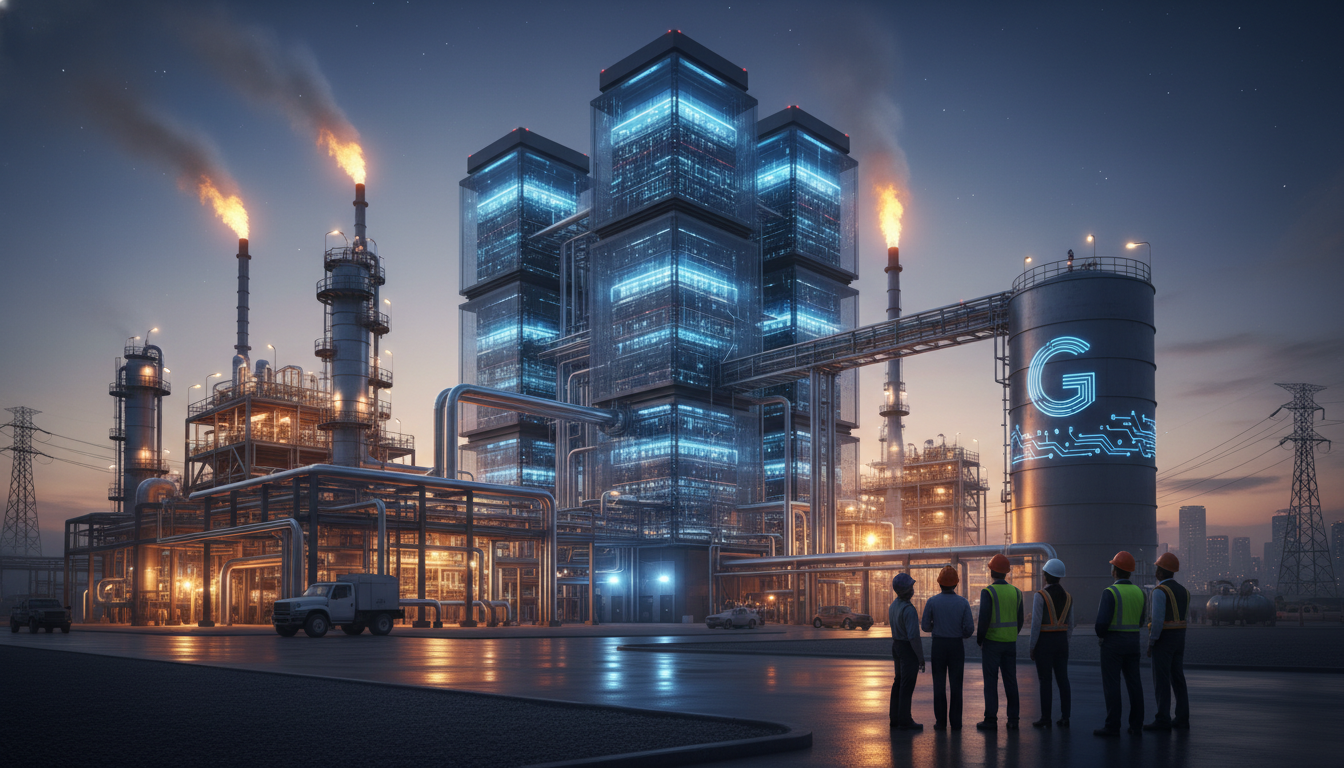
Tech Giant Pivots to Natural Gas: A Strategic Imperative for AI Power
The energy landscape for hyperscale data centers is undergoing a seismic shift, with a major tech titan now conspicuously embracing natural gas to fuel its burgeoning artificial intelligence ambitions. New research, subsequently confirmed by the company, reveals Google’s partnership with Crusoe Energy for a substantial natural gas power plant designed to supply one of its expansive data center campuses in Texas. This move signals a significant reevaluation of the company’s long-held commitment to solely carbon-free operations and presents compelling implications for the oil and gas sector.
The proposed 933-megawatt natural gas facility is slated for construction in Armstrong County, a sparsely populated region within the Texas panhandle. Spearheaded by Crusoe Energy, this project forms a critical component of Google’s “Goodnight” data center campus, named after a nearby locality. Cleanview, a leading research organization, brought this development to light, detailing Crusoe’s January permit application for the plant. The documentation confirms the facility’s design to operate off-grid, providing dedicated power to at least two buildings within the sprawling Goodnight campus. Satellite imagery commissioned by Cleanview further corroborates that construction is already well underway, indicating rapid progress on this vital energy infrastructure.
The scale of this undertaking demands attention from an environmental perspective, impacting the broader energy transition narrative. Crusoe’s 465-page permit application estimates the power plant’s annual carbon dioxide emissions could reach as much as 4.5 million tons. To contextualize this figure for investors monitoring climate policy and carbon markets, the entire city of San Francisco typically generates approximately 4 million tons of carbon dioxide annually. Michael Thomas, founder of Cleanview and author of the report, characterized this as one of Google’s first direct investments into fossil fuel infrastructure he has observed. Thomas critically observed, “Google has spent decades crafting an image as a clean energy leader. I’ve always considered them to be the most committed to their climate goals. But these projects suggest a major strategic pivot at the company could be under way.”
When questioned about the Crusoe partnership and the Texas gas power plant, Chrissy Moy, a Google spokesperson, did not refute the project’s existence. However, Moy stated that “We don’t have a contract in place for the plant in Texas,” suggesting ongoing negotiations regarding the volume of electricity Google might procure from the facility. She redirected inquiries towards a separate wind farm project the tech company is pursuing in the region with utility provider Serena Energy, underscoring Google’s diversified energy strategy. Crusoe Energy, for its part, has not responded to requests for comment regarding the project details.
This Texas development is not an isolated incident but rather the third known natural gas initiative involving Google in recent months. In October, the company announced an agreement to purchase power from a gas plant situated in Illinois. More recently, documents obtained by Flatwater Free Press last month revealed Google’s exploration of another substantial natural gas project in Nebraska, highlighting a broader strategic pattern emerging across multiple states.
Despite these significant investments in natural gas infrastructure, Google maintains that its overarching focus remains on carbon-free energy. The company states it does not perceive the utilization of natural gas as a deviation from its long-term climate objectives. Google articulates a strategic shift from simply purchasing carbon credits to actively engaging in “building the grid,” implying a hands-on approach to securing reliable power sources. When directly asked at a recent energy conference in Houston about how natural gas aligns with Google’s clean energy goals and overall strategy, Michael Terrell, Google’s head of advanced energy, offered no immediate comment, simply stating, “We don’t have anything to say on that.” This reticence suggests a complex internal discussion as the company navigates the demands of rapid growth against its historical environmental pledges.
The Shifting Sands of Climate Commitments: AI’s Energy Footprint Reshapes Tech Policy
Google once stood as a vanguard of climate leadership within the technology sector. In 2020, the company famously set an ambitious net-zero emissions goal, pledging to power all its operations with carbon-free energy by 2030. Throughout the years, it actively invested in a diverse portfolio of renewable projects, including wind, solar, geothermal, and even nuclear energy. However, the relentless acceleration of artificial intelligence development, with its immense and ever-increasing energy demands, has demonstrably softened Google’s once rigid emissions commitments.
In 2023, Google’s sustainability report acknowledged a significant change, stating it was “no longer maintaining operational carbon neutrality” while still asserting its commitment to net-zero by 2030. The implications of AI’s energy appetite became starkly clear in Google’s 2024 environmental report, which disclosed a striking 48% rise in greenhouse gas emissions since 2019, directly attributing this surge to increased data center energy consumption.
By 2025, Google’s language further evolved, moving away from concrete 2030 targets and recharacterizing its emissions ambitions as “climate moonshots.” This term, internally used by Google to denote highly speculative projects with uncertain outcomes—such as self-driving cars, which have succeeded, or wifi balloons, which largely have not—suggests a growing acknowledgment of the difficulty in achieving its original targets. Google’s 2025 environmental report underscored this complexity, stating, “While we remain committed to our climate moonshots, it’s become clear that achieving them is now more complex and challenging across every level.” The report explicitly cited AI’s rapid expansion as the primary driver of “significant uncertainties” surrounding future emissions trajectories.
This strategic reorientation at Google is far from isolated; it reflects a broader industry trend among hyperscale competitors. Tech giants like Meta, Amazon, and Microsoft, all of whom have previously espoused net-zero carbon goals, are also increasingly turning to natural gas to power their AI data centers. Meta is constructing a colossal facility in Louisiana, expressly designed to run on natural gas. Amazon operates several multi-gigawatt data centers already powered by natural gas. Microsoft recently unveiled plans for a new gas project to support a data center in West Virginia and, notably, signed a deal with Chevron this week to develop a 2.5-gigawatt gas power plant in west Texas.
Michael Thomas of Cleanview succinctly captured this industry-wide pivot: “For years, these hyperscalers have remained committed to their climate goals and have resisted the siren call of natural gas. But what has happened in the last few months is that the story has become more complicated… There’s this tension with the race to build AI.” For investors, this escalating demand from the tech sector represents a significant, sustained tailwind for the natural gas industry, particularly for companies involved in gas production, midstream infrastructure, and power generation. The insatiable energy demands of AI are forcing a pragmatic recalibration of energy strategies across the globe’s largest corporations, making reliable, dispatchable power a paramount concern, even at the expense of previously sacrosanct environmental pledges. This shift solidifies natural gas’s critical role in powering the next wave of technological innovation, underpinning a robust investment outlook for the sector.
Source


