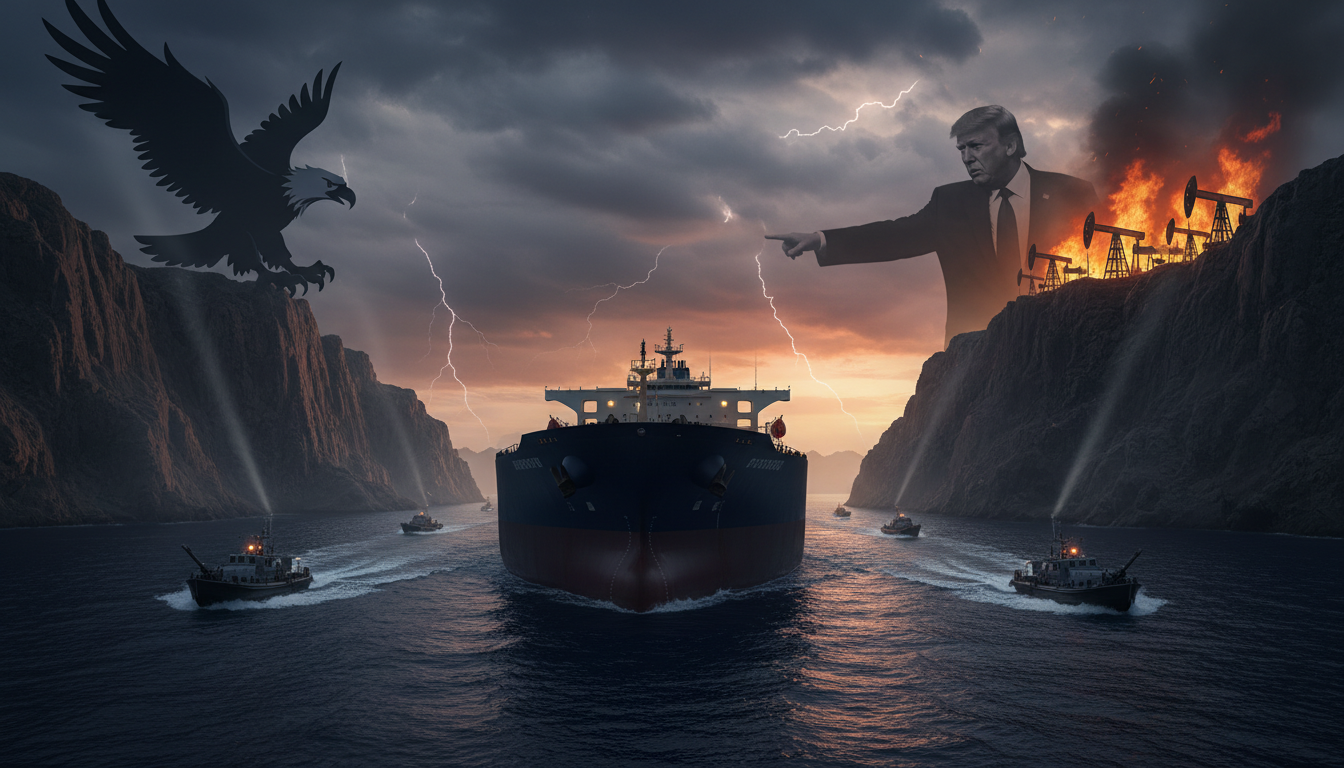
Geopolitical Tensions Escalate: Trump Threatens Iranian Energy Infrastructure Amidst Volatile Negotiations
The global oil and gas markets are grappling with heightened uncertainty following recent statements from President Donald Trump, who has issued a stark warning to Iran. In a dramatic escalation, the President has threatened to completely dismantle Iran’s critical energy infrastructure, including its electric generating plants, oil wells, and the vital Kharg Island export terminal, should diplomatic efforts fail and the Strait of Hormuz remain anything but “Open for Business.” This declaration comes amidst a month-long bombing campaign by the U.S. and Israel, which has already exerted significant upward pressure on global crude prices and tightened energy supply chains.
Trump’s latest pronouncement, disseminated via his preferred social media platform, outlined a chilling ultimatum: “Great progress has been made but, if for any reason a deal is not shortly reached, which it probably will be, and if the Hormuz Strait is not immediately ‘Open for Business,’ we will conclude our lovely ‘stay’ in Iran by blowing up and completely obliterating all of their Electric Generating Plants, Oil Wells and Kharg Island (and possibly all desalinization plants!), which we have purposefully not yet ‘touched.’” For oil and gas investors, this represents a severe escalation of geopolitical risk, underscoring the potential for rapid and dramatic shifts in crude supply dynamics.
The Critical Stakes of the Strait of Hormuz and Kharg Island
The explicit threat to Iran’s energy sector carries profound implications for global energy security. Kharg Island serves as Iran’s principal oil export terminal, handling the vast majority of its crude shipments. Any disruption or destruction of this facility would effectively cripple Iran’s ability to participate in the international oil market, removing substantial volumes from global supply. Similarly, the targeting of oil wells would devastate the country’s production capacity, further tightening an already sensitive market.
However, the cornerstone of this strategic chess match remains the Strait of Hormuz. This narrow waterway, a chokepoint between the Persian Gulf and the open ocean, is arguably the world’s most critical oil transit route. A significant percentage of the world’s seaborne oil passes through this strait daily. Its effective closure, resulting from the ongoing conflict, has already triggered a scramble for alternative supplies and fueled a sustained rally in oil prices. President Trump’s insistence on the strait being “immediately ‘Open for Business’” highlights its paramount importance to global trade and energy flow.
Conflicting Signals: Diplomacy vs. Destructive Threats
The President’s hawkish rhetoric, however, is juxtaposed with concurrent claims of diplomatic headway. Just days prior to his infrastructure threat, Trump informed reporters that Tehran had largely assented to “most of” a 15-point ceasefire proposal mediated by the U.S. through Pakistani intermediaries. Iran, in turn, presented its own five conditions for a truce, notably including its demand to retain control over the Strait of Hormuz – a direct contradiction to the U.S. position.
This dual narrative of progress and peril creates a highly volatile environment for energy investors. On one hand, the prospect of a diplomatic resolution could alleviate immediate supply concerns and potentially temper the geopolitical risk premium currently embedded in crude prices. On the other hand, the explicit threat of “obliterating” Iran’s energy backbone suggests a willingness to resort to extreme measures if negotiations falter, injecting an unprecedented level of uncertainty into forward market projections.
The Military Calculus: Seizing Iranian Oil Infrastructure
Beyond the threats of destruction, President Trump has also floated the controversial idea of seizing control of Iran’s oil assets, specifically Kharg Island. In an interview with the Financial Times, he openly pondered the military implications of such an operation, acknowledging that it would necessitate a significant and prolonged military presence: “mean we had to be there [in Kharg Island] for a while.”
For investors analyzing the geopolitical landscape, a ground invasion and occupation of Kharg Island would be an operation of immense scale and complexity. It would entail substantial military resources, incur significant human and financial costs, and likely provoke a protracted conflict with unpredictable regional ramifications. Such an undertaking would not only guarantee the cessation of Iranian oil exports for an indefinite period but also send shockwaves through global markets, potentially pushing crude benchmarks to unprecedented levels.
Regional Diplomacy and Military Reinforcements
As the U.S. intensifies its diplomatic and military pressure, regional actors are also attempting to navigate the volatile situation. Officials from Pakistan, Saudi Arabia, and Turkey reportedly convened over the recent weekend, though concrete progress towards a ceasefire or de-escalation remains unconfirmed. The limited visibility into these crucial regional discussions only compounds the uncertainty for market participants.
Despite President Trump’s intermittent optimistic pronouncements regarding negotiations, the U.S. has simultaneously reinforced its military posture in the Middle East. Thousands of American troops have been deployed to the region in recent days, including a specialized amphibious assault team and units from the elite Army’s 82nd Airborne Division. This significant military buildup stands as a stark reminder that while diplomatic channels remain open, the option of military intervention is being actively prepared. For oil and gas investing, this confluence of diplomatic overtures and military readiness means monitoring every development closely, as the balance between conflict and resolution hangs precariously.


