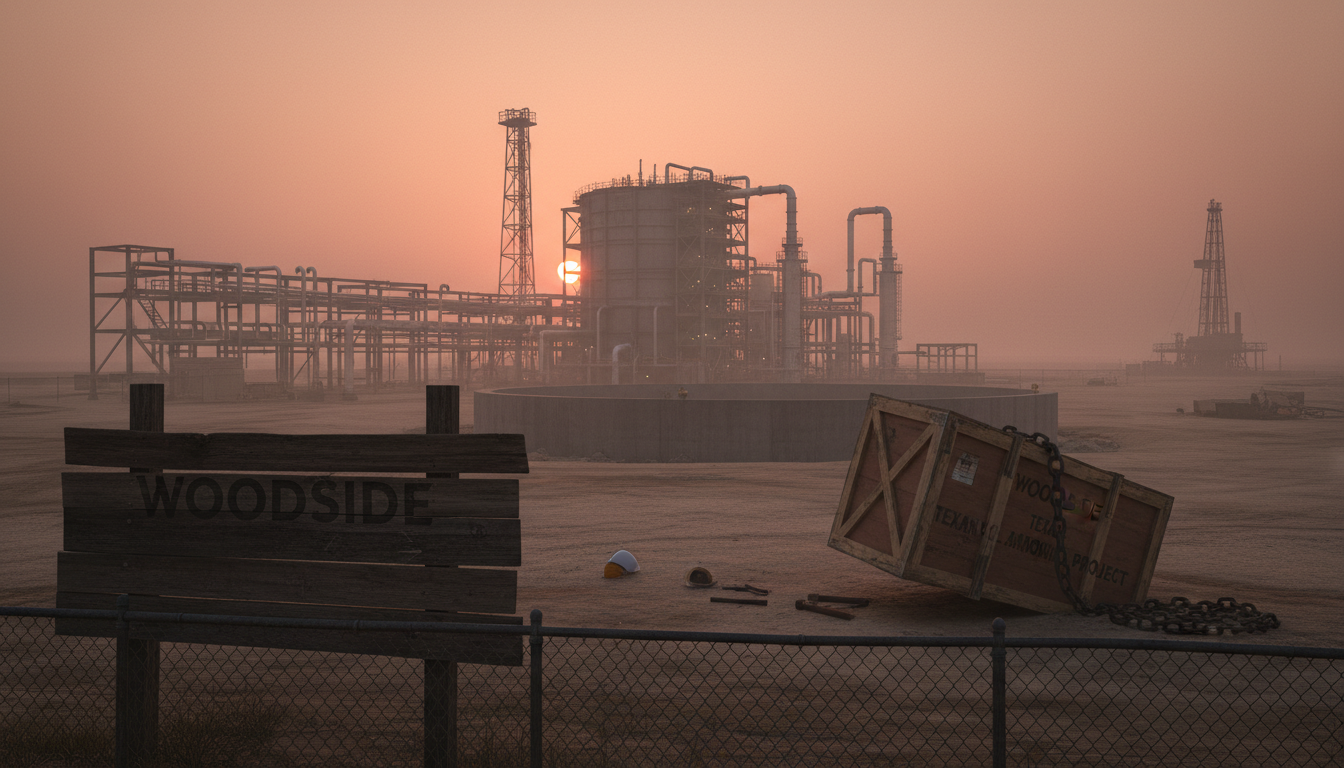
Woodside’s Beaumont Ammonia Project Faces Delay, Casting Shadow on 2024 Lower-Carbon Target
Woodside Energy Group Ltd. has announced a significant delay for its Beaumont New Ammonia (BNA) facility in southeast Texas, pushing back the anticipated start of lower-carbon production beyond the initial 2024 target. This setback, attributed to construction issues at a critical third-party feedstock supply facility, represents a crucial development for investors closely watching Woodside’s pivot into new energy products and decarbonization initiatives.
The Australian energy giant, which recently assumed full operational control of the project from OCI Global, confirmed the delay in a recent statement. For shareholders, this means a deferred timeline for the revenue streams and environmental benefits expected from this flagship lower-carbon project. The integrity of the feedstock supply chain is paramount for these complex facilities, and any disruption can have cascading effects on project economics and delivery schedules.
The Intricacies of Lower-Carbon Production and Strategic Partnerships
Achieving “lower-carbon production” at BNA is contingent on two pivotal elements: the reliable supply of carbon-abated hydrogen and the operational readiness of an ExxonMobil Corp. carbon capture and storage (CCS) facility. These interconnected dependencies highlight the complexity and multi-party coordination required for large-scale energy transition projects.
Previously, OCI, the project’s former owner, secured a vital agreement with Linde PLC in February 2023 for the provision of emissions-abated hydrogen and nitrogen to the Beaumont site. This was followed by a separate agreement in April 2023 between Linde and ExxonMobil, outlining ExxonMobil’s commitment to transport and permanently store up to 2.2 million metric tons of carbon dioxide annually from Linde’s hydrogen production facility. The current construction challenges at the feedstock supplier directly impact this carefully orchestrated value chain, underscoring the execution risks inherent in pioneering new energy infrastructure.
Woodside’s Strategic Play in Ammonia Exports and Energy Transition
Woodside’s acquisition of the Beaumont facility last year, valued at AUD 2.35 billion (approximately $1.62 billion), cemented its strategic intent to expand into new energy vectors. The BNA facility, designed for a peak production capacity of 1.1 million metric tons per annum, holds the potential to significantly reshape the U.S. ammonia export landscape, potentially doubling current volumes and stimulating regional economic growth.
CEO Liz Westcott has articulated the project’s alignment with Woodside’s broader strategy to invest in “new energy products and lower-carbon services.” Despite the current market disruptions and project delays, the company remains steadfast in its commitment to safely delivering ammonia to customers. In the long term, Woodside’s ambition remains to cultivate a competitive lower-carbon ammonia sector, positioning itself at the forefront of the global energy transition.
Investors will be keen to understand how this delay might affect Woodside’s capital expenditure forecasts and its ability to meet its stated decarbonization targets. While offtake agreements for BNA’s output have already been secured at prevailing market prices, any extended deferral of production could impact the timing of revenue generation and the project’s overall return on investment.
OCI Global’s Divestment and Financial Closure
From OCI Global’s perspective, the divestment of the Beaumont ammonia project has largely concluded, with the company providing further financial details related to the transaction. As part of the sale terms, OCI received a deferred consideration of $470 million, representing 20 percent of the total proceeds from the divestment. This amount, however, saw deductions for outstanding construction obligations, various closing-related adjustments, and remaining estimated close-out costs.
These deductions were accounted for within OCI’s previously disclosed total cost to complete of $1.8 billion. The company noted that these items were reflected in its 2025 year-end liability, which stood at $228 million on an undiscounted basis. Consequently, OCI anticipates netting approximately $242 million in proceeds during 2026, marking the final financial reconciliation of the sale.
OCI has clarified that its remaining obligations are now limited to administrative tasks, primarily closing out invoices and resolving any disputes related to work performed, in accordance with its contractual commitments to Woodside. For OCI shareholders, this announcement signals the near-complete financial exit from a significant capital-intensive project, allowing the company to refocus its balance sheet and strategic priorities.
Investment Implications and Forward Outlook
The deferral of Woodside’s Beaumont New Ammonia facility is a stark reminder to energy investors of the inherent complexities and execution risks associated with large-scale industrial projects, particularly those pioneering in the lower-carbon space. While the strategic rationale for BNA remains robust – tapping into growing demand for cleaner fuels and industrial feedstocks – the immediate impact will be felt in revised timelines and potentially escalated costs.
Investors will now scrutinize Woodside’s updated project schedule and any potential revisions to its capital guidance. The incident also highlights the critical importance of a robust, multi-faceted supply chain for new energy ventures and the need for clear oversight of third-party contractors. For companies like ExxonMobil and Linde, their roles in enabling lower-carbon infrastructure become even more pronounced as such projects navigate early-stage challenges.
The longer-term outlook for lower-carbon ammonia remains positive, driven by global decarbonization efforts. However, this delay serves as a tangible example that the transition to a lower-carbon economy will be a marathon, not a sprint, marked by both innovation and inevitable operational hurdles.


