The global energy landscape finds itself at a critical juncture, with escalating geopolitical tensions in the Middle East poised to inflict substantial economic and market repercussions. The consensus emerging from leading oil industry executives and market analysts points to a rapidly narrowing window of opportunity: if the vital Strait of Hormuz remains closed beyond the next one to three weeks, the fallout could intensify dramatically. Even a swift reopening might not avert sustained elevated energy prices and broader inflationary pressures, as considerable damage has likely already permeated supply chains.
Surprisingly, this profound risk has yet to be fully assimilated into some key financial benchmarks, notably the broader equity markets and the widely referenced Brent crude price. Current market stability largely stems from interim measures designed to cushion the impact of the oil supply disruption. However, experts caution that these temporary solutions are projected to lose their efficacy by early to mid-April, at which point governments, including the U.S., will possess limited options to prevent a significant surge in energy costs.
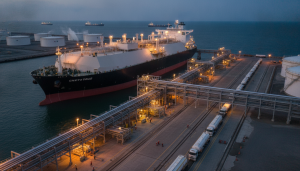
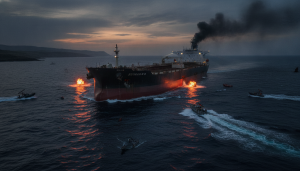
Hostilities in the region have seen attacks on civilian vessels and energy infrastructure, bringing maritime traffic in the Strait of Hormuz to a near standstill. This strategic chokepoint, bordering Iran, typically facilitates the transit of approximately 20% of the world’s daily oil supply across its roughly 100-mile expanse. While some crude has been rerouted via pipelines, their capacity is inherently limited. To provide the market with temporary relief, the U.S. and its allies have initiated the largest strategic reserve release on record, injecting 400 million barrels of oil. Concurrently, the U.S. has temporarily suspended sanctions on certain Russian and Iranian oil exports.
Satellite imagery, such as that capturing smoke rising from the UAE’s Fujairah port on March 15, 2026, amid the U.S.-Israeli conflict with Iran, visually underscores the tangible impact of these events. Despite these evident disruptions, the White House maintains an optimistic outlook, suggesting its military strategy will soon neutralize the Iranian threat, thereby alleviating price concerns. Yet, all stakeholders concur that there is no true substitute for the unimpeded flow of commerce through the Strait.
Industry Leaders Voice Mounting Concerns
Discussions among industry titans at S&P Global’s CERAWeek in Houston have highlighted the growing real-world consequences of the Strait’s closure. Chevron CEO Mike Wirth articulated on Monday that “very real, physical manifestations of the closure of the Strait of Hormuz are working their way around the world.” Shell CEO Wael Sawan echoed this sentiment days later, noting that disruptions, initially observed in South Asia, have progressively spread to Southeast Asia, Northeast Asia, and are now increasingly affecting European markets as April approaches. Ben Cahill, director for energy markets and policy at the Center for Energy and Environmental Systems Analysis at the University of Texas at Austin, observed that the critical divergence between “paper prices” and “physical prices” dominated conversations at the conference.
The Discrepancy Between Paper and Physical Prices
Paper prices, which represent trading activity in financial markets and often capture media headlines, have generally remained lower than the prices for actual, physical crude oil deliveries, especially in Asia, a primary recipient of Middle Eastern crude. For instance, Brent crude futures saw a 36% increase from February 27, the day hostilities commenced, through March 27, trading above $113 per barrel. In stark contrast, the Dubai price, a key indicator for physical deliveries from specific Middle Eastern producers, surged by 76%, reaching $126 per barrel—more than double the percentage gain of its paper counterpart. This physical price has exhibited particular volatility recently.
One contributing factor to the relatively subdued paper prices has been the consistent reaction to statements by President Trump, suggesting an imminent de-escalation or resolution of the conflict. This phenomenon, colloquially termed “jawboning” by traders, has, in Cahill’s view, succeeded in preventing a more dramatic reaction in the paper markets. However, he stressed, “the reality of the physical market disruption is really hard to ignore.”
The impact extends far beyond crude oil and its direct influence on U.S. gasoline prices. Liquefied natural gas (LNG) markets are also under pressure, with prices in key Asian hubs like Japan and South Korea climbing by 48%. The costs of jet fuel are spiraling, alongside more specialized commodities such as helium. Without a swift resolution, these price escalations risk fueling global inflation and significantly impeding economic growth.
Broader Market Deterioration Signals Investor Unease
In recent days, broader financial markets have begun to reflect growing apprehension. The S&P 500, after a modest half-percent gain on Tuesday amidst hopes that Trump might delay a planned strike on Iranian energy infrastructure, subsequently declined by 3.4% from Wednesday through Friday’s close. The yield on the 10-year Treasury note mirrored this trajectory, having risen by approximately half a percentage point over the course of the conflict to 4.4%. This movement underscores mounting investor concerns regarding inflationary pressures and the potential for the Federal Reserve to postpone anticipated interest rate cuts.
The persistent threat of physical supply shortages in the oil market increasingly appears to be overshadowing the calming effect of political rhetoric. Financial markets, while acknowledging the administration’s past ability to avert worst-case scenarios—such as the rapid decline in oil futures after a previous strike on Iran’s nuclear program in June when it became clear the conflict wouldn’t broaden—are now grappling with a more immediate and sustained threat. The deployment of thousands of additional troops to the region by the administration suggests various potential outcomes, from a military strike on Iran’s Kharg Island oil-export facility to compel a negotiated reopening of the Strait, to a military operation to retake the waterway, or even the collapse of the regime, all aimed at restoring energy flows.
Futures markets continue to price in these relatively optimistic possibilities. However, their capacity to do so indefinitely remains uncertain. Marko Papic, a geopolitical strategist with BCA Research, has estimated the world has been losing 4.5-5 million barrels per day (equivalent to about 5% of global supply) since the war began, through approximately April 19. His research note, circulated this week, ominously predicts that “that number will double by mid-April, becoming the largest loss of crude supply,” leading the world to an “oil cliff” as strategic petroleum reserves and sanctioned oil exemptions are depleted. Direct crude production and delivery remain irreplaceable.
Furthermore, the oil industry’s ability to swiftly resume full operations is itself in question. Middle Eastern producers, lacking sufficient storage for crude that cannot be shipped, have been forced to shut in production by temporarily closing wells. Reversing this process is not instantaneous. Sheikh Nawaf al-Sabah, CEO of Kuwait Petroleum Corp., cautioned at the energy conference that it could take three to four months to restore full production once hostilities cease.
While a White House official, speaking anonymously, expressed optimism about “glimmers of light” and disputed the oil industry’s skepticism, stating that “oil execs aren’t geopolitical masterminds,” the evidence suggests that the remaining market flexibility is rapidly diminishing. The official cited military progress and additional levers for getting energy to market, including “developments with Russia stepping in to expand its exports to fill that gap.” Yet, every passing day that Iran maintains its capacity and willingness to disrupt shipping in the Strait of Hormuz pushes the global economy closer to experiencing severe and lasting damage.