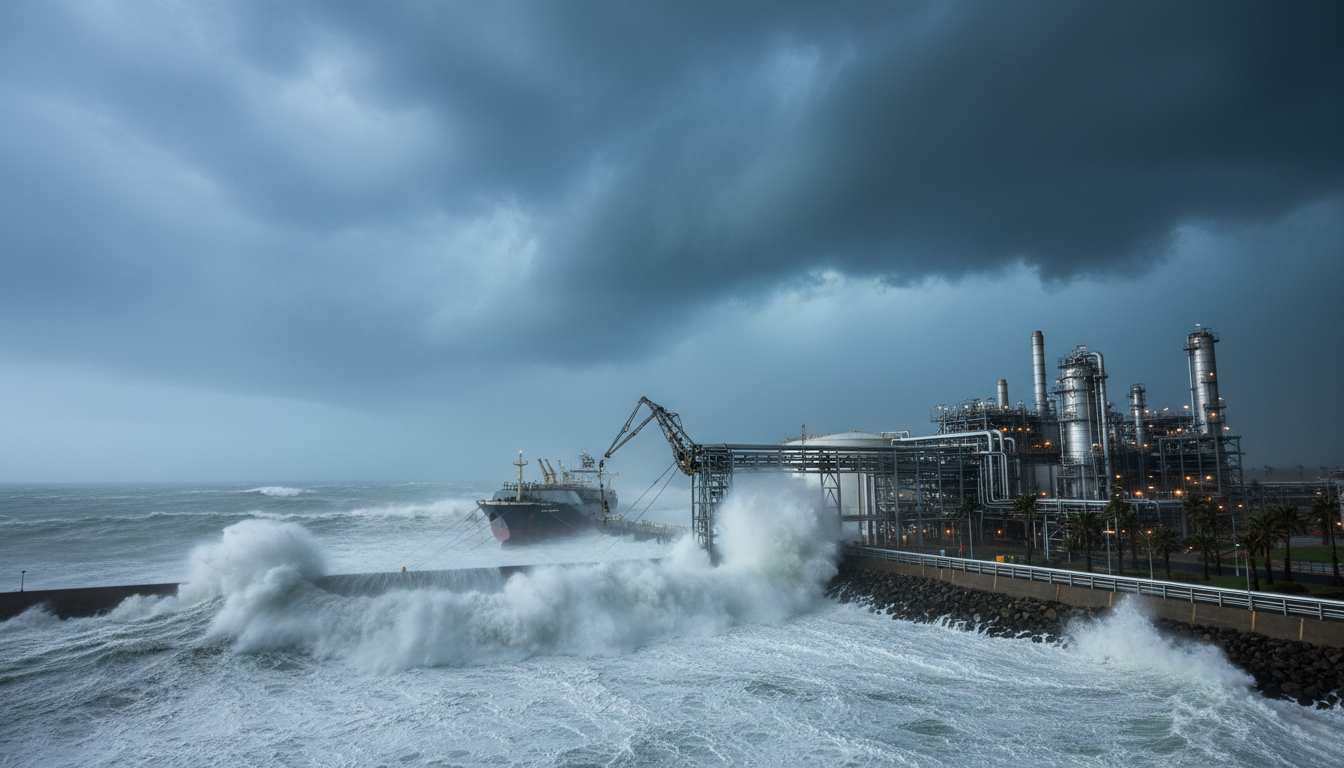
The global liquefied natural gas (LNG) market, already navigating a complex landscape of tightened supply and elevated demand, now faces intensified pressure following significant operational disruptions across key Australian export facilities. Recent cyclonic activity off Australia’s coast has compelled major energy producers to curtail output, exacerbating a global supply crunch and sending a fresh wave of volatility through international natural gas prices. This development presents a critical juncture for investors monitoring the energy sector, highlighting both the inherent risks of commodity supply chains and the potential for market price shifts.
At the forefront of these disruptions are industry giants Chevron, Santos, and Woodside, all reporting substantial impacts on their Australian LNG operations. Chevron, a pivotal player in the region, confirmed outages at its massive Gorgon and Wheatstone facilities. The Gorgon project stands as Australia’s largest LNG endeavor, boasting an impressive annual capacity of 15.6 million tons. Its sister facility, Wheatstone, contributes significantly with an 8.9 million tons per year capacity. A Chevron spokesperson assured that full production would resume once safety protocols were met, but the immediate impact on global availability is undeniable.
Prior to Chevron’s announcement, Santos initiated a shutdown at its Barossa gas field, a critical upstream asset that feeds the Darwin LNG terminal. The Darwin LNG facility has an annual processing capacity of 3.7 million tons, an important contribution to regional supply. Similarly, Woodside, another major Australian energy exporter, reported cyclone-related interruptions affecting operations linked to its formidable North West Shelf LNG project. This project is a cornerstone of Australia’s gas export infrastructure, capable of producing 14.3 million tons of LNG annually. Collectively, these facilities represent a substantial portion of Australia’s total LNG export capacity, and their temporary curtailment sends ripples across the global energy market.
These Australian outages arrive at a particularly sensitive juncture for the international LNG trade. For months, the global market has contended with a severe supply crunch, driven by a confluence of factors including geopolitical conflicts, notably the ongoing war in Eastern Europe, and robust post-pandemic demand growth. This pre-existing tightness meant that the market had little spare capacity to absorb sudden supply shocks, making the current disruptions in Australia especially impactful. The cumulative effect of these various supply-side pressures has created an environment of heightened price sensitivity and market instability.
The financial repercussions have been immediate and pronounced. Asian natural gas spot prices, a key benchmark for LNG transactions in the world’s largest consuming region, have witnessed an astronomical 143% surge since February 28th. European gas prices, while perhaps benefiting from previously built inventories, have not been immune, climbing an impressive 85% over the same period. While some market commentators point out that current prices remain below the historic peaks observed in 2022, the sheer magnitude and speed of these recent increases underscore the fragility of the global LNG supply-demand balance. For investors, this volatility presents both significant trading opportunities and considerable risk, necessitating a keen understanding of underlying market fundamentals and external disruptors.
Australian Government Eyes Windfall Profit Tax on Energy Companies
Adding another layer of complexity and potential headwind for energy investors, the Australian government is actively exploring the implementation of a windfall profit tax targeting the nation’s robust energy sector, specifically the gas and coal industries. This comes as international commodity prices remain elevated, translating into significant profits for producers. Reports indicate that the Department of Prime Minister and Cabinet has drafted documents outlining “new levy options” designed to capture a larger share of these profits for the public coffer.
The rationale behind such a tax, as articulated in government documents, is clear: “Energy producers should not benefit from high international prices at the expense of domestic customers.” This statement reflects a growing global sentiment among governments seeking to rebalance the benefits of commodity price surges, particularly in essential sectors like energy. For shareholders and potential investors, this move introduces considerable regulatory uncertainty, potentially impacting future earnings forecasts, capital expenditure decisions, and the overall attractiveness of investing in Australian energy assets.
The prospect of a windfall tax could influence investment decisions by major players like Chevron, Santos, and Woodside, who have significant long-term commitments and expansion plans in Australia. Such levies could diminish the profitability of new projects, potentially deterring future foreign direct investment into the Australian energy sector, which relies heavily on a stable and predictable regulatory environment. Investors will be closely watching the development of this policy, as it could fundamentally alter the financial calculus for Australian-based energy companies and their capacity to fund future growth or return capital to shareholders.
Navigating the Investor Landscape
The confluence of these events—cyclone-induced supply disruptions, an already tight global market, surging natural gas prices, and the looming threat of a windfall profit tax—creates a challenging yet dynamic environment for oil and gas investors. For those focused on the LNG sector, understanding the intricate interplay between weather events, geopolitical developments, demand growth, and evolving regulatory frameworks is paramount.
Companies with diversified portfolios and robust operational resilience may be better positioned to weather these storms. However, the direct impact on key Australian exporters cannot be understated. Investors should carefully analyze the short-term earnings implications for Chevron, Santos, and Woodside due to reduced output, juxtaposed with the potential long-term impacts of government policy on their project economics. The ability of these companies to mitigate disruptions, manage operational costs, and navigate regulatory changes will be crucial determinants of their investment appeal in the coming quarters.
Furthermore, the persistent tightness in the global LNG market suggests that elevated natural gas prices could remain a feature of the commodity landscape for the foreseeable future, barring a significant global economic slowdown or a dramatic increase in supply. This sustained price strength could partially offset the impact of temporary operational issues and potential new taxes, depending on the final structure of any levy. However, the increased interventionist stance from governments seeking to capture “excess” profits adds a layer of sovereign risk that investors must now factor into their assessments of energy investments in Australia and potentially other commodity-rich nations.


