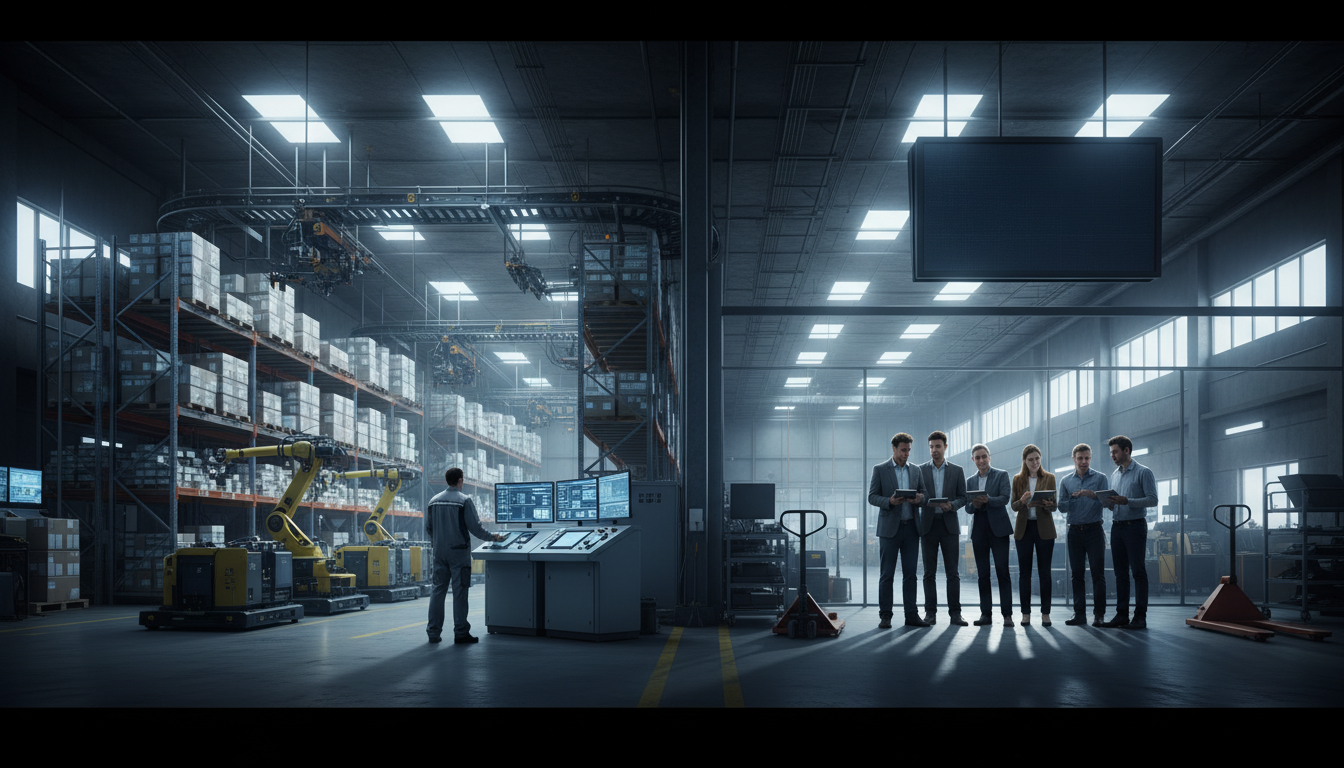
Smart Logistics: A Cross-Industry Catalyst for Investor Returns
In the relentless pursuit of operational efficiency and robust profit margins, companies across diverse sectors are embracing automation at an unprecedented pace. While much attention often centers on direct industry-specific innovations, astute investors understand that groundbreaking advancements in one arena can yield profound insights and competitive advantages for others. A prime example emerges from the retail logistics space, where Decathlon, the world’s largest sporting goods retailer, reports “significant” productivity enhancements across seven European distribution centers leveraging cutting-edge robotics from Exotec.
The impact of this technological integration extends far beyond mere cost reduction. Romain Moulin, CEO and co-founder of Exotec, highlights comprehensive benefits ranging from a dramatically reduced warehouse footprint to a substantial increase in items shipped from facilities. For instance, Decathlon’s Portuguese warehouse witnessed a doubling in its order preparation capacity, soaring from 57,000 to an impressive 114,000 orders. This leap in throughput underscores the transformative power of intelligent automation in meeting escalating market demands. Moreover, the human element within these facilities is evolving; employees experience less physical exertion, walking significantly shorter distances, and many are being reallocated to higher-value tasks, contributing to “much better working conditions,” as Moulin observed.
Exotec’s Robotic Ecosystem: A Blueprint for Industrial Efficiency
Exotec’s flagship offering, the Skypod system, represents a paradigm shift in warehouse automation. These are not bipedal humanoids but rather fleets of agile, wheeled robots capable of three-dimensional movement. Picture rectangular, autonomous units that navigate vertically and horizontally, expertly storing and retrieving hundreds of thousands of items daily from specialized storage bins. Crucially, each Skypod can ascend proprietary shelving systems up to 46 feet, a feature Moulin emphasizes for its ability to drastically condense warehouse footprints and maximize storage density. This design minimizes the need for expansive horizontal space, allowing companies to optimize their real estate or dedicate saved area to other critical operations.
The vision behind Exotec’s robotics and software platform is a fully automated, standardized goods flow—from inbound receiving to outbound shipment—that companies can rapidly deploy across multiple sites. A typical system might comprise 150 to 200 Skypods, integrated with automated depalletizers, palletizers, carton-opening machinery, and RFID tunnels that scan items on conveyor belts. This integrated approach allows for swift scalability, with Moulin noting the potential to operationalize a new warehouse every four months. Such rapid deployment and standardization capabilities present a compelling investment thesis for any industry facing complex, multi-site logistics challenges.
Reshaping the Workforce and Operational Footprint
Traditional warehouse operations often involve workers, known as pickers, manually retrieving items from shelves typically stacked 6 to 7 feet high. This labor-intensive model necessitates vast spaces, with the average warehouse spanning approximately 194,000 square feet, often forcing workers to cover distances of 10 kilometers daily. “That’s why workers are doing 10 kilometers per day, and that’s why density is so low,” Moulin explained, highlighting the inefficiencies inherent in conventional setups.
Automation fundamentally alters this dynamic. Exotec’s platform can condense a warehouse’s required footprint to as little as 65,000 square feet. This doesn’t necessarily imply downsizing; rather, it offers companies the flexibility to either reduce real estate costs or reallocate the freed space to higher-value activities. Decathlon’s UK logistics site provides tangible evidence: picker walking distances plummeted from over six miles to under one mile per day. Beyond physical strain, the platform contributes significantly to workplace safety, with incidents related to order picking at the same UK site decreasing from 1 in 5,000 to an impressive 1 in 10,000.
This technological shift also allows for strategic workforce optimization. While the number of dedicated pickers may decrease—from 50 to 12 at one site, for instance—the remaining workforce is not displaced but rather reassigned to other crucial operations like returns processing, repair services, or quality control. This reallocation increases overall throughput and enhances value creation. Decathlon’s French warehouse, for example, nearly doubled its replenishment capacity, servicing 73 stores compared to its previous 37. Similarly, its Portuguese site expanded its reach from 41 to 73 stores. These metrics underscore the dramatic operational leverage intelligent automation provides.
Strategic Investment Implications for Energy Sector Logistics
The overarching investment thesis here extends far beyond retail. Moulin emphasizes a universal challenge: “All of our customers — in Europe, in the US, in Japan — say the same thing, ‘I can’t find people to do the job.'” This global labor shortage, coupled with the imperative to double facility throughput, drives widespread adoption of automation. While some industries explore humanoid robots for simple tasks, Exotec’s approach prioritizes specialized, functional robotics powered by advanced AI. As Moulin asserts, “We don’t use a humanoid to push a cart doing 10 kilometers a day… So we use the most simple robots to move inventory and we power it with AI.”
For investors in the oil and gas sector, these advancements in smart logistics offer critical insights. The energy industry, with its complex supply chains, vast inventory requirements for drilling equipment, maintenance parts, and specialized chemicals, and often remote or hazardous operational environments, stands to gain immensely from similar automation strategies. Imagine the efficiency gains in managing spare parts inventories at large refining complexes, optimizing material flow to offshore platforms, or streamlining equipment logistics at remote shale plays. Reducing warehouse footprints, improving inventory accuracy, and enhancing safety in these capital-intensive operations directly translate into substantial cost savings and improved capital efficiency.
The ability to deploy standardized, scalable logistics systems rapidly can significantly de-risk new project developments or optimize existing asset bases. Moreover, reallocating skilled technicians from repetitive, physically demanding tasks to complex, higher-value engineering or diagnostic roles can help address persistent skilled labor shortages within the oil and gas industry. Investors should keenly assess energy companies that are actively exploring or implementing advanced warehouse and supply chain automation, as these strategic moves will increasingly define competitive advantage, operational resilience, and ultimately, superior returns in a dynamic global energy market. The lessons from retail logistics are clear: intelligent automation is not just a trend; it is a fundamental driver of future profitability across all industrial landscapes.


