The global energy landscape continues its turbulent dance, shaped by persistent geopolitical tensions in critical regions. While headlines often fixate on the fluctuating price of crude, a deeper dive into the market reveals a more nuanced, and often more profitable, story for integrated energy giants. Companies are demonstrating remarkable strategic agility, not just surviving but thriving amidst volatility, primarily by capitalizing on an unprecedented surge in refined product margins. This shift highlights how a diversified portfolio, extending from upstream production to downstream refining and distribution, is proving to be the ultimate financial buffer in today’s unpredictable environment.
Refining Margins: The True Engine of Energy Profits
While the focus frequently rests on the benchmark crude prices, the real financial story for integrated energy companies is currently playing out in the refined products market. Our proprietary market data shows Brent crude trading today at $92.37, down 0.93% within a daily range of $91.39 to $94.21. WTI crude similarly stands at $88.75, declining 1.03% in a range of $87.64 to $90.71. These figures reflect a broader trend; Brent, for instance, has softened by over 7% in the last 14 days, falling from $101.16 on April 1st to $94.09 on April 21st. Yet, despite these crude price movements, the profitability of downstream operations remains exceptionally strong.
Industry leaders, such as TotalEnergies’ Chairman and CEO Patrick Pouyanné, have underscored this dynamic, noting that while crude markets are robust, the product markets — which directly impact consumers — are experiencing far greater escalation. We’ve seen an extraordinary surge in refining margins, particularly for specialized products like Asian jet fuel, reaching levels the world has “never experienced.” This immense profitability in processing crude into products like gasoline, which currently trades at $3.1 per gallon, is more than offsetting production curtailments, even significant ones like TotalEnergies’ reported 15% output reduction. For investors, this signals that a company’s refining segment can be a powerful driver of earnings, even when upstream production faces headwinds.
LNG Under Pressure: A Global Supply Shock Reverberates
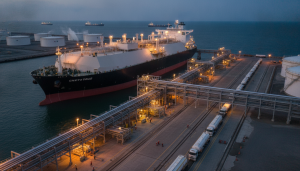
Beyond the petroleum markets, the liquefied natural gas (LNG) sector faces its own set of profound challenges, exacerbated by recent geopolitical events. The confirmation of extensive damage to QatarEnergy’s Ras Laffan plant following drone attacks has effectively removed a substantial 20% of global LNG supply from the market. This incident has sent natural gas prices soaring across key European and Asian trading hubs, posing significant risks to energy security and consumer costs worldwide.
As a leading exporter of U.S. LNG, TotalEnergies has affirmed its capability to meet contractual obligations across its diversified global portfolio. However, the broader outlook for natural gas remains precarious. Industry projections suggest that European natural gas, recently trading around $18 per million British thermal units (MMBtu), could skyrocket to $40/MMBtu if the current conflict persists through the summer months. Furthermore, the geopolitical flashpoint carries implications beyond energy, as the Strait of Hormuz, a critical maritime chokepoint, facilitates roughly 30% of global fertilizer shipments. Sustained disruption here threatens the upcoming spring planting season and could accelerate global food inflation, adding another layer of complexity to the investment landscape.
Investor Focus: Navigating Price Direction and Future Outlook
Our proprietary reader intent data reveals a clear and urgent focus among investors: predicting future price movements and understanding their impact on specific energy stocks. Common questions this week include direct inquiries about the direction of WTI crude and projections for oil prices by the end of 2026. Investors are also keen on understanding the performance trajectory of companies like Repsol, asking how well they might fare by the end of April 2026. This sentiment underscores the market’s intense desire for clarity in a highly volatile environment.
To address these forward-looking concerns, investors must closely monitor key data releases. The upcoming calendar is packed with critical indicators: the EIA Weekly Petroleum Status Reports on April 22nd, April 29th, and May 6th, which provide crucial insights into U.S. crude oil and product inventories. Additionally, the Baker Hughes Rig Count on April 24th and May 1st will offer a snapshot of drilling activity, signaling future supply trends. Perhaps most significantly, the EIA Short-Term Energy Outlook on May 2nd will provide updated forecasts for supply, demand, and prices across major energy markets. Each of these events offers essential data points that can inform investment decisions and help refine price predictions, moving beyond mere speculation to data-driven analysis.
Strategic Positioning in a Dynamic Market
The current energy market demands a sophisticated investment approach, one that looks beyond immediate crude price fluctuations to the underlying structural shifts and profit drivers. The unprecedented refining margins are a stark reminder that integrated energy companies, with their diverse revenue streams from upstream, midstream, and downstream operations, are uniquely positioned to weather geopolitical storms and capitalize on market imbalances. While upstream production may face curtailments or price volatility, a robust refining segment can provide significant earnings stability and growth.
For investors, this means prioritizing companies with strong downstream assets and diversified portfolios, including significant LNG operations, which offer exposure to evolving global energy security needs. The ongoing geopolitical risks in the Middle East will continue to cast a long shadow over both oil and natural gas markets, making supply chain resilience and strategic market positioning paramount. By focusing on firms demonstrating agility, robust financial health, and a clear strategy for navigating both crude and product markets, investors can better position their portfolios for success in this dynamic and often unpredictable energy future.