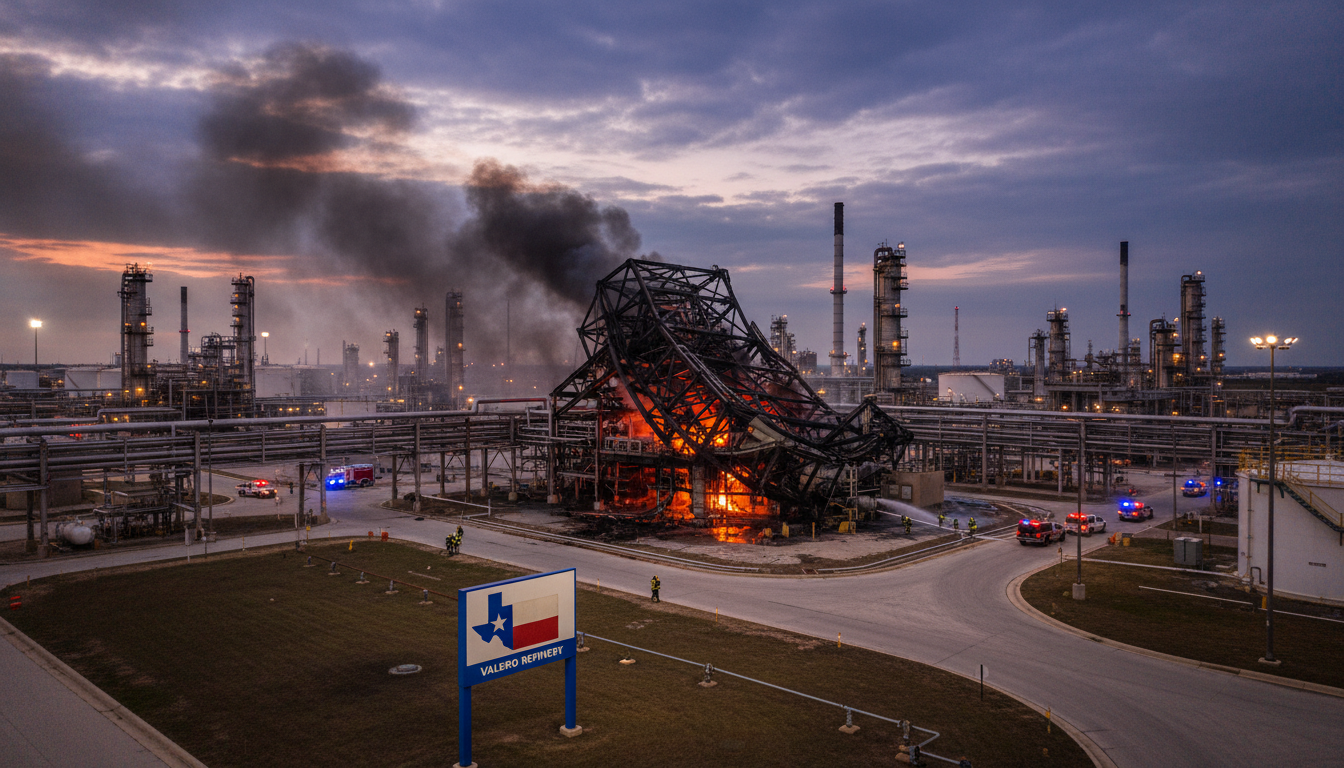
The energy market is once again reminded of the delicate balance in global supply chains as Valero Energy Corporation’s substantial 380,000-barrel-per-day (bpd) refinery in Port Arthur, Texas, has initiated a full shutdown. This critical operational pause follows a significant explosion and subsequent fire within a key diesel hydrotreater unit. The incident, impacting one of the largest refining assets on the U.S. Gulf Coast, immediately sends ripples through refined product markets, particularly for diesel, and demands immediate attention from investors tracking sector performance and fuel supply dynamics.
Operational Disruption at a Critical Gulf Coast Asset
The operational disruption at Valero’s Port Arthur complex commenced with an explosion around 7:30 p.m. CDT on Monday (0030 GMT, Tuesday), an event powerful enough to be heard up to 11 miles away. The epicenter was identified as the 47,000-bpd 243-diesel hydrotreater unit, a specialized component indispensable for modern refining. This unit employs hydrogen to remove sulfur compounds from motor fuels, ensuring compliance with stringent U.S. environmental regulations for cleaner-burning diesel. The fire that ensued raged for nearly five hours, complicating efforts due to a reported loss of crucial utilities like water supply and steam. While thankfully no injuries were reported, the complete shutdown of the Port Arthur refinery, Valero’s largest, became a necessary measure to contain the blaze and secure the plant. This facility’s strategic location, approximately 86 miles (139 km) east of Houston, places it squarely in the heart of the U.S. Gulf Coast refining hub, making its idled status a significant concern for regional and potentially national fuel supply chains.
Immediate Market Reaction and Diesel Price Volatility
The idling of a refinery of Port Arthur’s immense scale, especially one critical for low-sulfur diesel production, has immediate implications for refined product markets and, by extension, crude oil demand. As of today, Brent Crude trades at $92.37, reflecting a -0.93% dip within a day range of $91.39-$94.21, while WTI Crude stands at $88.75, down -1.03% with a daily range of $87.64-$90.71. Gasoline prices have also softened slightly to $3.1, a -0.96% change. This broader softening in crude and gasoline prices, observed over the past two weeks with Brent moving from $101.16 on April 1st to $94.09 on April 21st, creates a compelling dynamic. With crude input costs showing a recent downtrend, the sudden, significant reduction in diesel output from Port Arthur could lead to a widening of diesel crack spreads. Investors must closely monitor these spreads, which measure the profit margin for refining crude into products. A prolonged outage of the 47,000-bpd diesel hydrotreater, or the entire 380,000-bpd refinery, will inevitably tighten diesel supplies, particularly given the consistent demand for distillate fuels across transportation, agriculture, and industrial sectors. This localized supply shock against a backdrop of easing crude prices could disproportionately impact diesel profitability for other refiners with available capacity.
Navigating Forward Supply Outlook and Key Data Points
The duration of the Port Arthur shutdown remains the paramount question for market participants. A short-term repair will likely see a quick normalization of diesel supplies, but a prolonged outage could fundamentally shift regional and even national distillate balances. Investors should mark their calendars for upcoming energy data releases, which will provide crucial indicators. The EIA Weekly Petroleum Status Reports on April 22nd, April 29th, and May 6th will offer critical insights into U.S. crude and refined product inventories, including distillates. Any noticeable drawdowns in diesel stocks in these reports will signal the market’s absorption of the Port Arthur outage. Furthermore, the API Weekly Crude Inventory reports on April 28th and May 5th will provide an early look at crude stock changes, indirectly reflecting refining activity. The EIA Short-Term Energy Outlook on May 2nd will be particularly vital, as it may incorporate initial assessments of the incident’s impact on supply forecasts. While the Baker Hughes Rig Count on April 24th and May 1st provides a broader view of upstream activity, it’s the downstream inventory data that will directly illuminate the fallout from this refining disruption. These data points will be instrumental in assessing the severity and persistence of the supply constraint and its potential to influence future diesel price trajectories.
Investor Focus: Beyond the Blast to Strategic Implications
The Port Arthur incident highlights the inherent volatility and operational risks within the refining sector, prompting many investors to ask about the broader market direction. Questions like “is WTI going up or down?” or “what do you predict the price of oil per barrel will be by end of 2026?” underscore a desire for clarity in an often-unpredictable market. While no single event dictates the entire year-end outlook, a significant refining outage like this injects considerable short-to-medium term uncertainty. For investors, the focus should shift from immediate price movements to the underlying fundamentals. The incident will likely reinforce the value of integrated refiners with diversified assets or those with spare capacity to capitalize on potentially wider crack spreads. It also underscores the importance of operational resilience and robust safety protocols. Investors should evaluate refining companies based on their ability to manage such disruptions, their inventory levels, and their strategic positioning in key product markets like diesel. Monitoring the repair timeline for Port Arthur will be key, as any delays could further exacerbate supply concerns, supporting elevated diesel prices and refining margins for competitors. This event serves as a stark reminder that physical supply disruptions, even localized ones, can have outsized impacts on specific product markets and the profitability of the energy sector.