In the intricate world of energy investment, geopolitical turbulence traditionally casts a long shadow, often steering capital towards perceived safe havens like gold. Yet, the recent market action defies this conventional wisdom. Despite ongoing global tensions, gold has seen a notable retreat, signaling a profound shift in investor priorities and challenging long-held assumptions about risk aversion. This counter-intuitive movement is deeply intertwined with the unwavering strength of the U.S. dollar and has significant implications for how we assess risk and opportunity within the oil and gas sector.
The Dollar’s Unyielding Dominance Amidst Energy Volatility
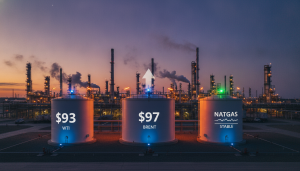
The United States dollar continues its reign as the preeminent global reserve currency, a status particularly amplified during periods of energy market dislocation. Given that virtually all international energy transactions are denominated in dollars, any supply crunch or heightened geopolitical risk inherently bolsters the greenback. As of today, Brent Crude trades at $92.37, reflecting a -0.93% dip within a day range of $91.39-$94.21, while WTI Crude sits at $88.75, down 1.03% with a range of $87.64-$90.71. These figures follow a broader trend where Brent has declined from $101.16 on April 1st to $94.09 by April 21st, a notable $7.07 or 7% drop over a two-week period. This recent softening in crude prices, even amidst a backdrop of geopolitical uncertainty, further underscores the dollar’s relative strength and its role in maintaining market stability. For the United States, a significant net energy exporter, dollar appreciation during periods of elevated crude prices reinforces its economic advantage relative to oil-importing nations, creating a dynamic that profoundly influences global commodity flows and investment strategies. This dollar strength, therefore, is a constant variable for energy investors, influencing everything from input costs to export revenues.
Gold’s Retreat: A Reassessment of Safe-Haven Status
The recent performance of gold presents a critical challenge to its traditional safe-haven narrative. Priced globally in U.S. dollars, gold becomes intrinsically more expensive for holders of other currencies as the greenback strengthens, effectively dampening demand. Beyond this direct currency effect, the prevailing environment of rising real yields, coupled with a more robust dollar, forms a potent double headwind for an asset that, by its nature, generates no income. This confluence of factors demands a reassessment of traditional safe-haven plays within a diversified investment portfolio, especially for those with significant exposure to oil and gas markets where dollar strength is a constant variable. The pronounced selling pressure on gold has been starkly evident in market structures designed to track its performance. Our proprietary data pipelines confirm a substantial flight from gold-backed exchange-traded funds (ETFs) since the onset of the current geopolitical instability. Investors have pulled an estimated $7.9 billion from these instruments, equivalent to approximately 54.8 metric tons of gold. A significant majority of these outflows originated from investment vehicles domiciled in the United States, indicating a broad-based shift in sentiment among both institutional and retail investors.
China’s Economic Pulse and Global Commodity Demand
Adding to the bearish signals for gold, and with wider implications for the entire resource sector, is the recent performance of Chinese markets. As the world’s largest gold buyer, China’s economic health serves as a crucial barometer for global commodity demand. The Shanghai Composite recently registered its steepest daily fall in a year, touching a critical psychological level for market participants. Weakening demand from the planet’s biggest consumer of precious metals is rarely a supportive indicator for its price trajectory. Energy investors keenly observe such trends, as shifts in Chinese economic health and commodity demand can have widespread implications across the global resource sector. A slowdown in China, or even a perception of one, can translate quickly into reduced demand for crude, natural gas, and other industrial commodities, potentially offsetting supply-side constraints or geopolitical premiums. This interconnectedness means that a market signal from Shanghai can ripple through global energy benchmarks like Brent and WTI, influencing future price expectations and investment decisions.
Navigating the Shifting Sands: Forward Outlook for Energy Investors
The current market dynamics, characterized by a strong dollar and a retreating gold price despite geopolitical tensions, necessitate a nuanced approach for energy investors. Our proprietary reader intent data reveals a consistent theme this week: investors are grappling with the future trajectory of crude prices, with questions like “is WTI going up or down?” and “what do you predict the price of oil per barrel will be by end of 2026?” dominating queries. These questions highlight the need for clarity amidst conflicting signals. The retreat from gold suggests a market that is prioritizing stability and yield over traditional risk hedges, potentially indicating a longer-term preference for dollar-denominated assets and a more cautious outlook on commodities not directly tied to immediate industrial demand. This environment influences how investors view energy company valuations, particularly those with significant exposure to international markets and currency fluctuations.
Looking ahead, energy investors will be closely watching several key upcoming events for further directional cues. The EIA Weekly Petroleum Status Reports on April 29th and May 6th will provide crucial insights into U.S. crude and product inventories, while the API Weekly Crude Inventory data on April 28th and May 5th will offer an early indication. The Baker Hughes Rig Count on May 1st will be vital for assessing North American supply dynamics. Perhaps most critically, the EIA Short-Term Energy Outlook on May 2nd will offer a comprehensive macro perspective on supply, demand, and price forecasts, especially relevant given the recent volatility in Brent, which has seen a 7% decline in the last two weeks. These reports, viewed through the lens of a strengthening dollar and a re-evaluated safe-haven landscape, will be pivotal in shaping investment strategies for the coming months, guiding decisions on everything from hedging strategies to portfolio allocations in a market that continues to defy simple narratives.