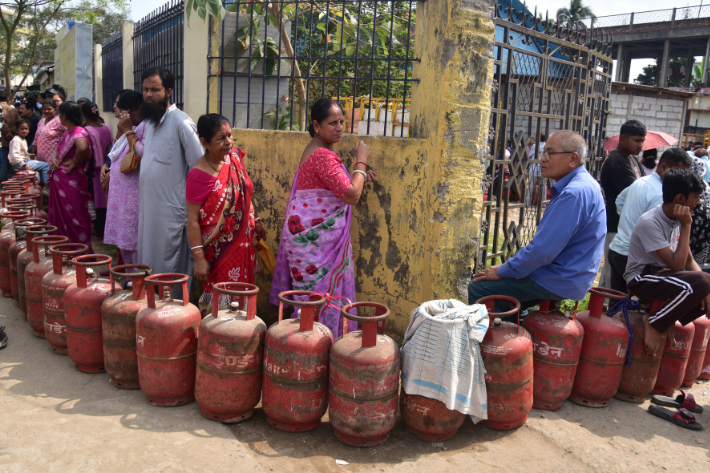
Geopolitical Flashpoints Escalate: India’s Energy Security Under Threat
The global energy landscape is once again navigating treacherous waters, with recent escalations in the Gulf region sending ripples through international markets and particularly impacting energy-dependent nations like India. A series of direct attacks on critical energy infrastructure, notably the world’s largest liquefied natural gas (LNG) facility in Qatar, has ignited fears of a broader “energy war.” These incidents, attributed to Iranian retaliation, underscore the fragility of global supply chains and the immediate challenges faced by major importers. India, heavily reliant on Qatari LNG for over 40% of its supply, has voiced deep concern, recognizing the potential for severe economic strain across its power generation, industrial, and household sectors. This analysis delves into the immediate market reactions, the strategic implications for LNG and crude flows, and what investors should monitor in the coming weeks.
Market Dynamics Amidst Mounting Geopolitical Risk
Despite the alarming headlines suggesting an impending “energy war,” crude markets have shown a nuanced reaction, presenting a complex picture for investors. As of today, Brent Crude trades at $92.1 per barrel, marking a -1.22% decline within a day range of $92 to $94.21. Similarly, WTI Crude stands at $88.39, down -1.43% from a daily range of $88.31 to $90.71. This intraday dip, however, follows a more significant downward trend observed over the past two weeks. Our proprietary data indicates that Brent Crude has actually decreased by 7% since April 1st, dropping from $101.16 to $94.09 by April 21st, and continuing its descent to today’s levels. This apparent disconnect – crude prices easing even as geopolitical tensions escalate and energy infrastructure is targeted – warrants closer examination. Investors are clearly asking, “Is WTI going up or down?” and the answer isn’t straightforward. The market’s recent retreat suggests that underlying demand concerns, potentially from a global economic slowdown or robust non-OPEC supply, might be temporarily outweighing the immediate supply disruption fears. However, the direct targeting of facilities in Qatar, Saudi Arabia, and Kuwait signals a dangerous new phase, suggesting that any sustained disruption could quickly reverse this downward trend and inject significant volatility back into prices.
The LNG Supply Chain Under Siege: A Critical Vulnerability
While crude oil often dominates headlines, the recent attacks on Qatar’s Ras Laffan LNG facility highlight a particularly acute vulnerability in the global energy matrix, especially for gas-dependent economies. Qatar is a cornerstone of global LNG supply, alongside major producers like the United States, Australia, and Russia. India’s reliance on Qatar for a substantial portion of its LNG makes these attacks a direct threat to its national energy security. Disruptions to LNG shipments, already hampered by the near-standstill of tanker traffic through the Strait of Hormuz, now face the added risk of damaged production capacity. The foreign ministry in New Delhi explicitly stated that its LNG supply is “going to be impacted,” confirming that initial shipments have already been reduced. For investors, this translates into potential upward pressure on natural gas prices globally, even if crude markets remain subdued. Companies with significant LNG assets or those involved in gas transportation and regasification could see their risk profiles altered, while nations heavily reliant on spot LNG purchases may face surging import costs, impacting their industrial output and economic stability.
Forward-Looking Analysis: Navigating Upcoming Catalysts
For investors positioning themselves in the current volatile environment, understanding upcoming market catalysts is paramount. Our proprietary event calendar highlights several key data releases over the next two weeks that will offer crucial insights into supply-demand balances and overall market sentiment. On April 22nd and 29th, the EIA Weekly Petroleum Status Reports will provide fresh data on crude oil, gasoline, and distillate inventories in the U.S., which could either reinforce or challenge the current price trends. These reports are critical for gauging immediate supply levels and refining demand. Furthermore, the Baker Hughes Rig Count on April 24th and May 1st will offer a snapshot of drilling activity in North America, indicating future production trajectories. Perhaps most significantly for those asking about the long-term outlook, such as “what do you predict the price of oil per barrel will be by end of 2026?”, the EIA Short-Term Energy Outlook (STEO) due on May 2nd will offer a comprehensive forecast for global supply, demand, and prices. This report, combined with the escalating geopolitical risks, will be instrumental in shaping longer-term investment strategies. Investors should monitor these releases closely, as any unexpected data points could trigger sharp market reactions, particularly if they suggest a tightening market that could be further exacerbated by ongoing geopolitical disruptions.
Strategic Implications and Investor Positioning
The “energy war” fears, even if not fully reflected in current crude prices, underscore a growing imperative for energy security and diversification among importing nations. For investors, this translates into a heightened focus on companies with resilient supply chains, diversified asset portfolios, and those poised to benefit from strategic shifts in energy procurement. While the immediate focus is on the Gulf, these events could accelerate investments in alternative energy sources or bolster interest in producers outside conflict zones. The Strait of Hormuz, a choke point for roughly a fifth of the world’s oil and LNG, remains a critical vulnerability. Any sustained disruption there, compounded by direct infrastructure damage, would undoubtedly shift market sentiment rapidly, potentially erasing recent price declines. Therefore, while short-term price movements might seem contradictory to the geopolitical narrative, the underlying risks are profound. Astute investors will be weighing these long-term security implications against immediate supply-demand fundamentals, recognizing that the potential for significant market disruption remains elevated.