Close Menu
  • Home
  • Market News
    • Crude Oil Prices
    • Brent vs WTI
    • Futures & Trading
    • OPEC Announcements
  • Company & Corporate
    • Mergers & Acquisitions
    • Earnings Reports
    • Executive Moves
    • ESG & Sustainability
  • Geopolitical & Global
    • Middle East
    • North America
    • Europe & Russia
    • Asia & China
    • Latin America
  • Supply & Disruption
    • Pipeline Disruptions
    • Refinery Outages
    • Weather Events (hurricanes, floods)
    • Labor Strikes & Protest Movements
  • Policy & Regulation
    • U.S. Energy Policy
    • EU Carbon Targets
    • Emissions Regulations
    • International Trade & Sanctions
  • Tech
    • Energy Transition
    • Hydrogen & LNG
    • Carbon Capture
    • Battery / Storage Tech
  • ESG
    • Climate Commitments
    • Greenwashing News
    • Net-Zero Tracking
    • Institutional Divestments
  • Financial
    • Interest Rates Impact on Oil
    • Inflation + Demand
    • Oil & Stock Correlation
    • Investor Sentiment

Subscribe to Updates

Subscribe to our newsletter and never miss our latest news

Subscribe my Newsletter for New Posts & tips Let's stay updated!

What's Hot

Q4 snapshot, KPIs in focus, and what management is signaling for 2026 – Oil & Gas 360

March 16, 2026

Q4 snapshot, KPIs in focus, and what management is signaling for 2026 – Oil & Gas 360

March 16, 2026

OTC announces 2026 Spotlight on New Technology Award winners

March 16, 2026
Facebook X (Twitter) Instagram Threads
Oil Market Cap – Global Oil & Energy News, Data & Analysis
  • Home
  • Market News
    • Crude Oil Prices
    • Brent vs WTI
    • Futures & Trading
    • OPEC Announcements
  • Company & Corporate
    • Mergers & Acquisitions
    • Earnings Reports
    • Executive Moves
    • ESG & Sustainability
  • Geopolitical & Global
    • Middle East
    • North America
    • Europe & Russia
    • Asia & China
    • Latin America
  • Supply & Disruption
    • Pipeline Disruptions
    • Refinery Outages
    • Weather Events (hurricanes, floods)
    • Labor Strikes & Protest Movements
  • Policy & Regulation
    • U.S. Energy Policy
    • EU Carbon Targets
    • Emissions Regulations
    • International Trade & Sanctions
  • Tech
    • Energy Transition
    • Hydrogen & LNG
    • Carbon Capture
    • Battery / Storage Tech
  • ESG
    • Climate Commitments
    • Greenwashing News
    • Net-Zero Tracking
    • Institutional Divestments
  • Financial
    • Interest Rates Impact on Oil
    • Inflation + Demand
    • Oil & Stock Correlation
    • Investor Sentiment
Oil Market Cap – Global Oil & Energy News, Data & Analysis
Home » AI Washing Becomes the New Greenwashing: The $1.5 Billion Collapse of Builder.ai
ESG & Sustainability

AI Washing Becomes the New Greenwashing: The $1.5 Billion Collapse of Builder.ai

omc_adminBy omc_adminMarch 16, 2026No Comments5 Mins Read
Share
Facebook Twitter Pinterest Threads Bluesky Copy Link


As artificial intelligence becomes increasingly integrated into corporate operations and investment strategies, the collapse of Builder.ai offers a cautionary lesson for investors and business leaders alike.

In the frothy years of artificial-intelligence exuberance, investors poured billions into companies promising to automate the future. One of the most celebrated was Builder.ai, a London-based startup that claimed its AI platform could build custom software applications with minimal human intervention.

By 2025, the company carried a reported valuation of $1.5 billion and had positioned itself as a pioneer of “no-code” AI-driven development. This week, it entered liquidation.

The trigger was a reported $37 million seizure by creditors. The underlying cause, according to emerging disclosures and creditor filings: inflated revenue figures, mounting debt, and a widening gap between the company’s marketing narrative and operational reality. Far from being powered primarily by autonomous AI systems, Builder.ai was reportedly relying on hundreds of human engineers to perform much of the work it described as automated.

The episode may prove more than a startup flameout. For institutional investors, it raises a larger question:Is “AI washing” becoming the new greenwashing?

Know Your AI Providers 

Builder.ai marketed itself as an AI-native platform capable of automating the software development lifecycle. Promotional materials suggested that customers could assemble sophisticated applications as easily as configuring products in an online store—an industrialization of coding through artificial intelligence.

The pitch resonated in a market hungry for productivity gains. Corporate clients sought cost efficiencies; venture investors sought exposure to scalable AI infrastructure; private markets rewarded companies that could plausibly claim technological defensibility.

Valuations reflected that optimism. Like many AI-adjacent startups, Builder.ai benefited from a capital environment in which growth narratives often outpaced technical scrutiny.

But the core value proposition—automation replacing manual labor at scale—appears to have been overstated. According to individuals familiar with the company’s operations, significant portions of the development work were executed manually by human engineers, with AI playing a more limited role than advertised.

The difference is not semantic. In the AI economy, the distinction between tool-assisted productivity and genuine automation is material to margins, scalability, and long-term valuation.

Revenue, Debt and Disclosure

Compounding the operational concerns were allegations of inflated revenue reporting. Creditors have cited discrepancies between projected growth and realized cash flows. The company also carried substantial debt obligations, which tightened as liquidity pressures mounted.

The reported $37 million seizure by creditors appears to have accelerated the collapse. Once key assets were frozen, the company’s ability to continue operating deteriorated rapidly, culminating in liquidation proceedings.

For investors, the more consequential issue is governance. If revenue figures were materially inflated, questions will inevitably follow:

What controls were in place around financial reporting?

How rigorous was board oversight?

What due diligence did investors conduct into the technical claims underpinning the business model?

The answers will matter not only for Builder.ai’s stakeholders, but for the broader AI investment landscape.

AI Washing: A Familiar Pattern

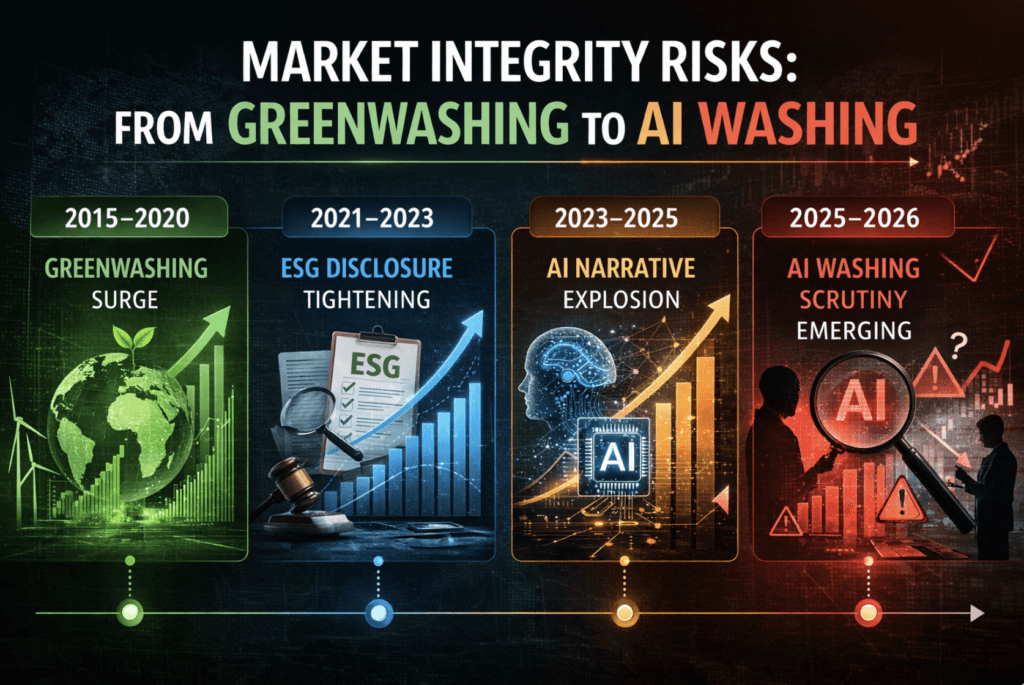
The ESG movement of the past decade was marked by a wave of “greenwashing”—companies overstating sustainability credentials to capture capital inflows. Regulators eventually responded with tighter disclosure requirements, assurance standards, and enforcement actions.

The Builder.ai case suggests that the AI sector may be entering a similar phase.

AI washing typically takes one of three forms:

Exaggerating the autonomy or intelligence of systems that rely heavily on human input.

Labeling traditional software tools as AI to attract valuation premiums.

Projecting scalability assumptions that depend on automation not yet achieved.

In an environment where AI multiples often exceed those of conventional software firms, the incentive to blur distinctions can be powerful.

Yet for institutional investors, the risks are concrete. Overstated automation translates into compressed margins. Inflated revenue narratives distort valuation models. Weak governance erodes exit pathways.

Governance as a Valuation Driver

The collapse underscores a broader shift: AI governance is becoming a core financial variable. Institutional allocators are increasingly examining:

Board-level AI literacy

Technical auditability of AI systems

Transparency around human-in-the-loop processes

Clear revenue recognition policies tied to actual automation metrics

In private markets, due diligence is evolving to include independent technical validation of AI claims. In public markets, analysts are beginning to scrutinize whether “AI-enabled” revenue reflects genuine algorithmic output or conventional labor rebranded with modern terminology.

For creditors, the lesson is equally sharp. Debt structures built on high-growth automation narratives may prove fragile if those assumptions fail.

A Market Inflection Point

Builder.ai’s liquidation does not signal a collapse of the AI sector. On the contrary, enterprise adoption of machine learning and automation continues to expand. But it may mark the end of a phase in which narrative alone could sustain billion-dollar valuations.

As regulators in the U.K., the EU and the U.S. sharpen oversight of AI deployment—particularly around transparency and accountability—disclosure standards are likely to tighten. Investors may demand clearer distinctions between AI-assisted services and AI-driven infrastructure.

The governance pillar of ESG—often overshadowed by environmental metrics—could become central to AI-era capital allocation.

For institutional investors, the takeaway is not to retreat from AI exposure. It is to interrogate it.

What proportion of revenue is truly automated?

What technical audits validate AI performance claims?

What controls prevent revenue inflation?

How resilient is the capital structure under stress?

In the wake of Builder.ai’s fall, those questions may become standard practice.

If greenwashing defined the last decade’s reputational risk cycle, AI washing may define the next governance test for capital markets.

Subscribe to ESG News’s Daily Newsletter


Source link

Share. Facebook Twitter Pinterest Bluesky Threads Tumblr Telegram Email
omc_admin
  • Website

Related Posts

Greening Wall Street: By Peter Fusaro

March 16, 2026

Early CSRD Filings Reveal How Mandatory EU Disclosure Is Reshaping Corporate Sustainability Reporting

March 16, 2026

AstraZeneca, Secaro And ERM Launch Clean Heat Program To Tackle Industrial Heat Emissions

March 16, 2026
Add A Comment
Leave A Reply Cancel Reply

Top Posts

Federal Reserve cuts key rate for first time this year

September 17, 202513 Views

Inflation or jobs: Federal Reserve officials are divided over competing concerns

August 14, 20259 Views

Cheap parcels from China will no longer be duty-free. Here’s what it means for buyers and sellers

May 1, 20259 Views
Don't Miss

OTC announces 2026 Spotlight on New Technology Award winners

By omc_adminMarch 16, 2026

(WO) – The Offshore Technology Conference (OTC) has announced the winners of its 2026 Spotlight…

IEA says Asia to receive immediate oil from 400 MMbbl reserve release

March 16, 2026

AI Washing Becomes the New Greenwashing: The $1.5 Billion Collapse of Builder.ai

March 16, 2026

TotalEnergies warns Middle East conflict could cut 15% of its output

March 16, 2026
Top Trending

ReNew Raises $95 Million to Expand Commercial & Industrial Decarbonization Platform

By omc_adminMarch 16, 2026

Nest to Vote Against Companies that Have Scaled Back Climate Commitments

By omc_adminMarch 16, 2026

Replacing 1m petrol cars with EVs could cut Australia’s reliance on foreign fuel by 1bn litres a year | Electric vehicles

By omc_adminMarch 16, 2026
Most Popular

The 5 Best 65-Inch TVs of 2025

July 3, 202520 Views

AI’s Next Bottleneck Isn’t Just Chips — It’s the Power Grid: Goldman

November 14, 202514 Views

The Layoffs List of 2025: Meta, Microsoft, Block, and More

May 9, 202510 Views
Our Picks

IEA Says It Has More Emergency Oil Reserves Available

March 16, 2026

North America Drops 6 Rigs WoW

March 16, 2026

ExxonMobil, Halliburton deploy closed-loop automated drilling in Guyana

March 16, 2026

Subscribe to Updates

Subscribe to our newsletter and never miss our latest news

Subscribe my Newsletter for New Posts & tips Let's stay updated!

Facebook X (Twitter) Instagram Pinterest
  • Home
  • About Us
  • Advertise With Us
  • Contact Us
  • DMCA
  • Privacy Policy
  • Terms & Conditions
© 2026 oilmarketcap. Designed by oilmarketcap.

Type above and press Enter to search. Press Esc to cancel.


