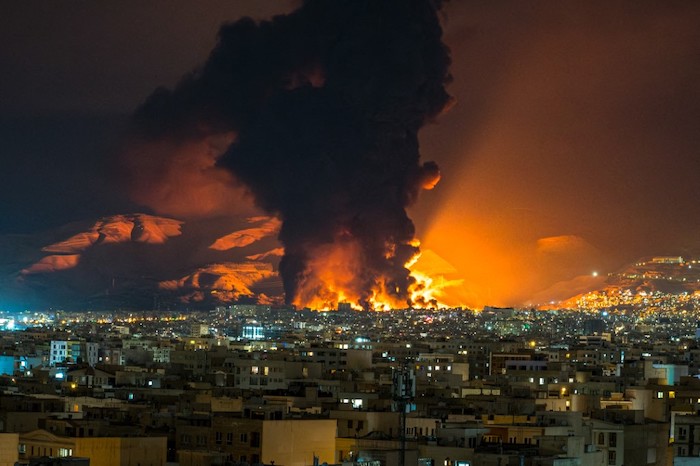
The crisis in Iran has intensified, with the selection of a new hardline leader and further strikes on the country and neighbouring states.
The price of oil surged past $100 a barrel on Monday, for the first time in four years, and Tehran has done nothing to suggest it might bow to US demands for an unconditional surrender or peace talks.
The war is a huge concern for multiple countries all across Asia – from Bangladesh, India, China, Thailand, Japan, Korea, the Philippines and more – because oil and gas prices have soared, and there is no indication yet on how long Iran’s blockade on tanker traffic in the Strait of Hormuz will last.
ALSO SEE: China Beats US Again in Global Patent Race, Huawei Keeps its Lead
Tehran had little hesitation in appointing Mojtaba Khamenei, son of the former hardline cleric Ali Khamenei, as the new Supreme Leader to replace his father. Indeed, it marked his appointment with another barrage of missiles against Israel and the Gulf states on Monday, according to AFP.
World oil prices continued to rise as Iran entered its new era – and the conflict its 10th day, while Saudi Arabia battled drones targeting its oilfields and Bahrain’s state energy company warned after a missile strike that it may be unable to fulfil export contracts.
Focus on alleviating energy crisis
So, the US, its allies and governments all over Asia have been focused on finding ways to mitigate the economic impacts.
Finance ministers from the G7 group of wealthy nations were due to meet on the crisis later today and, according to media reports, set to discuss releasing 300-400 million barrels of oil from strategic reserves to dampen the pressure on energy prices and protect the world economy.
The United Arab Emirates and Kuwait also reported new attacks, and Asian economic officials have reacted quickly.
The Japanese and South Korean stock markets closed down by more than 5%, while motorists in the Philippines queued to fill their tanks and Vietnam prepared to scrap tariffs on fuel imports. (For more details on responses from Asian governments, see below).
European markets also opened sharply down, and gas prices on the continent soared 30%. Since the start of the war, the benchmark oil contract WTI has risen more than 75% and Brent more than 60%.

‘Force majeure’
Following strikes on Bahrain’s sprawling Al Ma’ameer oil facility that ignited a fire and material damage, the country’s state-owned energy company Bapco joined its counterparts in Qatar and Kuwait in declaring “force majeure” – a warning that events beyond its control may lead it to miss export targets.
The war came just weeks after Iranian authorities under Ayatollah Ali Khamenei crushed nationwide protests against the government, killing many thousands according to rights groups. Some outlets, such as The Guardian, have said more than 30,000 people could have been killed.
The younger Khamenei, appointed to replace the cleric who led Iran for nearly four decades and who was killed in the first wave of US-Israeli strikes, is considered a fellow hardliner who will pursue his father’s rejection of dissent, AFP said.
US President Donald Trump had previously dismissed Mojtaba Khamenei as a “lightweight”, and insisted again on Sunday, on ABC News, before the announcement that: “If he doesn’t get approval from us, he’s not going to last long.”
After similar threats from Israel, a Chinese foreign ministry spokesman warned that Beijing opposes targeting leaders and insists “Iran’s sovereignty, security, and territorial integrity should be respected.”
‘Small price to pay’
Trump has dismissed the oil price spike, a politically sensitive issue in the United States, as a “small price to pay” for removing the alleged threat of Iran’s nuclear programme.
In a sign that the United States does not expect a quick end to the war, the State Department ordered non-emergency staff to leave Saudi Arabia, days after a drone hit the US embassy.
As questions swirl over the length and goals of the war, Trump told the ‘Times of Israel’ that any decision on when to end hostilities will be a joint one with Israel’s Prime Minister Benjamin Netanyahu.
“I think it’s mutual… a little bit. We’ve been talking. I’ll make a decision at the right time, but everything’s going to be taken into account,” Trump said.
Few expect major changes in Iran’s stance under the younger Khamenei, a trained cleric close to Iran’s powerful Islamic Revolutionary Guard Corps.
The Guards quickly pledged support for the new leader, who comes into the role with far less experience than his father, saying they were “ready for complete obedience and self-sacrifice in carrying out the divine commands”.
Iran’s allies and proxies also rushed to express support, with the powerful Badr organisation in Iraq saying the new leadership represents “blessed continuity of the path of the Islamic revolution”.
Clashes in Lebanon
The multi-front war also intensified in Lebanon. Iran-backed militants Hezbollah said they were engaging Israeli forces who landed in eastern Lebanon on 15 helicopters across the Syrian border and a new powerful strike hit the southern districts of Beirut.
Lebanon’s state-run National News Agency earlier reported “fierce clashes” around the town of Nabi Sheet, where an Israeli operation over the weekend killed 41 people. Lebanon’s health minister said Israeli strikes have killed at least 394 people since the start of the war, including 83 children and 42 women.
Iran’s health ministry said Sunday that at least 1,200 civilians had been killed and around 10,000 wounded – figures AFP could not independently verify.
In Israel, Iranian missile attacks have killed 10 people, while two soldiers had died in Lebanon, authorities said.
ASIAN ECONOMIES MOVE TO LIMIT IMPACTS
Faced with soaring prices and disruptions to their oil and gas supplies, Asian countries dependent on fossil fuels from the Gulf have moved to protect their domestic markets.
In South Korea, which is the world’s eighth-largest consumer of crude oil, President Lee Jae Myung said the country was moving toward instituting fuel price caps to alleviate pressure on energy supplies.
“We should swiftly introduce and decisively implement a price ceiling system for petroleum products that have recently seen excessive price increases,” he told a cabinet meeting on Monday.
His chief of staff said on Friday the country had already secured the “emergency delivery” of four million barrels of crude oil from ports in the United Arab Emirates.
Meanwhile, in Japan, Kyodo news agency said Tokyo is considering drawing on its national oil reserves to protect itself against possible prolonged supply disruptions – a measure demanded by the country’s refiners.
The government said last week that Japan had stocks equivalent to 254 days of crude oil consumption – including reserves held by the private sector – and three weeks of liquefied natural gas (LNG) consumption.
In China, the country’s main refiners have been asked to suspend exports of diesel and gasoline to prioritise domestic needs. About 57% of China’s direct imports of crude transported by sea in 2025 came from the Middle East, according to the analysis firm Kpler.
In Taiwan, which is highly dependent on fuel imports, the government is looking for LNG shipments from other sources to compensate for gas it can no longer get from Qatar.
The government was also seeking to keep prices “as stable as possible” for consumers via “a fuel pricing formula” that would take into account neighbouring markets, he said.
India, meanwhile, has been pushing ahead with imports of Russian oil, after the US issued a temporary waiver allowing New Delhi to buy Moscow’s oil if it was currently stranded at sea.
An Indian government source, however, said New Delhi does not need any country’s permission to source the fuel from Russia, its largest crude supplier. The source said India was “well stocked” with more than 250 million barrels of crude and petroleum products to “handle short-term disruptions”.
The country’s petroleum ministry has reassured the public that India “has sufficient energy reserves”, without ruling out potential measures to mitigate the impact.
In Bangladesh, the new government said on Monday it will close all universities and forward the Eid al-Fitr holidays forward, as part of emergency measures to conserve electricity and fuel amid its worsening energy crisis. It said the move will not only reduce power consumption but also ease traffic congestion, which leads to fuel wastage.
The country, which relies on imports for 95% of its energy needs, imposed daily limits on Friday on fuel sales after panic buying and stockpiling.
In Vietnam, the government says it has prepared a draft decree that would slash import tax rates to zero on certain petroleum products in a bid to “stabilize the domestic market”, its finance ministry said. Tariffs of 10% on unleaded gasoline and 7% on diesel, aviation fuel and kerosene would all be temporarily removed under the decree.
In the Philippines, the government began adopting a four-day working week on Monday to counter soaring fuel prices. President Ferdinand Marcos also ordered state agencies to reduce their fuel and electricity consumption by 10-20%, while police have warned against hoarding.
Indonesia, which is under pressure due to a fiscal policy that worries analysts and investors, warned it has limited room to manoeuvre. Finance Minister Purbaya Yudhi Sadewa warned on Friday that people may have to pay more if no other solution can be found. “This means that fuel prices will have to rise and the budget can no longer support” increased energy subsidies, he said.
In Thailand, the interim Bhumjaithai government said last week it had secured two months’ worth of oil supplies but was suspending exports to conserve its holdings. The government also capped the price of diesel at just under 30 baht ($0.94) per litre for a 15-day period.
In Cambodia, which relies completely on imported diesel and petrol for consumer fuel needs, the energy minister said their reserves would only last for about three weeks. So, retail fuel prices have already been raised.
And in Myanmar, the military government has enforced rules to ration fuel, requiring half of all private vehicles to stay off the roads each day, depending on their licence plate numbers. Reporters in Yangon have seen queues at some petrol stations and restrictions on the amount of fuel sold to each driver, but the junta has only allowed modest price hikes so far, AFP said.
But the most interesting impact could be whether the war in the Gulf prevents Iran from supplying jet fuel and military drone technology to the military regime, and provides some respite to citizens in the war-torn nation.
Recent investigations by Amnesty International and Reuters revealed that Iran-linked “ghost ships” transported aviation fuel to Myanmar’s Western-sanctioned military regime in 2024 and 2025, driving the junta’s daily airstrikes on pro-democracy rebels and civilian targets.
Amnesty warned that the regime could now pivot back to Southeast Asia to secure fuel from its previous suppliers in Vietnam, Thailand, Singapore, China and Malaysia, Irrawaddy reported.
ALSO SEE:
Asian Market Rout Intensifies as Mideast Crisis Pushes Oil Higher
War in Iran Could Hit Some of Asia’s Biggest Economies Hard
Asian Markets Slump, Oil Prices Rise as Iran War Fears Intensify
BNP Wins Bangladesh Election, Son of Former Leaders to be PM
India Puts Off Talks, China Says ‘Cancel Tariffs’ After US Ruling
China Using Trump ‘Uncertainty’ to Dominate Global Trade
‘Ghost Tankers’ From Iran Ferried Jet Fuel to Myanmar Airforce
