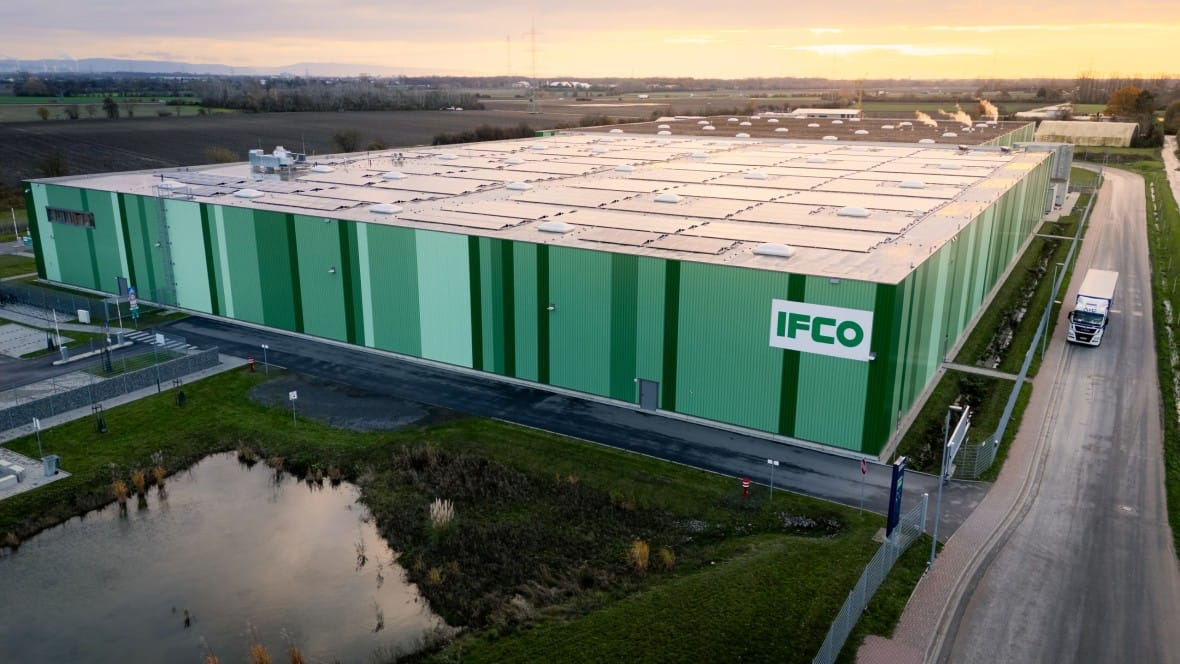
IFCO targets one million tonnes of annual customer emissions savings by 2030, building on 803 million kilograms avoided in 2025.
The company’s new 2030 ESG strategy expands circularity, water stewardship, digital traceability, and Net Zero-aligned targets validated by SBTi.
Governance, supply-chain standards, and community food security anchor a widened mandate that embeds circularity into global grocery systems.
ESG strategy shifts packaging from waste stream to Scope 3 climate lever
Packaging provider IFCO has set a target to help its grocery and retail customers avoid one million tonnes of carbon emissions annually by 2030, expanding circular supply-chain solutions as companies contend with tightening climate disclosure requirements and rising scrutiny of Scope 3 emissions.
The commitment anchors IFCO’s new 2030 ESG strategy, Thriving with Purpose, which broadens the firm’s sustainability mandate to include science-based climate targets, renewable electricity adoption across key partners, water stewardship, waste reduction, certification-based governance, and digital traceability across food logistics.
“At IFCO, sustainability progress is something we measure, verify, and deliver year after year together with our customers,” said CEO Mike Pooley. “Our record 2025 results show that circularity at scale works.” He added that the company’s new goals are “fully embedded in how we operate and grow our business globally.”

In 2025, customers using IFCO’s reusable packaging avoided more than 803 million kilograms of CO₂e and reduced water, waste, energy use, and food losses, based on third-party reviewed life-cycle assessments aligned with ISO 14040 and ISO 14044.
Climate ambition extends into partner networks and Net Zero alignment
A significant change from earlier strategy cycles is the extension of climate and ESG requirements beyond IFCO’s direct operations into its logistics and manufacturing partners. The company will pursue 100 percent renewable electricity across key service-centre partners and reusable crate manufacturers by the end of the decade.
The firm’s near-term 2031 science-based targets have been validated by the Science Based Targets initiative (SBTi), including a 46.2 percent reduction in Scope 1 and 2 emissions and a 17 percent reduction in specified Scope 3 categories from a FY21 baseline. IFCO intends to set a validated Net Zero target by 2030.
For retailers and food producers tackling Scope 3, the company positions reusable crates as both a decarbonisation tool and an operational efficiency asset. Circular systems also reduce regulatory risk as multiple jurisdictions advance waste, plastics, and EPR (extended producer responsibility) legislation that increases the cost of single-use packaging.
Digital traceability pushes packaging into the food-systems data layer
The strategy introduces a digital traceability layer across IFCO’s SmartCycle via track-and-trace solutions. The firm expects 25 percent of its retail customers to use these tools for food-waste reduction and traceability by 2030. IFCO’s data-enabled crates allow real-time logistics monitoring, tamper and condition information, and asset-loss control, responding to both food-safety requirements and emerging digital product passport regimes.
This move positions packaging infrastructure inside broader food-systems transformation efforts, where regulators and investors expect stronger data disclosure across land use, emissions, water, waste, and food loss.
Water, materials, and waste elevated as climate-linked resource risks
Beyond carbon, the strategy introduces water-stewardship commitments reflecting growing physical-risk exposure for food logistics. IFCO will halve freshwater use per crate in extremely high-stress locations by 2030 and deploy site-level stewardship programmes.
Material circularity commitments include upcycling all reusable crates at end-of-life, maintaining zero waste to landfill with verification, and innovating lower-carbon material alternatives to virgin plastics. The approach aligns with EU circular-economy directives, national plastics strategies, and corporate Scope 3 procurement expectations.
RELATED ARTICLE: IFCO Introduces Dora: The Game-Changing Reusable Plastic Pallet
People, certification, and food security round out ESG scope
Safety, culture, and gender targets form the “Society” pillar of the strategy, including a goal for women to represent 40 percent of managers and 40 percent of the executive team by 2030. IFCO will require key partners representing 80 percent of operational volume to meet or exceed industry safety benchmarks and obtain ISO 45001, 14001, and 9001 certifications.
The strategy also scales a long-standing partnership model with food banks, aiming to support the delivery of 500,000 tonnes of food by 2030. Reusable crates offer food-quality and logistics advantages that reduce waste and improve handling efficiency.
“While circularity remains central, our new focus highlights creating shared value for people, communities, and the planet,” said Iñigo Canalejo, VP ESG and Strategic Marketing.

Why this matters for corporate climate and food-systems investors
The IFCO strategy lands as global companies face structural pressure to quantify, disclose, and reduce supply-chain emissions under CSRD, ISSB, and evolving national reporting regimes. Packaging seldom features as a headline climate lever, yet contributes materially to Scope 3 emissions, food waste, and resource use across food systems.
For institutional investors, the strategy illustrates how circular models can evolve into industrial decarbonisation mechanisms; for food and retail corporates, it converts logistics infrastructure into a scalable emissions-avoidance tool; and for policymakers, it complements regulatory efforts to phase out single-use waste streams while improving system efficiency.
The company characterises Thriving with Purpose as a strategy “to scale what works.” The wider test will be whether circular systems can expand fast enough to meet regulatory timeframes and tightening climate budgets in the food sector — a space where yield, emissions, water, and waste are increasingly interdependent.
Follow ESG News on LinkedIn


