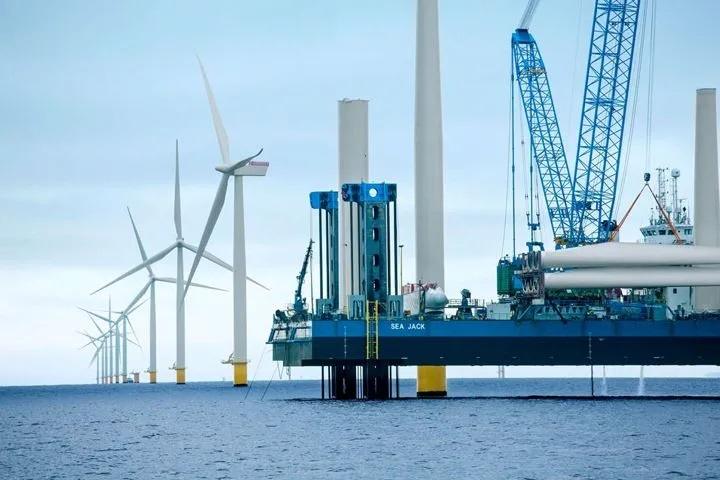
The recent legal challenge by Ørsted and its joint venture partner, Skyborn Renewables, against a U.S. government order to halt work on their nearly complete Revolution Wind project off the coast of Rhode Island sends a clear signal to energy investors: political risk in large-scale infrastructure projects is on the rise. With approximately $5 billion already spent or committed to this critical offshore wind development, and commercial operation expected within weeks, the sudden suspension, citing “national security risks,” introduces a significant layer of uncertainty into the energy transition narrative. This move, which mirrors a similar challenge from Dominion Energy regarding its Coastal Virginia Offshore Wind project and impacts nearly 6 GW of planned capacity, underscores the complex interplay between policy, permitting, and project execution that investors must now meticulously navigate. As capital markets grapple with these headwinds in the renewable sector, the implications for traditional oil and gas investments become even more pertinent.
Market Crossroads: Renewable Headwinds and Oil’s Enduring Resilience
The unfolding situation in the U.S. offshore wind sector adds a new dimension to energy investment strategies, particularly when juxtaposed against the current dynamics in traditional crude markets. As of today, Brent crude trades at $90.24, experiencing a marginal dip of 0.21%, with its day range between $93.87 and $95.69. WTI crude similarly saw a decrease of 0.85%, settling at $86.68, within a daily range of $85.50 to $87.49. While both benchmarks have shown some volatility, the 14-day Brent trend reveals a notable correction, moving from $118.35 on March 31st to $94.86 on April 20th, a decline of nearly 20%. This broader market movement reflects a complex mix of supply-demand signals and macro-economic concerns, yet crude prices remain at a level that supports robust profitability for upstream producers.
The regulatory quagmire engulfing projects like Revolution Wind, despite securing all federal and state permits in 2023 and engaging in years-long consultations with agencies including the U.S. Department of Defense, starkly contrasts with the relatively more predictable, albeit cyclical, investment landscape of oil and gas. Investors looking for capital deployment opportunities might view the escalating political and legal risks in the renewable space as a deterrent, potentially redirecting capital towards sectors with clearer operational pathways. The fact that the Revolution Wind project, a joint venture involving BlackRock’s infrastructure investment unit Skyborn Renewables, faces such hurdles even after a previous BOEM halt in August 2025 was overturned by a federal court, highlights a persistent and unpredictable regulatory environment that could impede the pace of the energy transition and, by extension, prolong the market’s reliance on fossil fuels.
Navigating Policy Uncertainty: Upcoming Catalysts for Traditional Energy
The escalating regulatory friction in the renewable energy sector creates a dynamic backdrop for investors closely monitoring the traditional oil and gas markets. While Ørsted and Dominion Energy pursue legal avenues to unfreeze their substantial offshore wind investments, the conventional energy calendar offers a series of concrete events that will provide clearer market direction. On April 21st, the OPEC+ JMMC Meeting is a critical event for global supply outlooks, with any signals regarding production adjustments directly influencing crude prices. This meeting will be closely watched for cues on how major producers plan to manage market stability amidst geopolitical tensions and evolving demand projections. For investors, these scheduled events offer tangible data points, a stark contrast to the protracted legal battles and policy reversals now plaguing large-scale renewable projects.
Further insights into the U.S. supply picture will come from the EIA Weekly Petroleum Status Reports on April 22nd and April 29th, which detail crude inventory levels, refinery activity, and product demand. These reports are instrumental in gauging domestic market health and potential price movements. Simultaneously, the Baker Hughes Rig Count on April 24th and May 1st will provide a crucial barometer of U.S. drilling activity, indicating future production trends. These recurring data releases, coupled with the comprehensive EIA Short-Term Energy Outlook on May 2nd, offer a more structured and transparent framework for analysis compared to the unpredictable nature of political interventions in new energy infrastructure. Investors are increasingly seeking clarity, and these established data streams from the oil and gas sector may offer a perceived sanctuary from policy-driven volatility.
Investor Sentiment: Seeking Clarity Amidst Energy Transition Friction
Our proprietary reader intent data reveals a clear focus among investors on the immediate trajectory of crude prices and the stability of the traditional energy sector. Questions such as “is WTI going up or down” and “what do you predict the price of oil per barrel will be by end of 2026?” underscore a desire for direct, actionable insights into oil’s future. This intensified interest in the fundamentals of crude oil occurs at a time when the renewable energy sector faces unprecedented political and regulatory headwinds. The $5 billion Revolution Wind project, nearly complete and fully permitted, now languishes under a federal work stoppage, raising serious questions about the predictability of investment returns in green infrastructure.
For investors, this situation highlights the significant, often underappreciated, political risk associated with long-duration, capital-intensive renewable projects. When an administration can unilaterally pause projects representing nearly 6 GW of energy capacity, citing vague “national security risks” despite extensive prior departmental approvals, it erodes investor confidence. This uncertainty may compel some to re-evaluate their exposure to renewable development, potentially shifting capital back towards the traditional oil and gas sector, which, despite its own cyclicality and environmental pressures, often operates within a more established and predictable regulatory framework. The ongoing legal challenges by Ørsted and Dominion Energy will be closely monitored, not just for their outcome, but for the precedent they set regarding the sanctity of permits and the enforceability of project agreements in the energy transition.
Investment Implications: Re-evaluating Risk in the Energy Landscape
The U.S. government’s repeated attempts to halt major offshore wind projects, as demonstrated by the current challenge against the Revolution Wind order, represent a significant paradigm shift in energy investment risk. This is not an isolated incident; it’s part of a broader pattern, including a presidential memorandum that was later struck down by a federal court, and two separate attempts to stop the Revolution Wind project alone. The scale of capital committed, approximately $5 billion for Revolution Wind, and the breadth of projects affected, nearly 6 GW of capacity along the U.S. east coast, necessitate a fundamental re-evaluation of investment theses for both renewable and traditional energy. Investors must now factor in the increasing likelihood of protracted legal battles and policy reversals, which can lead to significant cost overruns, delays, and stranded assets.
This heightened political risk could slow the pace of the energy transition, as developers become more cautious about committing vast sums to projects vulnerable to policy shifts. For oil and gas investors, this scenario might paradoxically strengthen the investment case for traditional energy assets in the near to medium term. While the long-term imperative for decarbonization remains, the immediate practicalities of energy supply, security, and affordability are being highlighted by these regulatory roadblocks. The challenge for investors lies in balancing the long-term strategic shift towards cleaner energy with the immediate tactical need to navigate a volatile political landscape. Capital will flow to where returns are most predictable and risks are best understood, and the current environment suggests a renewed appreciation for the more established, albeit evolving, investment parameters of the oil and gas sector.


