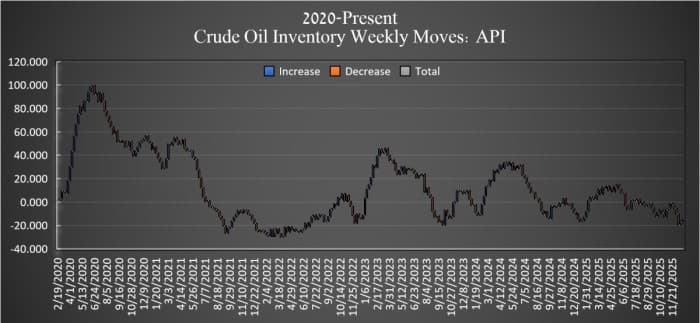
The latest US inventory data points to an easing of immediate supply pressures, with crude oil, gasoline, and distillate stockpiles all registering builds. Specifically, the American Petroleum Institute (API) estimated a 1.7 million barrel increase in US crude inventories for the week ending December 26, following a 2.4 million barrel rise the prior week. This trend, coupled with significant builds in refined products and the Strategic Petroleum Reserve (SPR), presents a nuanced picture for energy investors. While these figures might typically signal bearish sentiment, the broader market context, including recent price volatility and upcoming geopolitical and production decisions, suggests a complex interplay of factors that demand close attention.
Inventory Builds Signal Potential Supply Relief Amidst Volatility
The recent inventory data reveals a clear trend of increasing stockpiles across key segments of the US oil market. Beyond the 1.7 million barrel crude build, gasoline inventories saw a substantial increase of 6.2 million barrels, pushing them slightly above the five-year average for this time of year. Distillate inventories also rose by 1 million barrels, though they still remain about 5% below their five-year average. Adding to the supply side, the Department of Energy (DoE) reported a 200,000 barrel increase in the Strategic Petroleum Reserve (SPR), bringing its total to 413.2 million barrels as replenishment efforts continue. Even Cushing, the critical delivery hub for WTI futures, saw an 800,000 barrel increase. As of today, Brent crude trades at $90.4, registering a marginal decrease of 0.03% within a daily range of $93.87-$95.69, while WTI crude stands at $86.8, down 0.71% with a day range of $85.5-$87.49. These inventory builds, while indicative of easing supply, occur in a market that has seen significant price action. Our proprietary data shows Brent crude has shed nearly 20% over the past 14 days, falling from $118.35 on March 31 to $90.4 today. This substantial price correction underscores that the market is actively digesting these inventory signals alongside broader macro and geopolitical developments.
Dissecting Production Trends and Demand Indicators
While inventories swelled, US crude production offered a mixed signal. Output for the week ending December 19 slightly decreased to 13.825 million barrels per day (bpd), a minor dip from the prior week’s 13.843 million bpd. However, looking at the bigger picture, current production levels are still 262,000 bpd higher than at the beginning of the year, demonstrating the underlying resilience of US shale. The diverging paths of gasoline and distillate inventories also provide insight into demand. Gasoline, now above its five-year average, suggests relatively robust consumer mobility or perhaps an oversupply in refining output relative to immediate consumption. Conversely, distillates, remaining 5% below their five-year average despite recent builds, could point to persistent industrial demand or tighter supply-side constraints for these products. Investors should carefully consider how these production and refined product inventory dynamics might evolve, especially given the significant 14-day decline in Brent crude, which suggests a broader shift in market sentiment towards potential demand headwinds or increased supply expectations, despite the nuanced weekly inventory reports.
Addressing Investor Concerns: Navigating Price Outlook
Our proprietary reader intent data reveals a clear and pressing question on the minds of OilMarketCap.com investors: “is WTI going up or down?” and “what do you predict the price of oil per barrel will be by end of 2026?” These questions highlight the prevailing uncertainty and the challenge of forecasting in a volatile market. The recent 14-day Brent crude price drop of nearly 20% from $118.35 to $90.4 vividly illustrates this volatility. While the current inventory builds might exert bearish pressure, the absolute price levels for Brent and WTI, at $90.4 and $86.8 respectively, remain historically elevated. Predicting a definitive “up” or “down” requires a comprehensive view of supply-side decisions from major producers, the pace of global economic recovery, and geopolitical stability. Investors are advised to focus on understanding the key drivers rather than chasing short-term price movements. The interplay of US production, strategic reserve management, and global demand cues will dictate the longer-term trajectory, making a granular understanding of market forces paramount.
Key Events on the Horizon: Shaping the Next Market Moves
The coming weeks are packed with critical energy events that will undoubtedly influence market sentiment and price discovery. Investors should mark their calendars for several pivotal announcements. On April 21, the OPEC+ Joint Ministerial Monitoring Committee (JMMC) meeting could provide crucial signals regarding the alliance’s production policy, a key determinant of global crude supply. This will be swiftly followed by the EIA Weekly Petroleum Status Report on April 22 and again on April 29, which will offer official government data on US inventories, production, and demand, either confirming or challenging the API estimates. The Baker Hughes Rig Count, scheduled for April 24 and May 1, will shed light on North American drilling activity and potential future production growth. Perhaps one of the most anticipated events is the EIA Short-Term Energy Outlook (STEO) on May 2, which will offer the agency’s updated forecasts for supply, demand, and prices through 2026 and beyond. These upcoming events represent significant catalysts for market re-evaluation and will be instrumental in shaping investor expectations for crude oil and refined product prices, providing the next pieces of the puzzle for those seeking to understand the future direction of oil markets.