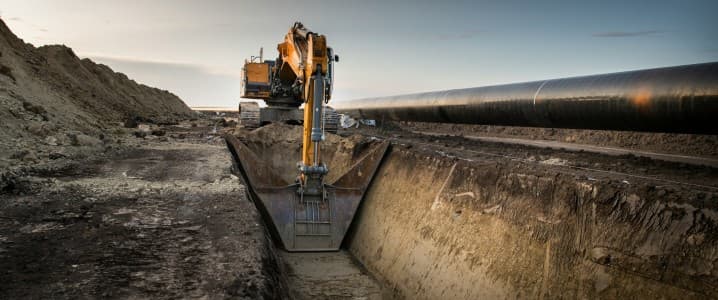
The East African Crude Oil Pipeline (EACOP) project is rapidly advancing, with its developers confirming a 75% completion rate. This significant infrastructure undertaking, valued at $5 billion, is poised to transform Uganda from a landlocked nation with substantial oil reserves into a key crude exporter on the global stage. As the 1,443-kilometer pipeline, designed to transport up to 246,000 barrels of crude per day from Uganda’s Albertine rift basin to Tanzania’s Tanga port, moves closer to its projected operational start in the second half of 2026, investors are keenly assessing the implications for regional energy dynamics and the broader oil market.
EACOP: Unlocking a New Hydrocarbon Frontier
Uganda’s Lake Albert region holds an estimated one billion barrels of oil and gas equivalent, a resource base that has long awaited a viable export route. The EACOP project represents the culmination of years of planning and investment, primarily driven by lead shareholder TotalEnergies (62%), alongside Uganda National Oil Company (UNOC) and Tanzania Petroleum Development Corporation (TPDC), each with a 15% stake, and China’s CNOOC holding 8%. This consortium is developing the Tilenga and Kingfisher fields, which will feed the pipeline. The progress on EACOP is a critical de-risking event for these upstream assets, signaling a clear path to market for what will be a significant new source of African crude. The pipeline’s substantial capacity underscores its potential to materially impact regional supply chains and provide long-term revenue streams for the participating nations.
Navigating Current Market Headwinds and Investor Queries
As EACOP presses towards completion, it enters a global oil market marked by considerable volatility. As of today, Brent Crude trades at $94.68, reflecting a 0.84% decline, while WTI Crude stands at $86.34, down 1.24%. This follows a particularly turbulent period, with Brent having shed nearly 20% in just three weeks, plummeting from $118.35 on March 31 to its current levels. Such fluctuations naturally heighten investor caution. Our proprietary reader intent data reveals a strong focus on future price trajectories, with investors frequently asking, “what do you predict the price of oil per barrel will be by end of 2026?” and “is WTI going up or down?” These questions highlight the overarching concern about the market environment EACOP will enter. While TotalEnergies has addressed environmental scrutiny by citing the project’s low Scope 1 and 2 emissions intensity of 12 kilograms of CO2 equivalent per barrel of oil equivalent, investor sentiment also balances these ESG considerations against the fundamental need for new supply in a world increasingly focused on energy security. The long-term viability and profitability of projects like EACOP hinge significantly on sustained healthy crude prices.
Key Upcoming Events Shaping the 2026 Landscape
The operational timeline for EACOP in the second half of 2026 means that the project’s market entry will be significantly influenced by a series of upcoming macroeconomic and industry-specific events. In the immediate term, investors will be closely watching the OPEC+ Joint Ministerial Monitoring Committee (JMMC) Meeting on April 21st, which could signal future production policy and impact global supply balances. The EIA Weekly Petroleum Status Reports, scheduled for April 22nd and April 29th, will offer crucial insights into U.S. inventory levels and demand trends, often setting the tone for short-term price movements. Furthermore, the Baker Hughes Rig Count on April 24th and May 1st will provide a barometer for future upstream activity. Longer-term, the EIA Short-Term Energy Outlook on May 2nd will be particularly relevant, offering a comprehensive forecast that can influence investment decisions and provide a clearer picture of the demand and supply conditions EACOP will face upon commissioning. These events, collectively, will help shape the market narrative and pricing environment into which Uganda’s new crude stream will flow.
Investment Implications and Strategic Positioning
For shareholders like TotalEnergies and CNOOC, the advanced progress of EACOP de-risks a substantial capital commitment and solidifies their strategic positioning in East Africa. The project’s 75% completion mark provides a tangible milestone for analysts assessing the companies’ future production profiles and cash flow generation. For UNOC and TPDC, the pipeline represents a transformational economic catalyst, providing direct access to international markets and fostering national energy independence. While the project has faced environmental opposition, TotalEnergies has emphasized its commitment to minimizing the carbon footprint, projecting total lifetime emissions of 13.5 million tons of CO2 equivalent for both the Tilenga and EACOP projects. Investors should consider the geopolitical stability of the region, the long-term global demand outlook for crude, and the potential for further infrastructure development in East Africa as key factors in evaluating the full investment thesis for EACOP and its associated upstream assets. The timely execution of this project, despite past delays, positions the consortium to capitalize on anticipated global energy needs in the coming years.


