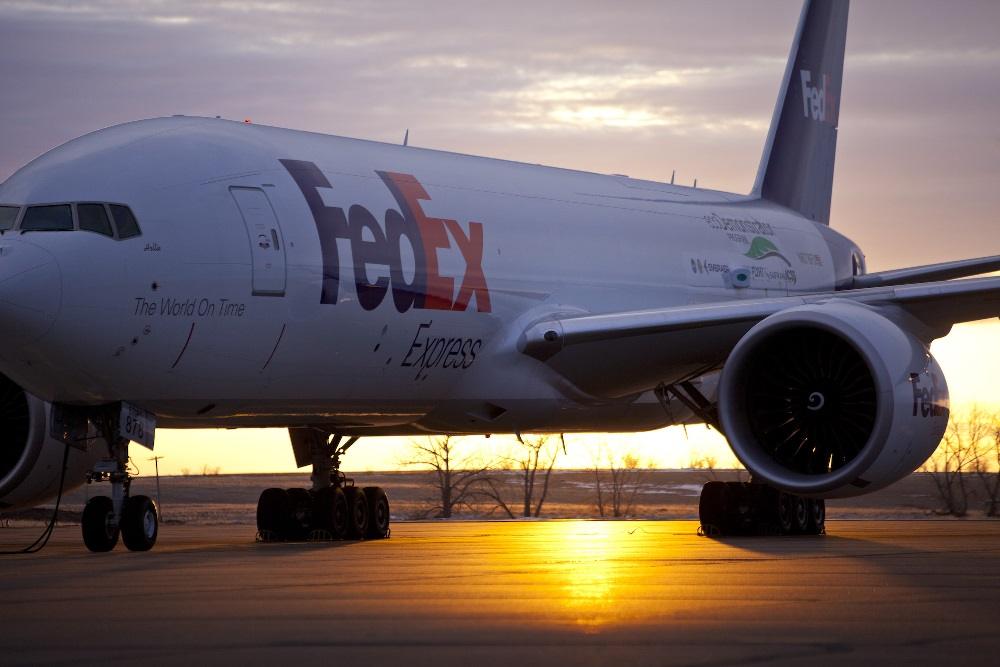
The global logistics behemoth, FedEx, has significantly expanded its commitment to Sustainable Aviation Fuel (SAF) by announcing new sourcing agreements for its operations at Chicago O’Hare and Miami International Airports. This strategic move, building on an earlier deployment at Los Angeles International, signals a robust and growing demand signal from major corporate players for cleaner aviation alternatives. For energy investors, this isn’t just a corporate sustainability headline; it’s a clear indicator of an accelerating shift in the aviation fuel market, creating both challenges and lucrative opportunities within the broader oil and gas ecosystem.
A Concrete Demand Signal for Sustainable Aviation Fuel
FedEx’s latest agreements underscore a tangible and escalating corporate drive towards decarbonization. At Chicago O’Hare, the company will receive a blend incorporating one million gallons of neat SAF from Air bp, representing a minimum 30% blend. This makes FedEx the first US all-cargo airline to procure and deploy SAF at this major hub. Concurrently, operations in Miami have commenced receiving approximately three million gallons of blended SAF, also at a minimum 30% blend, from AEG. These commitments follow an initial acquisition of over three million gallons of blended SAF from Neste for flights out of Los Angeles International earlier this year. Such specific, large-scale procurement efforts by a logistics giant like FedEx, which aims to achieve carbon neutrality by 2040 and source 30% of its fuel from alternative sources by 2030, translate directly into a powerful demand pull for SAF producers and the entire sustainable aviation supply chain. The $2 billion FedEx has allocated for its carbon neutrality goals highlights the substantial capital poised to flow into this nascent, but rapidly expanding, sector.
Navigating Volatility: SAF as a Strategic Hedge Amidst Market Swings
The increasing corporate adoption of SAF comes at a time of notable volatility in traditional energy markets, a key concern for many investors, particularly those asking about the future trajectory of crude oil prices. As of today, Brent crude trades at $90.17, marking a significant 9.28% decline, with WTI crude similarly down 9.83% to $82.21. This sharp daily correction follows a broader 14-day trend where Brent has shed over 12% from its recent highs, falling from $112.57 to $98.57. Such pronounced price swings in conventional jet fuel feedstock present a complex challenge for long-term operational planning in the aviation sector. For companies like FedEx, investing in SAF, despite its current premium, offers a strategic hedge against this market unpredictability. It provides a pathway to greater price stability and environmental compliance, decoupling a portion of their operational costs from the often-turbulent conventional crude market. Investors are keenly watching how these demand shifts from major consumers will influence future crude oil consumption patterns and, consequently, the long-term price outlook for traditional fuels.
The Supply Side Imperative and Upcoming Market Catalysts
While demand signals from major players like FedEx are strengthening, the aviation industry still faces a significant “mismatch between available SAF supply and carrier demand,” as noted by FedEx’s Chief Sustainability Officer. This gap, however, presents a compelling opportunity for investors positioned across the SAF value chain. The upcoming energy calendar holds several events that, while primarily focused on conventional oil markets, will indirectly influence the urgency and investment climate for SAF. The OPEC+ Joint Ministerial Monitoring Committee (JMMC) meeting tomorrow, April 17th, followed by the full Ministerial meeting on April 18th, will be critical. Decisions on production quotas directly impact crude oil prices. Should OPEC+ maintain or further tighten supply, pushing conventional fuel prices higher, the economic rationale for scaling SAF production becomes even more compelling. Regular updates from the API and EIA on crude inventories, scheduled for April 21st and 22nd respectively, will also offer insights into the immediate supply-demand dynamics of conventional fuels, further framing the competitive landscape for alternative options. Investors asking about current OPEC+ production quotas understand that these decisions have ripple effects far beyond just crude oil, influencing the acceleration of the energy transition in sectors like aviation.
Investment Opportunities Across the SAF Ecosystem
The expansion of SAF deployment by FedEx, combined with its ambitious long-term goals and a $2 billion investment commitment, signals a maturing market ripe for investor interest. Opportunities extend beyond just the direct production of SAF by companies like Air bp, Neste, and AEG. Investors should also consider the upstream elements: the development and sourcing of sustainable feedstocks (e.g., waste oils, agricultural residues, algae), the technological advancements in conversion processes, and the necessary infrastructure for transport, blending, and distribution. Furthermore, companies providing carbon sequestration solutions, electric vehicle technologies for ground operations, and other sustainable energy solutions that contribute to FedEx’s broader carbon neutrality target also stand to benefit. The aviation sector’s move towards a 40% reduction in aircraft emissions intensity by 2034, as targeted by FedEx, indicates a sustained and growing need for innovative solutions across the entire energy transition spectrum. Identifying and backing the companies that are building out this future SAF ecosystem will be key for long-term growth in the evolving energy investment landscape.


