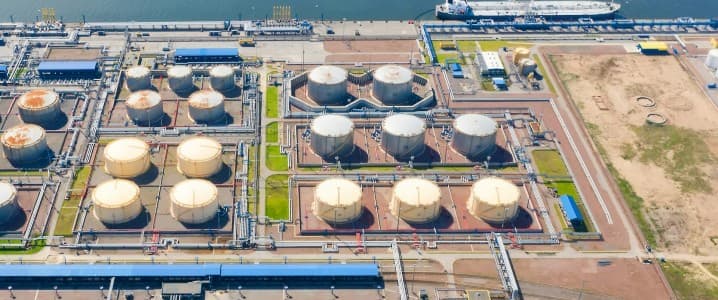
The global energy landscape is constantly shifting, but few developments demand investor attention quite like significant disruptions at critical infrastructure. Africa’s largest refining complex, the Dangote refinery in Nigeria, is currently grappling with a series of operational challenges that have substantially curtailed its gasoline output. This situation creates a ripple effect across regional product markets and influences global crude dynamics, offering both risks and opportunities for savvy oil and gas investors. Our proprietary data pipelines highlight a tightening refined product market even as crude prices face headwinds, underscoring the divergence that investors must meticulously track.
Operational Hurdles Cripple Gasoline Production
The 650,000 barrels-per-day Dangote refinery, a pivotal facility for refined product supply across Africa and beyond, has seen its crude oil purchases dramatically reduced in recent weeks. Our analysis of vessel-tracking data and allocation lists indicates that the plant is set to buy fewer than 300,000 barrels per day (bpd) of crude in October. This marks a stark reduction from the robust over 600,000 bpd purchased in July, signaling deep-seated operational issues. These challenges are multifaceted, encompassing unplanned outages, general operational setbacks, and even suspected sabotage amidst ongoing worker restructuring. A national strike in late September, reportedly triggered by layoffs, led to an estimated production loss of 600,000 barrels, as confirmed by the Nigerian National Petroleum Company’s chief executive. This prolonged period of underperformance, with low gasoline output projected to continue into next year, directly impacts product availability and pricing, particularly for gasoline.
Historically, the Dangote refinery demonstrated flexibility in its crude sourcing, even importing significant volumes of U.S. WTI crude earlier this year, which at one point exceeded local Nigerian crude supplies in July. However, since then, the facility has scaled back both its U.S. crude imports and purchases of Nigerian grades. October’s crude supply is estimated at just 287,000 bpd, with 153,000 bpd being Nigerian crude and the remainder comprising U.S. barrels. This subdued crude buying pattern further confirms the persistent issues within its gasoline-producing units, creating a vacuum in regional supply that other refiners and traders are now scrambling to fill.
Market Dynamics: Product Tightness Amidst Crude Weakness
The operational woes at Dangote have created a fascinating dichotomy in the global energy market. While the refinery’s reduced gasoline output has undeniably tightened product markets, particularly in Europe, the broader crude oil complex has experienced significant downward pressure. As of today, Brent Crude trades at $90.38, marking a notable 9.07% decline within the day, with its range fluctuating between $86.08 and $98.97. Similarly, WTI Crude stands at $82.59, down 9.41%, trading in a daily range of $78.97 to $90.34. This recent depreciation in crude prices follows a pronounced trend over the past 14 days, where Brent crude has plummeted from $112.78 to its current $90.38, representing a substantial 19.9% drop.
This crude market weakness stands in contrast to the specific product market dynamics. Despite the overall bearish sentiment in crude, and even a daily dip in gasoline prices to $2.93 (down 5.18%), the underlying structural support for gasoline in the wake of Dangote’s issues remains critical. The reduction in supply from Africa’s largest refinery has historically supported European gasoline prices, and any further delays or extended underperformance will continue to provide a floor for product margins. Investors should recognize this divergence: a generally softer crude market does not necessarily translate to weakness across all refined products, especially when a major supply source like Dangote is constrained. Refining margins, therefore, could see resilience or even expansion in specific product categories despite broader crude price trends.
Forward-Looking Analysis: OPEC+ and Investor Sentiment
The ongoing situation at the Dangote refinery adds another layer of complexity to the global oil supply-demand balance, directly influencing key decisions and investor sentiment. Our reader intent data reveals that investors are keenly asking about the trajectory of crude prices by year-end and, crucially, about OPEC+’s current production quotas. These questions underscore a focus on supply-side stability and future price direction, both of which are impacted by large-scale disruptions like those in Nigeria.
Looking ahead, the next 14 days are packed with critical energy events that could further shape market sentiment. The OPEC+ Joint Ministerial Monitoring Committee (JMMC) Meeting on April 19th, followed by the full OPEC+ Ministerial Meeting on April 20th, will be closely watched. With Brent crude having fallen by nearly 20% in the last fortnight, the group’s stance on production levels becomes paramount. While the Dangote issues relate to refined products, sustained operational challenges at such a large refinery reduce global crude demand, potentially influencing OPEC+’s calculus. If the group decides to maintain or even deepen existing production cuts to stabilize prices, the impact on crude benchmarks could be significant. Further insights into U.S. supply will come from the API Weekly Crude Inventory reports on April 21st and 28th, and the EIA Weekly Petroleum Status Reports on April 22nd and 29th, alongside the Baker Hughes Rig Count on April 24th and May 1st. These reports will provide a clearer picture of demand-side pressures and U.S. production response, all against the backdrop of reduced refinery throughput in Africa.
Investment Implications: Navigating Refined Product Volatility
For investors, the prolonged operational challenges at the Dangote refinery present a compelling case for a nuanced approach to energy portfolios. With analysts projecting subdued gasoline output well into next year, the structural tightness in the regional and potentially European gasoline markets will likely persist. This scenario could benefit companies with refining assets outside the affected region, particularly those with strong export capabilities to West Africa or Europe. Furthermore, companies involved in product tanker shipping could see increased demand for their services as gasoline is rerouted from other regions to fill the supply gap.
Conversely, integrated oil companies with significant downstream exposure in the affected markets, or those relying on consistent fuel supply from the Dangote complex, may face margin pressures or supply chain disruptions. Investors should carefully evaluate the exposure of their holdings to these dynamics. The divergence between falling crude prices and resilient refined product margins, particularly for gasoline, highlights the importance of granular analysis within the energy sector. As the market digests the upcoming OPEC+ decisions and weekly inventory data, the operational status of key refining hubs like Dangote will remain a critical, albeit often overlooked, factor influencing both crude and product market trajectories.


