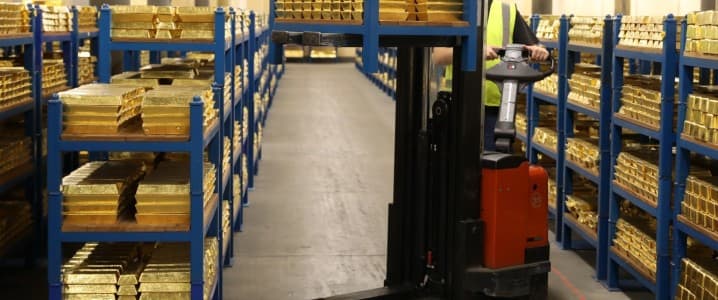
The global investment landscape is currently witnessing a dramatic reallocation of capital, epitomized by gold’s unprecedented surge past the $4,000 per ounce mark for the first time in history. This monumental rally, building on a robust 50% gain since January, reflects a profound flight to safety driven by escalating political tensions and renewed anxieties over global financial stability. While precious metals like silver and platinum also register multi-year highs, the oil market is charting a distinctly different, more volatile course. Investors are rapidly de-risking from growth-sensitive assets, and the implications for crude prices are immediate and significant. Understanding this divergence, and the catalysts shaping it, is crucial for navigating the energy sector in the coming weeks and months.
The Broad Market Shift: Gold’s Ascent and Oil’s Retreat
The spectacular performance of gold, which jumped over 3% in intraday trading recently, underscores a deepening concern among investors regarding both policy stability and geopolitical uncertainty. This move into traditional safe havens is a direct consequence of a broader risk-off sentiment permeating financial markets. For the oil sector, this translates into sharp downward pressure on prices, as crude is often seen as a bellwether for global economic activity and is sensitive to demand fears.
As of today, Brent Crude trades at $90.38 per barrel, a significant 9.07% decline within the trading day, with its range fluctuating between $86.08 and $98.97. Similarly, WTI Crude has fallen even further, settling at $82.59, marking a substantial 9.41% drop for the day, having traded between $78.97 and $90.34. This sharp sell-off is not an isolated event; it continues a bearish trend that has seen Brent Crude shed $22.40 per barrel, or nearly 20%, since March 30th when it traded at $112.78. Gasoline prices are also feeling the pinch, currently at $2.93, down 5.18% today. This clear divergence from other strengthening commodity classes highlights oil’s specific vulnerability to fears of demand destruction and economic slowdown in an increasingly uncertain global environment.
Geopolitical Tensions and Policy Fog: The Underlying Drivers
The catalysts for this market re-evaluation are multifaceted, but increasingly centered on political and financial stability. Intensifying political standoff in the United States, including high-profile calls for legal action against state and city leaders and the preparation for potential deployment of National Guard troops to major urban centers, introduces a layer of domestic political risk rarely seen. Legal experts are already flagging potential constitutional confrontations, indicating the gravity of the situation. Such events, while seemingly localized, contribute to an overarching sense of instability that prompts investors to seek refuge in assets perceived as immune to political chaos.
Beyond domestic politics, the broader global financial landscape is characterized by renewed fears over stability and future policy direction. Expectations of potential Federal Reserve rate cuts later in the year, coupled with central banks—particularly in Asia and the Middle East—actively expanding their gold holdings, signal a collective hedge against potential dollar instability and persistent inflationary pressures. This global movement away from traditional risk assets and towards tangible stores of value like gold reflects a systemic concern about the long-term health of the global economy and the efficacy of monetary policy, ultimately weighing heavily on commodities like oil that rely on robust industrial demand.
Investor Focus: Navigating Uncertainty and Upcoming Catalysts
Our proprietary reader intent data reveals a clear preoccupation among investors with the forward trajectory of crude prices, with many actively asking “what do you predict the price of oil per barrel will be by end of 2026?” The current steep declines in Brent and WTI, down nearly 10% today alone, only amplify these concerns, making accurate long-term forecasting significantly more challenging. Similarly, questions around “OPEC+ current production quotas” are prominent, indicating investor reliance on cartel policy for stability in a volatile market.
The immediate future for crude prices hinges critically on a series of key upcoming events that investors will scrutinize for directional cues. The OPEC+ Joint Ministerial Monitoring Committee (JMMC) Meeting on April 19th, followed immediately by the full OPEC+ Ministerial Meeting on April 20th, will be under intense scrutiny. Given the prevailing bearish sentiment and sharp price declines, any hints of production adjustments or clear reaffirmations of current output cuts will be pivotal in shaping market direction. Beyond OPEC+, crucial insights into supply-demand dynamics will come from the API Weekly Crude Inventory reports on April 21st and 28th, and the EIA Weekly Petroleum Status Reports on April 22nd and 29th. These will provide vital data on U.S. inventory levels. Furthermore, the Baker Hughes Rig Count reports on April 24th and May 1st will offer an early read on U.S. shale activity and potential future supply responses. Each of these events carries the potential to either mitigate or exacerbate the current bearish sentiment, making the next two weeks critical for oil market positioning.
Beyond Crude: Broader Commodity Trends and the Dollar’s Influence
While oil suffers from risk aversion, the broader precious metals complex is experiencing a robust rally, driven by the same underlying concerns about inflation, currency risk, and geopolitical uncertainty. Silver and platinum are hitting multi-year highs, and the overall strengthening across precious metal markets indicates a systemic hedging strategy. Notably, the value of America’s gold reserves has now exceeded $1 trillion for the first time, driven primarily by price appreciation rather than new acquisitions, highlighting the global shift in asset valuation.
The easing of U.S. Treasury yields on safe-haven flows further underscores this capital reallocation. This dynamic suggests that while some commodities are benefiting from their role as inflation hedges or safe havens, oil’s deep linkage to industrial activity and global economic growth places it in a different category. Investors are making a clear distinction: they are embracing assets that protect against systemic risk, but simultaneously pulling back from those perceived to suffer from potential economic contraction or geopolitical disruption to trade and demand. The oil market’s trajectory will therefore remain highly sensitive to evolving geopolitical narratives and the precise timing and scope of central bank policy adjustments.


