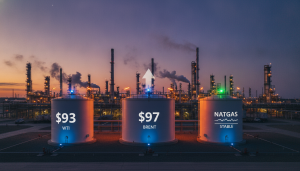
Geopolitical Tensions Drive Crude Volatility, Current Prices See Pullback
While recent days have seen crude oil markets react sharply to escalating geopolitical tensions, particularly in the Middle East, the immediate price action reveals a complex interplay of risk premiums and broader market forces. Earlier in the week, reports of an Israeli strike on Hamas leaders in Doha, subsequently condemned by influential OPEC+ members including Saudi Arabia, Iran, and the UAE, indeed injected a bullish sentiment into crude futures. This was fueled by concerns over potential supply disruptions and already tight OPEC+ spare capacity, alongside continued Chinese crude stockpiling efforts. However, the market’s dynamism means daily sentiment can shift. As of today, Brent crude trades at $98.44, marking a 0.96% decline, while WTI crude follows suit, down 1.21% to $90.07. This immediate pullback, even amidst ongoing geopolitical undercurrents, underscores the delicate balance between supply-side fears and demand-side realities, suggesting investors are processing a confluence of factors beyond headline risks.
Navigating Brent’s Evolving Technical Landscape
The technical picture for Brent crude has undergone a significant transformation, with levels that were once critical resistance and support now serving as historical markers. Previously, traders closely monitored the 200-day moving average at $67.70 as a pivotal resistance, with a break above potentially targeting swing highs in the $68.40s. Immediate support levels were identified at $64.92 and $64.37, structural points that had demonstrated resilience during prior market pullbacks. However, current market conditions, as revealed by our proprietary data, show Brent trading significantly above these historical ranges. Our 14-day trend analysis indicates Brent crude has recently experienced a substantial correction, dropping from $112.57 on March 27th to $98.57 yesterday, representing a notable $14 or 12.4% decrease. This pronounced movement means that while geopolitical risk may provide a floor, the market has recalibrated its immediate technical outlook, focusing on new resistance and support levels far above those observed in earlier trading periods. Investors are now assessing whether this recent downtrend indicates a broader shift or merely a healthy correction within a still-bullish long-term geopolitical narrative.
Upcoming Catalysts: OPEC+ and Inventory Data in Focus
The coming weeks are packed with critical events poised to shape the trajectory of crude oil prices, providing key forward-looking insights for investors. Our proprietary event calendar highlights several high-impact dates. This Friday, April 17th, brings the latest Baker Hughes Rig Count, offering a pulse check on North American drilling activity. More significantly, the market’s attention will then pivot to OPEC+. The Joint Ministerial Monitoring Committee (JMMC) meets on April 18th, followed by the full OPEC+ Ministerial Meeting on April 20th. These gatherings are paramount, as investors are keenly awaiting any signals regarding future production policy, a sentiment clearly reflected in our reader intent data, where queries like “What are OPEC+ current production quotas?” frequently emerge. Any deviation from current production agreements, or even a strong affirmation of the status quo, could trigger significant price movements. Beyond OPEC+, weekly inventory reports from the American Petroleum Institute (API) on April 21st and the official EIA Weekly Petroleum Status Report on April 22nd will offer crucial insights into U.S. supply and demand dynamics, directly impacting crude and gasoline stockpiles. With gasoline trading at $3.09, these inventory figures will provide vital context for refined product markets as well. These recurring events, including the subsequent Baker Hughes Rig Count on April 24th and further API and EIA reports on April 28th and 29th, respectively, collectively form the backbone of near-term market expectations, demanding close monitoring from energy investors.
Investor Intelligence: The Demand for Robust Data and Analytics
In today’s volatile energy market, investors are increasingly sophisticated in their demand for timely, accurate, and transparent data. Our proprietary reader intent signals underscore this trend, with a significant number of inquiries focusing not just on price points, but on the underlying data infrastructure. Questions such as “What data sources does EnerGPT use? What APIs or feeds power your market data?” and “What is the current Brent crude price and what model powers this response?” highlight a strong desire among our audience to understand the provenance and reliability of the information guiding their investment decisions. This focus on data integrity is crucial in an environment where geopolitical events and technical shifts can cause rapid market swings. Investors recognize that proprietary data pipelines, like those powering our analysis, offer a distinct advantage by providing real-time market snapshots and trend insights that general news feeds cannot replicate. As crude markets continue to navigate geopolitical risks, production policy debates, and evolving demand pictures, the ability to access and interpret first-party, high-fidelity data becomes an indispensable tool for identifying actionable investment opportunities and managing risk effectively.