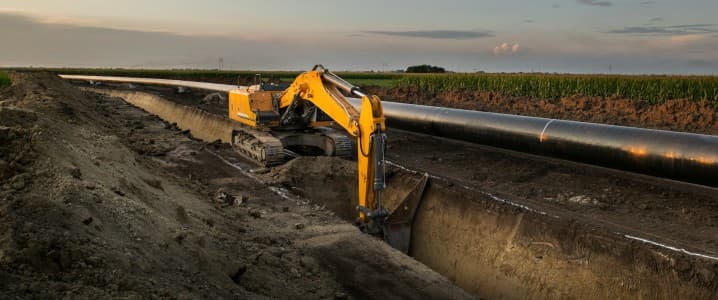
The U.S. energy landscape continues its dynamic evolution, with the Permian Basin remaining a cornerstone of domestic crude oil and natural gas production. A significant development further solidifying this trend is the announcement of the Eiger Express Pipeline, a new natural gas project poised to significantly enhance takeaway capacity from West Texas to the Gulf Coast. This 450-mile, 42-inch pipeline, a collaborative effort involving ONEOK, MPLX LP, Whitewater, and Enbridge Inc., is engineered to transport up to 2.5 billion cubic feet per day (Bcf/d) of natural gas. Expected to be operational by mid-2028, the Eiger Express represents a critical infrastructure investment designed to connect the prolific Midland and Delaware basins to high-demand markets in the Katy area near Houston, with reserved capacity extending to Corpus Christi, Texas. For investors, this project underscores the enduring strategic value of midstream assets in monetizing the Permian’s robust output and catering to escalating domestic and international gas demand.
Permian’s Production Boom Drives Midstream Necessity
The Permian Basin’s reputation as a leading oil-producing region inherently means a substantial volume of associated natural gas is brought to the surface as a byproduct. As crude oil output has surged, so too has natural gas production, frequently outpacing the existing infrastructure’s ability to transport it. This imbalance has historically led to depressed local gas prices and increased flaring, representing both an environmental concern and a lost revenue opportunity. The Eiger Express Pipeline directly addresses this challenge by providing crucial additional takeaway capacity. The project’s substantial 2.5 Bcf/d capacity is not just a number; it reflects a strategic response to the Permian’s sustained growth trajectory, ensuring that valuable natural gas can efficiently reach markets rather than being constrained. The involvement of established players like ONEOK, MPLX, Whitewater, and Enbridge, leveraging their existing Matterhorn joint venture, signals strong industry confidence in the project’s necessity and long-term viability. Furthermore, the pipeline is supported by firm transportation agreements extending 10 years or longer, demonstrating robust customer commitment and a predictable revenue stream for the participating companies.
Navigating Market Volatility with Strategic Infrastructure
In a commodity market often characterized by sharp price fluctuations, the stability offered by midstream infrastructure projects like the Eiger Express becomes particularly attractive to investors. As of today, Brent crude trades at $90.38 per barrel, reflecting a significant 9.07% decline for the day, with its price range spanning $86.08 to $98.97. Similarly, WTI crude sits at $82.59, down 9.41%, having traded between $78.97 and $90.34. This daily volatility follows a broader trend, with Brent having fallen from $112.78 on March 30 to $91.87 just yesterday, an 18.5% drop over two weeks. Such swings highlight the inherent risks in direct commodity exposure. In contrast, investments in pipelines, supported by long-term, fee-based contracts, offer a more insulated financial profile. The Eiger Express, with its decade-long firm transportation agreements, exemplifies this stability. Its revenue generation is tied to the volume of gas transported, rather than the daily spot price of natural gas, providing a predictable cash flow stream that can help mitigate the impact of broader market volatility on an investment portfolio. This structural advantage positions midstream assets as a compelling component for diversification in the energy sector.
Forward Momentum: Anticipating Impact from Upcoming Events
The Eiger Express Pipeline, slated for completion in mid-2028, is a long-term play, but its future impact is continuously shaped by ongoing market dynamics and upcoming events. Investors closely monitor key data points that provide insight into the underlying supply-demand fundamentals driving the need for such infrastructure. For instance, the API Weekly Crude Inventory report on April 21st and the EIA Weekly Petroleum Status Report on April 22nd will offer fresh data on U.S. crude and natural gas inventories and production levels. Consistent growth in Permian crude production, often leading to increased associated gas, reinforces the long-term demand for takeaway capacity like Eiger Express. Subsequent reports on April 28th (API) and April 29th (EIA) will continue this trend analysis. Furthermore, the Baker Hughes Rig Count reports on April 24th and May 1st provide a leading indicator of future drilling activity in the Permian and other basins, directly influencing future natural gas supply. While the OPEC+ Joint Ministerial Monitoring Committee (JMMC) meeting on April 18th and the full Ministerial Meeting on April 19th will primarily focus on crude production quotas, their decisions can indirectly influence the pace of Permian oil drilling, and thus associated gas output, further underscoring the critical need for robust gas infrastructure. The successful completion of the Eiger Express is also contingent on obtaining customary regulatory approvals, a key milestone investors will track as the project progresses towards its 2028 operational target.
Addressing Investor Concerns: Stability in a Volatile World
Our proprietary reader intent data reveals a clear focus among investors on commodity price predictability, with common questions like “what do you predict the price of oil per barrel will be by end of 2026?” This reflects a deep-seated desire for clarity in an inherently uncertain market. While forecasting specific crude prices years in advance is speculative, the investment case for midstream assets like the Eiger Express Pipeline offers a different kind of certainty. Rather than betting on future commodity prices, investors in these projects are investing in the essential infrastructure that underpins the entire energy value chain. The long-term firm transportation agreements associated with Eiger Express provide revenue predictability, insulating returns from the daily gyrations of oil and gas spot prices. Another recurring question, “What are OPEC+ current production quotas?”, highlights investor sensitivity to global supply management. While OPEC+ decisions directly impact global crude supply, the Permian’s natural gas production, often a byproduct of oil, continues its growth trajectory, driven by U.S. domestic energy needs and the burgeoning demand for liquefied natural gas (LNG) exports. This disconnect reinforces the view that Permian gas takeaway capacity is a structural growth story, less susceptible to the immediate impacts of OPEC+ oil policy. The Eiger Express Pipeline represents a strategic opportunity for investors seeking stable, long-term returns from critical infrastructure, providing essential connectivity for the Permian Basin’s abundant natural gas resources to meet growing demand both domestically and internationally.


