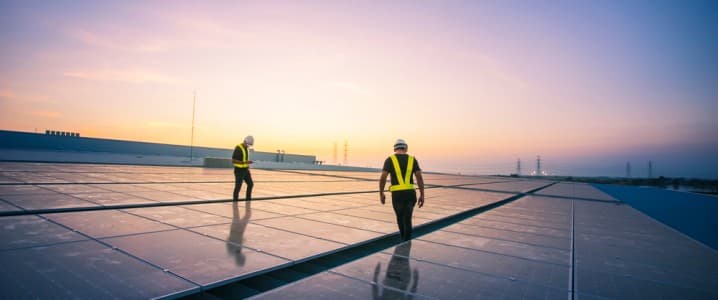
A recent policy decision by the U.S. Department of Agriculture (USDA) to ban the use of productive farmland for solar and wind installations marks a significant pivot in America’s energy landscape, one that warrants close attention from oil and gas investors. Effective immediately, this move halts the funding and construction of renewable projects on prime agricultural land, citing concerns over food security, taxpayer subsidies, and reliance on foreign-made panels. While seemingly a niche agricultural policy, its implications ripple through the broader energy transition narrative, potentially offering a tangible tailwind for the hydrocarbon sector at a time of considerable market volatility. As of today, Brent crude trades at $90.38 per barrel, experiencing a notable 9.07% decline, while WTI sits at $82.59, down 9.41% within the current trading range. This recent downturn, following an 18.5% drop in Brent over the past two weeks, underscores the sensitivity of energy markets to policy shifts and supply-demand dynamics.
USDA Policy Shift: Unpacking the Farmland Ban
The USDA’s new directive, championed by Agriculture Secretary Brooke Rollins, directly confronts the burgeoning trend of solar developers leasing prime farmland. Previously, these developers could offer farmers more lucrative deals than traditional crop cultivation, leading to a steady conversion of agricultural land. The Secretary’s rationale is multifaceted: preserving prime soil for future food production, ending what she describes as “massive taxpayer handouts” for renewable projects, and reducing dependence on panels from “foreign adversaries.” This policy reverses the prior administration’s support for alternative energy projects on such lands, which had seen over $2 billion in funding via programs like the Rural Energy for America. While reports from 2020 indicated that wind and solar projects affected a relatively small 424,000 acres—less than 0.05% of the nation’s nearly 900 million acres of farmland—the trend was accelerating. Halting this trajectory eliminates a convenient and often cost-effective avenue for renewable expansion, forcing developers to seek alternative, potentially more expensive or less suitable sites.
Re-evaluating the Pace of Energy Transition
For investors keenly observing the long-term demand outlook for oil and gas, this USDA ban introduces a new variable into the energy transition equation. While 0.05% might appear insignificant at first glance, the cumulative effect of hundreds of thousands of acres being repurposed for solar farms was a material contributor to renewable capacity build-out, especially given the rapid expansion observed post-2020. By removing a prime, geographically dispersed, and often readily available land resource, the ban will inevitably slow the pace of solar deployment in the United States. This doesn’t halt the transition, but it certainly complicates and potentially delays it. Such a deceleration in renewable growth, particularly in a major economy like the U.S., suggests a prolonged reliance on conventional energy sources to meet growing electricity demand. This nuanced shift strengthens the investment thesis for oil and gas, as it implies a longer runway for hydrocarbon demand than some aggressive transition models previously forecast.
Market Dynamics and Upcoming Catalysts
The immediate market reaction to the USDA’s announcement might not be directly reflected in today’s crude prices, given the broader macroeconomic and geopolitical factors influencing the significant daily declines for both Brent and WTI. However, this policy change will undoubtedly factor into future market sentiment and long-term price predictions, a key concern for our readers who frequently inquire about the price of oil per barrel by the end of 2026. The 14-day Brent trend, showing a sharp $20.91 drop from $112.78 to $91.87, highlights the market’s current sensitivity to supply-demand signals and policy shifts. Against this backdrop, upcoming events become even more critical. The OPEC+ Joint Ministerial Monitoring Committee (JMMC) and full Ministerial meetings scheduled for April 18th and 19th will be closely watched. Investors are asking about OPEC+’s current production quotas and how the cartel will interpret global demand signals. A slowdown in U.S. renewable growth could subtly ease pressure on OPEC+ to maintain tight supply, as it potentially delays the peak of global oil demand. Furthermore, the weekly API and EIA crude inventory reports on April 21st/22nd and April 28th/29th, alongside the Baker Hughes Rig Count on April 24th and May 1st, will offer real-time insights into domestic supply and demand, providing further context for how the U.S. energy mix is evolving in light of this new policy.
Investment Implications for Hydrocarbon Portfolios
For oil and gas investors, the USDA farmland ban is not a standalone event but rather a piece of a larger puzzle that reconfigures the risk-reward profile of the sector. The policy adds another layer of resilience to the long-term demand for crude oil and natural gas, particularly in the U.S. market. Companies with significant domestic production assets, robust midstream infrastructure, or exposure to refining could see sustained demand for their products and services. While the direct acreage impact of the ban is fractional, its symbolic weight and practical consequences for solar deployment are substantial. It signals a governmental re-prioritization, shifting focus from rapid renewable expansion at the expense of agriculture to a more balanced approach that acknowledges traditional resource needs. This could translate into more stable, predictable cash flows for hydrocarbon companies, potentially making their valuations more attractive to long-term investors. As the energy transition continues to unfold, such policy interventions will be crucial in shaping the trajectory and opportunities within both traditional and alternative energy markets.


