In a dynamic global energy landscape where capital efficiency and environmental stewardship increasingly dictate investor confidence, breakthrough technologies are paramount. One such innovation emerging on the horizon involves ‘alternative carbon carriers’ designed to revolutionize enhanced oil recovery (EOR) and carbon capture utilization and storage (CCUS). This isn’t merely an incremental improvement; it’s a strategic evolution offering a dual benefit: significantly higher oil recovery rates from mature assets combined with a substantial boost in secure carbon storage. For investors navigating volatile commodity markets and growing ESG pressures, understanding these advancements is crucial for identifying long-term value creators in the oil and gas sector.
Unlocking Deeper Value in Existing Assets Through Advanced EOR
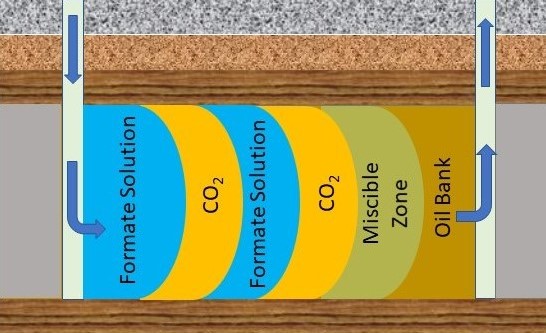
The core promise of alternative carbon carriers lies in their ability to extract more value from conventional oil reservoirs. Traditional CO2-EOR has been a staple for decades, pushing residual oil out of rock pores while also sequestering some carbon. However, new research highlights that by synthesizing more effective carbon-based molecules, such as formate species, from captured CO2, we can achieve far superior results. Modeling studies demonstrate that solutions like potassium or sodium formate, when injected, can recover up to 19.5% more oil compared to conventional methods. This significant uplift in recovery means extended asset life, maximized production from existing infrastructure, and a more robust return on investment for companies operating mature fields. These formate solutions are inherently more viscous and store more carbon in the rock pores than an equivalent volume of CO2 gas, leading to a more efficient and effective EOR process.
The ESG Imperative: Enhanced Carbon Storage in a Volatile Market
Beyond increasing oil recovery, the enhanced carbon storage capabilities of these new carriers directly address the escalating ESG demands placed on the energy sector. The technology boasts the potential to store up to 17.5% more carbon than traditional EOR, effectively reducing the net carbon footprint of produced oil. This aspect becomes particularly relevant in the current market climate. As of today, Brent crude trades at $94.25, marking a 1.29% decrease, while WTI crude is at $85.9, down 1.74%. This daily fluctuation is part of a broader trend; Brent has seen a significant decline, dropping from $118.35 on March 31st to $94.86 on April 20th, a nearly 20% reduction in just two weeks. Such volatility underscores the imperative for companies to not only optimize production but also demonstrate strong environmental performance. Investors are increasingly scrutinizing companies’ carbon intensity, and innovations that offer verifiable carbon storage solutions provide a critical competitive advantage, potentially influencing access to capital and valuation multiples.
Navigating Future Supply & Demand: Investor Outlook and Key Events
Investors are keenly focused on the trajectory of crude prices, with questions frequently surfacing regarding the short-term direction of WTI and predictions for crude oil prices by the end of 2026. While daily market movements are influenced by a multitude of factors, long-term value creation in the oil and gas sector will increasingly hinge on operational efficiency and sustainable practices. Upcoming calendar events will undoubtedly shape near-term sentiment. The OPEC+ JMMC Meeting on April 21st, for instance, could provide signals on production policy that immediately impact supply expectations. Subsequent EIA Weekly Petroleum Status Reports (April 22nd, April 29th) and API Weekly Crude Inventory data (April 28th, May 5th) will offer crucial insights into U.S. inventory levels, while the Baker Hughes Rig Count (April 24th, May 1st) indicates drilling activity. Looking further out, the EIA Short-Term Energy Outlook on May 2nd will offer critical forecasts. Against this backdrop of ongoing market analysis, technologies like alternative carbon carriers, which enhance recovery and reduce emissions, position companies to thrive regardless of the precise market swings, by improving their fundamental economics and ESG profile, thereby appealing to a broader investor base seeking resilience.
Strategic Implications for Oil & Gas Portfolios
For investors constructing a robust oil and gas portfolio, the emergence of alternative carbon carriers presents a compelling lens through which to evaluate potential holdings. Companies actively researching, piloting, or deploying such advanced EOR and CCUS technologies are not just investing in future production; they are future-proofing their operations against evolving environmental regulations and societal expectations. This innovation allows for the transformation of CO2 from a liability into a valuable resource for enhanced recovery and permanent storage. Identifying operators that prioritize these dual-benefit solutions—maximizing hydrocarbon output while simultaneously achieving superior carbon sequestration—will be key. These companies are demonstrating a forward-thinking approach that mitigates risk, enhances resource efficiency, and positions them as leaders in the energy transition, offering a more sustainable investment proposition in the long run.