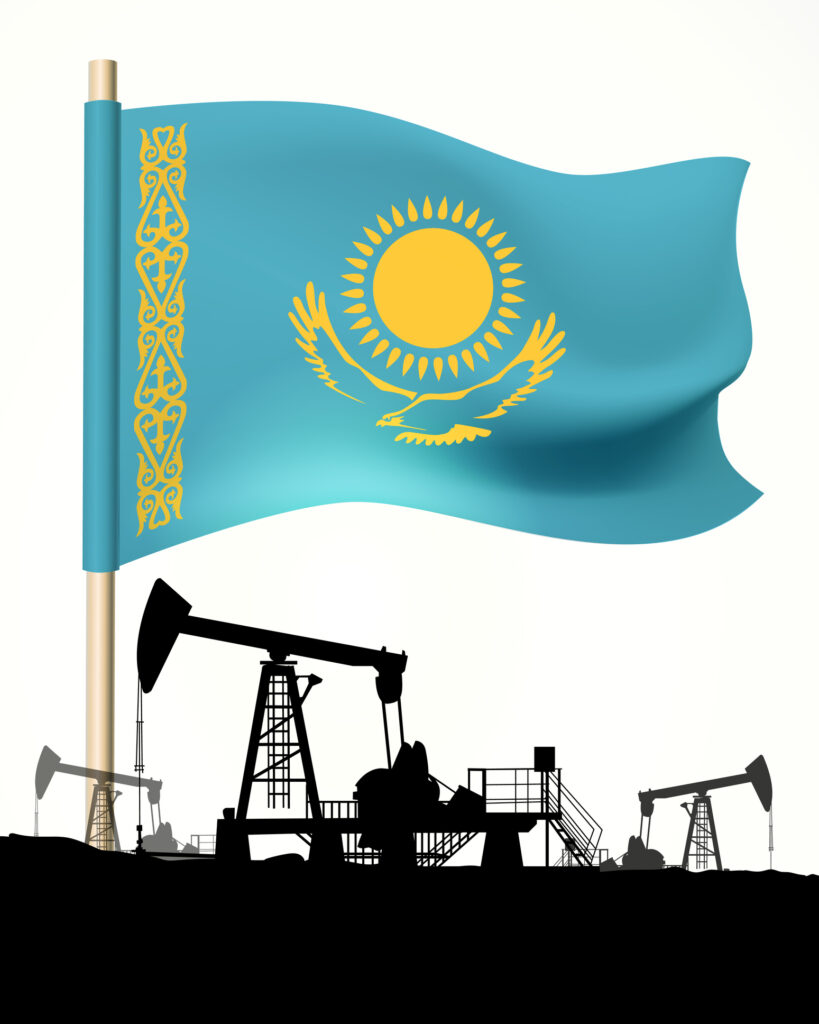
Kazakhstan’s Production Surge: A Stress Test for OPEC+ Discipline
The delicate balance of global oil supply, meticulously managed by the OPEC+ alliance, faces a renewed challenge from an unexpected quarter: Kazakhstan. Recent data reveals a significant surge in the nation’s crude oil output, pushing it well beyond its agreed-upon quota. This sustained overproduction, primarily driven by international energy majors operating within the country, not only strains OPEC+’s cohesion but also sends clear signals to investors about potential volatility and the limits of collective supply management in a complex geopolitical and economic landscape.
Kazakhstan’s Output Peak Defies Quotas Amidst IOC Autonomy
Kazakhstan’s crude oil production reached an impressive 1.88 million barrels per day (bpd) in June, marking a 7.5% increase and matching the all-time high set in March. This figure significantly overshoots the country’s official OPEC+ quota of 1.5 million bpd. When including condensates, total oil and condensate production climbed to 2.15 million bpd in June, up from 2.02 million bpd in May. A major contributor to this growth is the Chevron-led Tengiz mega-field, which saw its output surge from 813,200 bpd in May to 953,000 bpd in June, propelled by a $48 billion expansion project. For the first half of 2025, Kazakhstan’s crude output, excluding condensates, averaged 1.79 million bpd, a substantial 13% increase from the prior year’s period.
The core of the problem lies in the operational autonomy of international consortiums like Chevron and ExxonMobil, which account for over 70% of Kazakhstan’s oil production. The nation’s energy ministry has openly acknowledged its inability to enforce production cuts on these foreign operators. This structural reality renders Kazakhstan’s commitment to OPEC+ goals largely symbolic, with past promises to offset overproduction by 2026 widely viewed as unenforceable. For investors, this highlights a critical fissure within the OPEC+ framework: a significant portion of global supply remains outside the direct control of the very alliance designed to manage it.
Market Response and Investor Sentiment: Navigating Price Softness
This ongoing supply pressure from Kazakhstan emerges at a time when crude prices have shown signs of softening. As of today, Brent crude trades at $94.78, reflecting a marginal dip of 0.01% within a daily range of $91-$96.89. WTI crude similarly hovers at $91.22, down 0.07% on the day. More broadly, our proprietary data indicates a noticeable 14-day Brent trend, declining from $102.22 on March 25th to $93.22 on April 14th – an 8.8% reduction. This backdrop of weakening prices amplifies the impact of non-compliance, as additional barrels on the market can exacerbate downward pressure.
Our first-party reader intent data reveals that investors are keenly focused on understanding these dynamics. Specifically, there’s significant interest in building a base-case Brent price forecast for the next quarter and identifying the consensus 2026 Brent outlook. This underscores the market’s sensitivity to supply-side uncertainties, with Kazakhstan’s actions directly complicating attempts to model future price trajectories. Investors are asking: how much of this non-compliance is already priced in, and what are the implications for long-term price stability if OPEC+ discipline continues to fray?
Upcoming OPEC+ Meetings and Forward-Looking Analysis
The spotlight now turns to the upcoming OPEC+ meetings, which serve as critical junctures for assessing the alliance’s resolve. The Joint Ministerial Monitoring Committee (JMMC) is scheduled to meet on April 18th, followed swiftly by the Full Ministerial Meeting on April 20th. These gatherings will undoubtedly address the persistent overproduction from members like Kazakhstan, particularly given that a further 411,000 bpd increase in overall production targets is reportedly on the table. The ongoing non-compliance from Kazakhstan, with its major international operators asserting their independence from OPEC+ discussions, complicates any potential decision on increasing supply or enforcing existing cuts.
For investors, the outcomes of these April meetings are crucial. Will OPEC+ issue stronger warnings or even consider punitive measures? Or will core members like Saudi Arabia be forced to shoulder a larger burden of cuts to offset the excess supply, a move that could test the alliance’s long-term sustainability? The continued growth from projects like Tengiz suggests a structural challenge that cannot be easily resolved by ministerial decrees. We anticipate that discussions around accountability and the effectiveness of current quotas will dominate, potentially leading to increased market volatility as participants gauge the alliance’s ability to maintain a coherent strategy.
Investment Implications: Navigating Supply Uncertainty
The situation in Kazakhstan offers profound insights for oil and gas investors. Firstly, it highlights the inherent challenges of collective action in a global commodity market where diverse national interests and the powerful influence of international oil companies intersect. The inability of a sovereign nation to enforce production cuts on IOCs within its borders creates a precedent that other nations might observe, potentially weakening the entire OPEC+ framework over time. This structural rigidity, where expansion projects proceed irrespective of global supply management goals, introduces a layer of unpredictable supply growth.
Secondly, for portfolios exposed to crude oil, this scenario underscores the importance of monitoring not just headline OPEC+ decisions but also the granular compliance of individual members and the operational realities of major production fields. Companies with significant production in non-compliant nations might offer a different risk/reward profile. As the market grapples with a softening price environment and persistent supply-side questions, understanding these complex dynamics becomes paramount for effective risk management and strategic positioning in the evolving oil and gas investment landscape.